Whole-Home Water Filtration Luxury: From Municipal Tap to Hydrogen Water
By Kenneth Bordewick, in clinical collaboration with Dr. Thom Lobe MD and Dr. Fouad I. Ghaly MD
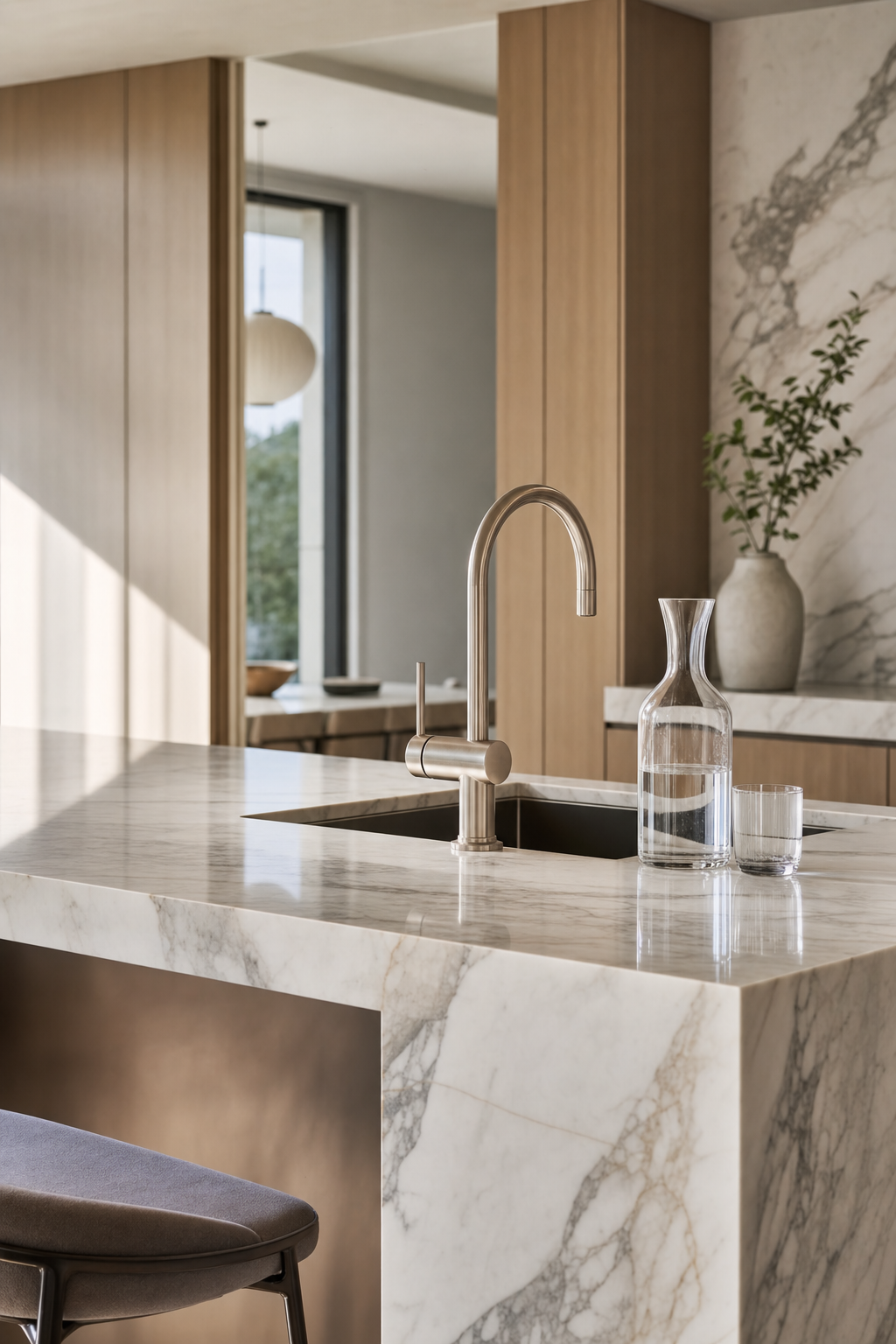
Whole-home water filtration luxury means treating every litre entering the building, not merely the water at the kitchen tap. A complete residential specification runs sediment pre-filtration, catalytic carbon, softening or conditioning where the analysis requires it, reverse osmosis at the drinking points, remineralisation, ultraviolet disinfection and, increasingly, molecular hydrogen generation at one or two hydration stations.
That sequence is the article in miniature, and every stage of it exists because the previous stage cannot do the job alone. Water is Pillar Four of ÖND's Nine Pillars, Water as Luxury Utility, and it is the pillar where the distance between what a household believes it has bought and what it actually receives is widest.
Municipal Safe and Household Excellent Are Different Thresholds
Municipal treatment is one of the great public health achievements of the modern era, and I say so before criticising anything. Its objective, however, is to make water safe for a population at a price a city can bear. My objective is to make water excellent for one household, at a specification that household can choose. Those are different thresholds and they produce different engineering.
Consider what municipal treatment is not designed to remove. A study reported by NPR found that PFAS compounds, the so-called forever chemicals, could be present in nearly half of United States tap water. Research summarised by the University of Birmingham detected them in tap and bottled water sampled around the world, which is worth pausing on, because the standard wealthy response to a water concern is to buy bottled, frequently in plastic, and that research suggests the substitution is not the escape it appears to be.
Then there are disinfection byproducts. Chlorine and chloramine are added deliberately and correctly, to keep water safe across miles of ageing distribution pipe. They react along the way with organic matter to produce trihalomethanes and haloacetic acids. And there is everything the last hundred metres contributes after the utility's responsibility ends, which is to say the service pipe, the internal plumbing, the storage tank in the roof void that nobody has opened since 1998, and in older properties the lead solder at the joints.
None of this makes municipal water dangerous. It makes it a starting point rather than a finished product, and in a residence where every other material has been chosen deliberately, water is a curious thing to leave to the city.
What Should a Whole-Home System Actually Include?
Seven stages, in this order, with the caveat that a good water engineer will vary them according to a laboratory analysis of your specific supply rather than a template.
Sediment pre-filtration at the point of entry. Unglamorous, inexpensive and protective of everything downstream. Skip it and you shorten the life of every expensive component that follows.
Catalytic carbon. This is the stage that removes chlorine, chloramine and the byproducts, and it is where most of the perceptible improvement in taste, smell and skin comfort originates. Sized properly for the whole house, it also protects the membranes further along.
Softening or conditioning, where the analysis calls for it. Hard water is not a health matter but it is a luxury matter, since it damages fittings, dulls stone, spots glass and makes hair and skin feel worse. I prefer salt-free conditioning where the hardness allows, largely because I dislike adding sodium to a system I have just spent considerable effort purifying.
Reverse osmosis at the drinking and cooking points. Whole-house reverse osmosis is occasionally justified and usually not, given the water it wastes and the volumes involved. At the kitchen, the pantry, the primary suite and the gym, it is the correct answer.
Remineralisation, without exception. Reverse osmosis is superb at removing contaminants and equally superb at removing the calcium, magnesium and trace elements that give water its taste and its physiological usefulness. Water stripped of everything is not the standard I am building towards, and it is flat on the palate in a way that clients notice within a week. This is the stage most systems skip, and I regard it as non-negotiable.
Ultraviolet disinfection, particularly where there is storage anywhere in the building, or where the supply is private rather than municipal.
Point-of-use hydrogen generation at one or two hydration stations, discussed further below.
To that list I would add the stage nobody sells, which is monitoring. A whole-home water system without a way to know when a membrane has failed or a carbon bed is exhausted is a system that will eventually be delivering untreated water through a very expensive housing whilst the household continues to believe otherwise.
How Do You Find Out What Is Actually in Your Water?
Commission an independent laboratory analysis of a sample drawn from a tap inside the house, not from the main, and ask for a panel that covers PFAS, disinfection byproducts, heavy metals including lead and copper, hardness, nitrates and bacteriological indicators. Expect to pay somewhere between $300 and $900 for a panel worth having. Do not rely on the utility's published water quality report.
That last point is the one that surprises people, so let me explain it. A utility report describes the water leaving the treatment works, averaged across an entire distribution zone, tested against the parameters the regulator requires. It is accurate and it is not about your house. It cannot know what your service pipe is made of, whether your building has a storage tank, how long water sits in a rarely used wing, or what a neighbouring development's works did to the mains last spring. Two properties on the same street can test differently, and I have seen it.
I ask for the sample to be taken twice, once first thing in the morning after the water has stood overnight in the pipes, and once after running the tap for several minutes. The difference between those two results tells you how much of the problem belongs to the city and how much belongs to your own plumbing. It is a cheap piece of information and it frequently changes the entire specification, occasionally by revealing that the correct first intervention is replacing thirty metres of pipe rather than buying any equipment at all. That kind of finding is precisely why I will not quote a water system before seeing an analysis.
Why the Shower Matters More Than the Glass
Here is the line I most often have to argue in a first meeting. The largest daily chlorine exposure in most homes is not what you drink. It is what you shower in.
Hot water volatilises chlorine and its byproducts, which are then inhaled in the enclosed, steam-filled space of a shower for ten or fifteen minutes, whilst the skin, warm and with its pores dilated, is in continuous contact with the water itself. A kitchen-only filter, however sophisticated, addresses perhaps two litres a day and leaves eighty litres of the most intimate exposure entirely untreated.
This is why my specification begins at the point of entry rather than under the sink, and it is the argument that most reliably converts a client from a $900 tap filter to a proper installation. It also happens to produce the effect they notice first, because filtered shower water changes how hair and skin feel within days, particularly in a hard-water city. Clients frequently attribute the improvement to something else entirely for a fortnight before they connect it to the plant room.
Is Hydrogen Water Worth It, or Is It a Fad?
The honest answer is that molecular hydrogen is a genuinely interesting area of research with a real and growing body of preliminary study behind it, and that it is also being marketed far beyond what that research currently supports. Both things are true at once. I install it when clients ask for it, at the point of use, and I describe it to them as promising rather than proven.
What is not in doubt is that it has arrived at the top of the market. Nasdaq carried the announcement of Dr. Nicholas Perricone's ultra-premium hydrogen-infused wellness water, and Trend Hunter's coverage of optimised hydrogen water systems tracks how quickly domestic generation equipment has moved from novelty to fixture. When a category acquires that much commercial momentum, my responsibility is to specify it competently rather than to pretend the request will go away.
Competently means two things. First, point of use, never storage, because dissolved hydrogen escapes quickly and a bottle poured an hour ago is simply water. Second, downstream of full filtration and remineralisation, so that what you are enriching is already excellent. A hydrogen generator fitted to poor water produces poor water with hydrogen in it.
Dr. Lobe and Dr. Ghaly are the right people to discuss the clinical literature with, and they do so with clients directly. My position as the designer is narrower and, I think, more useful: I will build you the cleanest, best-mineralised, best-tasting water your supply and budget permit, and I will make the hydrogen station a proper plumbed fixture rather than a countertop appliance. What it does for you thereafter is a conversation with a physician.
What This Costs
For a substantial residence, a complete whole-home specification typically runs from around $30,000 to $120,000 installed, covering point-of-entry filtration, conditioning, reverse osmosis and remineralisation at multiple points of use, ultraviolet disinfection and controls. Add roughly $5,000 to $15,000 for each properly plumbed hydrogen station. Very large estates, private wells requiring bespoke treatment, or properties needing significant plumbing modification sit above that range.
As with air, the equipment is rarely the expensive part. Access is. A house with a generous plant room and modern manifold plumbing is straightforward. A period property where the incoming main arrives in a cellar corner with no space, no drainage and no power is a considerably larger undertaking, and the honest quote reflects the building rather than the technology. The broader economics of sequencing this kind of infrastructure appear in the cost of a longevity home.
Running costs deserve a mention because they are routinely omitted from proposals. Filter media, membranes and ultraviolet lamps all have finite lives, and a system on a neglected maintenance schedule quietly stops performing whilst continuing to reassure. Budget for the service contract at the same moment you budget for the installation.
The market has begun to price this in. Rocket Mortgage's buyer research found that 34 percent of home buyers rank clean air and water filtration amongst their top three desired home features, the National Association of Realtors reports resale premiums of 10 to 25 percent for wellness-designed homes, and Fine Homes & Living has documented clean water becoming an explicit luxury feature in contemporary residential design rather than a hidden utility. Inman now lists mineralised water beside purified air and circadian lighting as foundational for the 2026 buyer, a reading echoed in the New York Post's coverage of Sotheby's 2026 report, which records filtration systems as core rather than optional amongst ultra-wealthy purchasers.
From the Doha Coast to a Costa Blanca Pool
A new-build private wing on the Doha coast showed me how the pillar behaves inside a complete commission rather than as a standalone installation. The existing residence was aesthetically extraordinary and physiologically uncomfortable, with measurable dryness from the air handling and visiting family complaining of poor sleep. Alongside humidity control held between 45 and 55 percent, we specified a whole-house system with reverse osmosis, remineralisation and molecular hydrogen stations at the two primary hydration points. The family reported better sleep within the first extended stay. I would not attribute that to the water alone, and I did not at the time. Water rarely operates as an isolated fix, and in an integrated commission it changes how a residence feels rather than merely how it tests.
A very different project on the Costa Blanca made the aesthetic case. The clients wanted pools they could actually swim in daily without the smell, the stinging eyes and the bleached swimwear that chlorine imposes. We specified magnesium electrolysis filtration in place of chlorine, which produces water that is softer on the skin, kinder to the eyes and, according to the family, considerably more pleasant to spend an hour in. Whether the magnesium confers a therapeutic benefit beyond that is a claim I leave to others. What I can report without hesitation is that they swim more, which is the sort of outcome a designer can genuinely take credit for. Making the healthy thing pleasant is most of my profession.
The Mistakes I See Most Often
Buying bottled water as a solution is the first, and the University of Birmingham findings are the reason. You are paying a great deal for water of unverified provenance, frequently in plastic, and delivering an enormous logistical burden to a household in the process.
Fitting reverse osmosis without remineralisation is the second, and it is astonishingly common. Clients who dislike the taste of their new $40,000 system are almost always describing demineralised water, and the fix costs a fraction of the complaint.
Treating the kitchen and ignoring the bathrooms is the third, for the reasons set out above.
Specifying from a brochure rather than from a laboratory analysis is the fourth. Water chemistry is local. A system that is perfect in one city is over-engineered in the next and inadequate in the one after. Test first.
And the fifth is installing beautifully and never servicing. I have opened housings in magnificent houses and found media that should have been replaced two years earlier. A wellness system that nobody maintains is a decorative object with plumbing attached. The wider question of how to appoint a studio that will hold a contractor to this standard is covered in how to hire a luxury wellness interior designer.
The ÖND Perspective
Water is the pillar that has taught me the most about the difference between luxury as appearance and luxury as substance. A brass tap can be exquisite, hand-finished, sourced from a workshop that has made them for four generations, and deliver water that has spent the previous six hours in a cold water tank in the roof beneath a loose lid. We have spent a century perfecting the fitting and almost no time at all on what comes out of it.
Amongst the Nine Pillars, water is also the one where the correction is most complete. Air quality can be improved but never perfected, since the occupants themselves are a source. Light must contend with the building's orientation. Water arrives at a single point, under pressure, through a pipe you can put a housing on, and can be brought to a standard limited only by budget and plant space. There are not many problems in my profession that yield so cleanly.
What I ask clients to hold on to is the shift in category. Water is not a beverage decision, to be solved with a delivery subscription and a nice glass carafe. It is a utility, and utilities are engineered into buildings by people who measure things. Once a household makes that shift, the rest of the specification tends to follow, because it becomes obvious that the same reasoning applies to the air, to the light and to the materials. The reasoning behind the whole framework is set out at the Nine Pillars, in depth in the Nine Pillars of wellness design, and at its most complete in what a longevity home is.
Begin With a Conversation
The first step is not a proposal. It is a laboratory analysis of the water arriving at your property and a survey of what happens to it after it enters. A Longevity Home Wellness Design Audit includes both, along with a prioritised and honestly costed roadmap, with no obligation to install anything at all.
If you would rather discuss it before committing to anything, please do write to us. I read every enquiry personally.
Sources
- PFAS forever chemicals detected in nearly half of U.S. tap water, NPR
- Forever chemicals found in bottled and tap water from around the world, University of Birmingham
- Clean Water as a Luxury Feature in Contemporary Home Design, Fine Homes & Living
- Dr. Nicholas Perricone Announces Launch of Ultra-Premium Hydrogen-Infused Wellness Water, Nasdaq
- Optimised Hydrogen Water Systems, Trend Hunter
- Home buyers value green living nearly as much as safety, Rocket Mortgage
- Wellness Trend Driving Real Estate Price Premiums, National Association of Realtors
- Luxury's Next Phase: What The 2026 Buyer Really Wants, Inman
- Ultra-wealthy home buyers are clamouring for longevity amenities, New York Post
- The Longevity Home Wellness Design Audit, ÖND
Commission Your Longevity Home Wellness Design Audit
The Longevity Home Wellness Design Audit — offered by Beverly Hills Luxury Interiors and ÖND | Life's Breath™ in clinical collaboration with Dr. Thom Lobe MD and Dr. Fouad I. Ghaly MD — is a comprehensive assessment of your current home's biological environment: material toxicology, air and water purity, acoustic conditions, circadian light architecture, electromagnetic exposure, and thermal comfort. It delivers a prioritised, physician-reviewed roadmap for transformation — the first step towards a home that does not merely shelter, but actively extends your health, clarity, and vitality. Your environment is shaping your biology in every moment. The question is whether it is doing so with intention.
Enquire About Your Audit