How to Hire a Luxury Wellness Interior Designer
By Kenneth Bordewick, in clinical collaboration with Dr. Thom Lobe MD and Dr. Fouad I. Ghaly MD
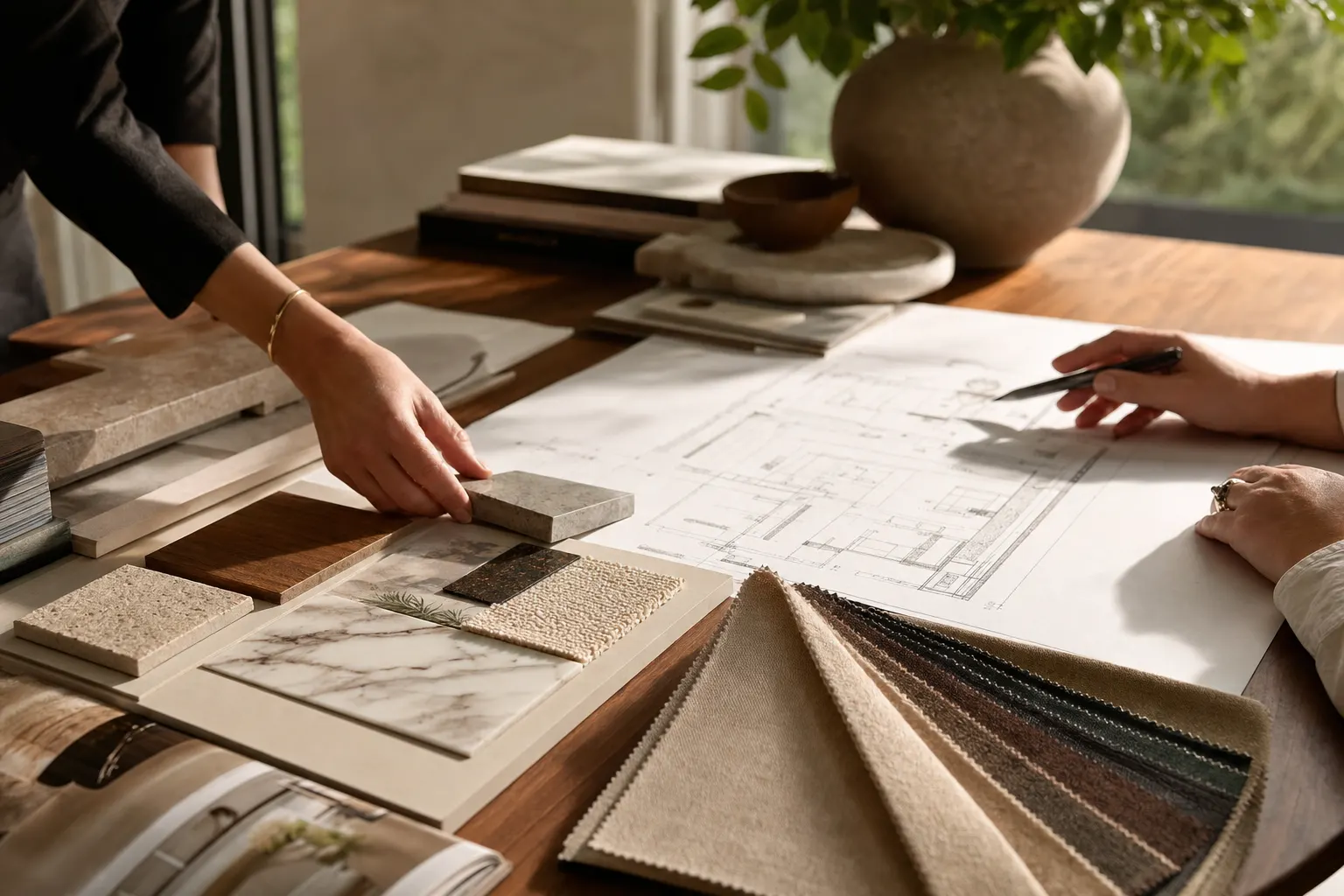
If you are researching how to hire a luxury wellness interior designer, allow me to say something at the outset that most people in my profession will not: the credential means very little. I have spent thirty-one years designing residences for royal families, for heads of state, for two of the most photographed men in modern music, and for clients whose names you would recognise instantly and whose privacy I shall always protect. In that time I have watched extraordinary talents ruin extraordinary homes, and I have watched quiet, methodical professionals produce residences that genuinely change how their occupants live and age. The difference was never taste. It was rigour. This is the honest version of what to ask, what to avoid, and what a proper contract should contain before you commission anyone with your home and, increasingly, your health.
Why the Question Has Changed
A decade ago, hiring a luxury interior designer meant vetting portfolios, checking client references, and trusting your eye. That is no longer sufficient. Homes are now understood, correctly, as biological environments, places that regulate your circadian rhythm, your exposure to airborne particulates, and your nervous system's baseline arousal through ambient noise and electromagnetic load. The WELL Building Standard, developed by the International WELL Building Institute, now codifies ten concepts, being air, water, light, sound, materials, thermal comfort, movement, nourishment, mind and community, as measurable, third-party-verifiable features of a space. That standard was built for commercial buildings, but its underlying premise applies with even greater force to a private residence, where you spend a third of your life unconscious and vulnerable to whatever the room is doing to you.
The principle behind this shift is straightforward. Wellness has moved from a marketing gesture to a buyer expectation. Zillow's most recent trend data found that wellness feature mentions in listings rose 33 percent year over year, with spa-inspired bathroom mentions up 22 percent, which is evidence that this is now a mainstream real estate signal rather than a niche one (Zillow, 2025). The National Association of Realtors has gone further, reporting that homes designed around wellness principles command resale premiums of 10 to 25 percent, citing Global Wellness Institute research (NAR, 2025). The qualifying questions for a designer have shifted accordingly. You are no longer only asking whether you like this person's aesthetic. You are asking whether this person understands ventilation science, non-toxic material chemistry, circadian lighting protocols, and how to coordinate with a physician if that forms part of your brief. Most decorators, however gifted, were never trained for any of it. Few architecture schools cover it either. That gap is precisely why so many nine-figure renovations still leave clients with beautiful rooms that quietly work against their sleep, their hormones and their long-term vitality.
I say this having sat on both sides of the table. Early in my career, working across London, Paris and the Gulf on projects for royal families and hospitality landmarks including the Savoy and the Plaza, my brief was almost entirely aesthetic: proportion, materiality, the choreography of a room. Those skills still matter enormously, since a wellness-engineered home that is visually mediocre has failed just as surely as a beautiful one with poor air handling. But the profession I practise today asks for both at once, from the same team. Very few firms have made that transition seriously. Most have simply added the word “wellness” to their marketing without changing their process, their specification sheets, or their subcontractor relationships. Learning to tell the difference is the entire purpose of the questions below.
The Ten Questions I Would Ask, If I Were the Client
First, ask how the designer defines wellness design, and listen for specificity. “Calm palettes and natural light” is a decorator's answer. A wellness architect should reference measurable domains, so lux levels and colour temperature curves through the day, air changes per hour, VOC thresholds in specified materials, and EMF readings at the bed. Second, ask whether they conduct any form of environmental assessment before design begins, and what precisely it measures. Third, ask who verifies the outcome once construction is complete, and whether there is a post-occupancy test or whether the relationship simply ends at handover.
Fourth, ask about physician or clinical collaboration. This is where the field separates cleanly, and it connects to a broader industry shift, since physician-informed wellness real estate standards, of the kind pioneered by firms such as Delos and codified in the WELL Building Standard, are increasingly cited as the credible benchmark separating serious wellness design from marketing language (Forbes, 2023). At ÖND, every substantial commission benefits from the counsel of physician partners including Dr. Thom E. Lobe, a regenerative medicine and longevity specialist, and Dr. Fouad I. Ghaly, a hyperbaricologist, whose clinical perspective shapes decisions no decorator would think to make, such as how a room's oxygen environment interacts with a client's specific health profile. Fifth, ask for a materials disclosure policy. Will you receive documentation on off-gassing, microplastic content and provenance for every major surface and textile, or is that considered proprietary and withheld.
Sixth, ask how the designer handles electromagnetic and acoustic conditions. Most will offer nothing beyond “we can add soundproofing,” which tells you they have not treated Electromagnetic Quiet and Acoustic Serenity, two of the Nine Pillars we work from, as design disciplines in their own right. Seventh, ask to see a project timeline with actual delivery dates from three past clients, not aspirational ones. Eighth, ask what happens when a specified material or system proves unavailable, and whether they substitute quietly or return to you with alternatives and trade-offs explained. Ninth, ask directly about their failure rate, meaning what percentage of projects have required significant remediation after completion. Anyone with real experience will have an honest number. Tenth, ask what they will refuse to do, because a designer with genuine standards has said no to a client before, usually over a material or a shortcut that compromised the home's integrity.
Red Flags Worth Taking Seriously
There are a handful of patterns I would treat as disqualifying. The first is a designer who cannot describe their material sourcing beyond brand names, since “we use only the finest Italian marble” tells you nothing about radon testing or sealant chemistry. The second is anyone who promises health outcomes. Let me be unambiguous here. No interior designer, however skilled, treats or cures disease. ÖND's work supports the body's environment. It does not replace medicine, and any professional who tells you a room will “reverse ageing” or “cure insomnia” is making a claim no credible physician would endorse.
The third red flag is opacity around subcontractors and specification sheets. If a firm will not show you exactly what is going into your walls, your ductwork and your water system, you have no way to verify anything after the fact. The fourth is a portfolio built entirely on photography with no data, so beautiful renders, no lux readings, no air quality baselines, no acoustic modelling. This distinction matters more than ever, since a recent industry analysis found that longevity has become the defining category shaping high-net-worth home purchases in 2026, with buyers actively seeking documented, third-party verified performance rather than aspirational claims (PR Newswire, 2026). The fifth red flag, and this one I feel strongly about after three decades in hospitality design for properties such as the Ritz Carlton Riyadh and the George V Paris, is a designer unwilling to name past clients who will speak candidly, even if privately, about the experience of working together. Confidentiality protects identity. It should never protect performance.
What a Proper Contract Should Include
A serious wellness design contract should specify in writing the environmental targets for the finished home, not merely the aesthetic brief. That means target lux curves for circadian lighting by room and time of day, air change rates, filtration specifications at HEPA level and beyond, water filtration and remineralisation standards, VOC and formaldehyde thresholds for all specified materials, and EMF mitigation targets for sleeping areas. It should specify a post-completion verification period, during which independent testing, and not merely the design firm's own assurance, confirms those targets were met. It should be explicit about physician involvement, if commissioned, including the scope and confidentiality of any health information shared. And it should include a materials disclosure schedule as a deliverable, not an afterthought.
I have seen extraordinary firms produce forgettable contracts, and forgettable firms produce watertight ones. Read the document as carefully as you read the portfolio.
One further clause is worth insisting upon, being a right to independent verification. Any firm confident in its own specifications should have no objection to a third-party testing agency confirming air quality, water quality and lighting performance once the work is complete. This is standard practice under performance-based frameworks such as the WELL Building Standard, which requires on-site testing by an authorised performance testing agent before certification is awarded, precisely because self-reported compliance is not considered sufficient evidence in any other serious industry, and should not be here either.
On a recent Belgravia townhouse commission, the client's first question to me concerned neither fabric nor finish. It concerned our air change rate specification and how we would verify it after handover. That client, a finance principal splitting his time between London and Riyadh, had spent two decades arriving home exhausted and waking most nights between 2am and 4am despite an already well-appointed bedroom with excellent blackout. We rebuilt the master suite's lighting around a full circadian protocol, with 6500K daylight-equivalent morning light delivered indirectly, tunable fixtures shifting to 2700K after sunset, and an amber-only scene throughout the private floor after 9pm, because what he lacked was not darkness but daytime signal. Within ninety days he reported a return to a single seven-hour block of sleep on most nights, with reduced reliance on melatonin supplementation. We answered his original question with documentation: a pre-construction baseline audit, target specifications by room, and a post-occupancy verification protocol involving independent third-party testing rather than our own sign-off. That project became one of the more technically demanding of my career, and one of the most satisfying, because the client understood from the first day that we were building an environment and not merely decorating one. The lesson for anyone hiring a designer is to insist on the same rigour before you sign, not after you move in.
How to Evaluate the Relationship, Not Just the Résumé
Beyond the technical questions there is a softer diagnostic that matters just as much over a multi-year commission, namely how the designer handles disagreement. A renovation of any serious scale, whether a Bel Air estate, a Riyadh palace wing or a Manhattan penthouse, will involve moments where the client's instinct and the designer's recommendation diverge. I have found that the firms worth hiring are those willing to push back, respectfully and with evidence, rather than accommodating every preference in order to preserve the relationship. If a designer agrees with everything you propose in the first meeting, they are either inexperienced or not being candid with you. Ask how they have handled disagreement with a past client, and ask for a specific example rather than a general philosophy.
A Bel Air commission illustrates this well. The owner, a media principal and chronic insomniac since his twenties, agreed to a full estate renovation only on the condition that the master suite be completed and occupied first, and only if it demonstrably improved his sleep before he committed to the rest of the project. We disagreed with several of his initial instincts. He wanted visible technology at the bedside, whereas we argued for hardware-free surfaces with electronics relocated to a distant closet, full blackout on independent circuits, dawn simulation, EMF shielding, and whole-suite air filtration with independent supply. Within eight weeks he reported his best sleep in fifteen years, and signed off on the balance of the estate. The lesson was not that we were right and he was wrong. It was that a designer willing to hold a position, supported by evidence, earned the trust required to complete a much larger commission.
It is also worth asking how the firm structures its own team. Wellness design at a serious level cannot be delivered by a single principal designer working alone, however talented. It requires coordination between lighting engineers, air and water system specialists, acoustic consultants, materials researchers, and, where relevant, physician advisers, all working from a shared specification rather than in isolated silos. Ask who sits on that team, whether they are in-house or subcontracted, and how design decisions are reconciled when, for instance, an aesthetic preference conflicts with an air quality target. The honest answer involves compromise and a hierarchy of priorities decided in advance, not improvisation mid-project.
“The clients who ask the most rigorous questions before signing are, without exception, the ones who are happiest five years in. Comfort with ambiguity at the contract stage almost always becomes regret at the finished-home stage.”
— Dr. Thom E. Lobe, MD, FACS, FAARFM, ABAARM
What an Audit-First Engagement Looks Like
Not every serious client wants a full renovation as the first engagement, and a good designer should welcome that. A pharmaceutical executive who had just acquired a Milan pied-a-terre came to us for exactly this reason. He wanted an audit only, without any commitment to renovate, before deciding whether to keep or sell a recently renovated apartment that looked immaculate but whose actual performance he could not verify. Our full Longevity Home Wellness Design Audit measured light quality across the day, PM2.5, CO2 and VOC levels across a full week, a water panel, an EMF walk-through, acoustic measurements, and a material composition audit of every finish and furniture piece, with an optional physician review. The apartment scored well on light and acoustics, poorly on materials owing to recent renovation off-gassing, and moderately on water. He used the report as leverage in a renegotiation with the seller and subsequently commissioned a phased remediation. This is precisely the sort of engagement a genuinely rigorous designer should offer without resistance, because the willingness to measure before recommending anything is itself a signal of competence, and its absence should concern any prospective client.
The ÖND Perspective
Hiring a luxury wellness interior designer used to be an exercise in taste-matching. It is now, properly understood, an exercise in due diligence, closer to selecting a physician or a private banker than to selecting an artist. The Nine Pillars we work from at ÖND, being Circadian Light Architecture, Air Excellence, Material Purity and Microplastic Elimination, Water as Luxury Utility, Electromagnetic Quiet, Acoustic Serenity, Thermal Comfort and Contrast Therapy, Grounding and Earthing, and Blood Filtration and Detoxification, exist because each is a measurable determinant of how a body functions inside a home, not a decorative preference. Industry analysts now describe this shift as the emergence of the “longevity residence” as its own real estate category, distinct from ordinary luxury renovation (Global Wellness Summit, 2026).
When you interview a designer, you are really asking whether they understand that your bedroom, your air handling system and your water are as consequential to your long-term vitality as your physician's recommendations. Most firms are not built to answer that question honestly. The ones that are will welcome every question on this list, because they have already asked themselves harder ones. That, more than any portfolio image, is the signal worth trusting. If you wish to see how we reason about it ourselves, our philosophy and the story of the practice are the places to begin.
Begin With a Conversation
If you are evaluating designers for a residence where wellness is a genuine priority rather than a marketing gesture, the most useful first step is not a design consultation. It is an assessment of what your current home is already doing to you. Commission a Longevity Home Wellness Design Audit and you will have measured baselines, a prioritised roadmap, and a document you can put in front of any firm you are considering.
When you are ready, write to us and we shall begin with a conversation.
Sources
- WELL Building Standard overview, Wikipedia
- Zillow, 2026 Home Trends
- National Association of Realtors, Wellness Trend Driving Real Estate Price Premiums
- Forbes, Real Estate Experts Share ROI Trends Of Wellness Design Home Features
- PR Newswire, Longevity Is The New Luxury
- Global Wellness Summit, 10 Wellness Trends for 2026
- The Nine Pillars, ÖND
- The Longevity Home Wellness Design Audit, ÖND
Commission Your Longevity Home Wellness Design Audit
The Longevity Home Wellness Design Audit — offered by Beverly Hills Luxury Interiors and ÖND | Life's Breath™ in clinical collaboration with Dr. Thom Lobe MD and Dr. Fouad I. Ghaly MD — is a comprehensive assessment of your current home's biological environment: material toxicology, air and water purity, acoustic conditions, circadian light architecture, electromagnetic exposure, and thermal comfort. It delivers a prioritised, physician-reviewed roadmap for transformation — the first step towards a home that does not merely shelter, but actively extends your health, clarity, and vitality. Your environment is shaping your biology in every moment. The question is whether it is doing so with intention.
Enquire About Your Audit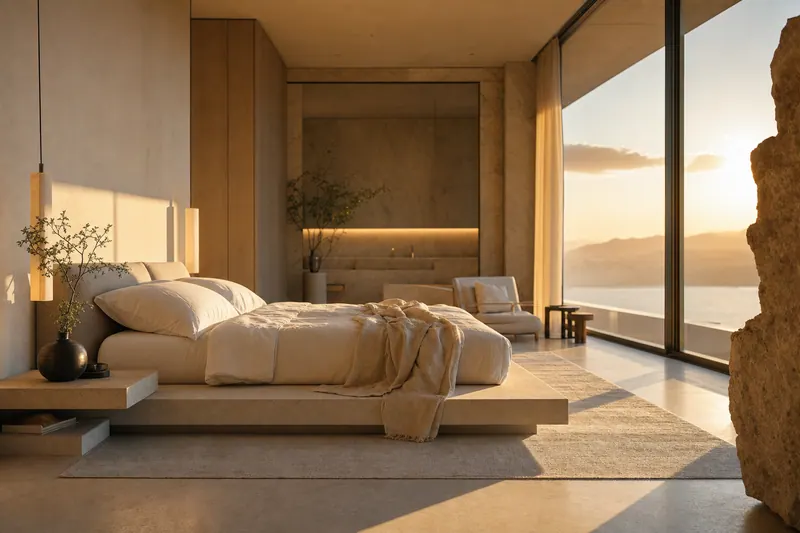
Every ÖND residence begins with a private conversation.