Whole-Home Air Purification: What UHNW Homeowners Should Actually Demand
By Kenneth Bordewick, in clinical collaboration with Dr. Thom Lobe MD and Dr. Fouad I. Ghaly MD
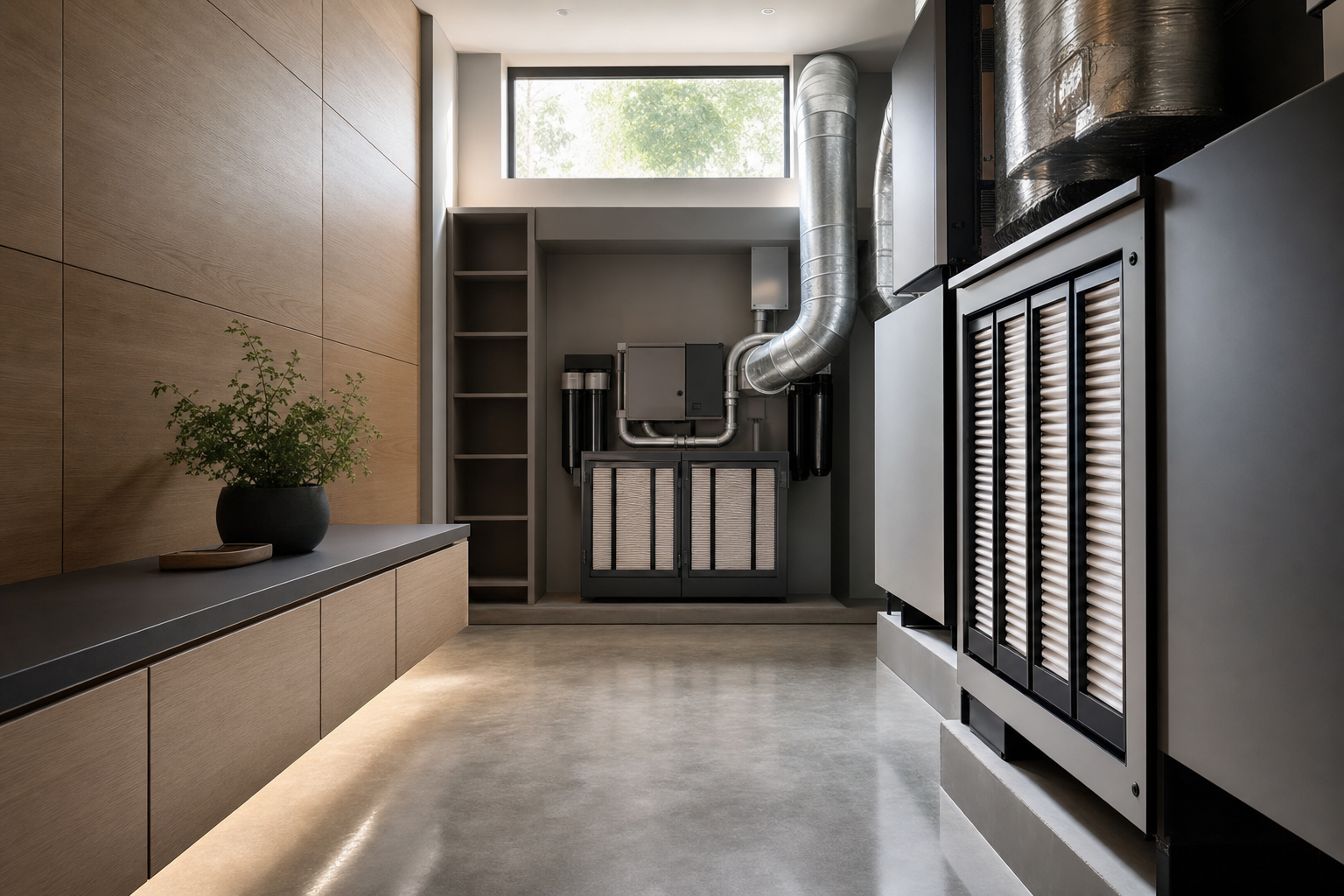
Whole-home air purification is filtration and ventilation engineered into the building itself, rather than an appliance added to a room. Done properly it means MERV 13 or higher on every air handler, true HEPA and carbon on the sleeping-zone path, filtered fresh air, humidity held between 40 and 60 percent, and performance verified after commissioning.
Most of what is sold as whole-home air purification is not that. It is a better filter in an existing furnace, or a very expensive appliance standing in the corner of a drawing room, and the gap between those and genuine air infrastructure is the subject of this article. Air is Pillar Two of ÖND's Nine Pillars, Air Excellence, and it is the pillar clients most often believe they have already solved.
Why Air Deserves Infrastructure Rather Than an Appliance
Air is the only input a person cannot pause, curate or decline. You choose your water, your food and your materials. You breathe roughly twelve thousand litres a day of whatever the building hands you, awake and asleep, without the option of abstaining for an afternoon.
A portable purifier addresses the air immediately around it. It does not address how air moves through a building, which is governed by ductwork, pressure differentials, filter bypass, the integrity of the envelope and where the fresh air intake happens to sit relative to the driveway. I have measured excellent readings within a metre of a very expensive portable unit and unremarkable readings in the same room's opposite corner. The device was working perfectly. It was simply solving a smaller problem than the client believed they had bought.
The failure is architectural. If a residence draws unfiltered air through gaps in the envelope, or recirculates through ducts that have never been sealed, or runs a filter loose enough in its housing that a third of the air goes round it rather than through it, then the specification on the filter box is a description of an intention rather than a result. This is why I treat air as a system with a boundary, a pathway and a verification step, in that order.
What Does the Research Actually Show?
Three findings do most of the work in this conversation.
A double-blind randomised crossover study published in the Journal of Exposure Science and Environmental Epidemiology found that true HEPA filtration reduced indoor PM2.5 by 60 percent and personal exposure by 53 percent. The personal exposure figure is the interesting one, because it measures what the person actually breathed as they moved about, not what the sensor on the sideboard recorded.
Harvard's COGfx research at the T.H. Chan School of Public Health found that cognitive function scores roughly doubled amongst occupants of enhanced-ventilation buildings. That study was conducted in offices rather than homes, and I say so plainly, but a great many of my clients now run substantial enterprises from a study on the first floor of a residence. The relevance is not hypothetical.
The third is a standard rather than a study. The WELL Building Standard's air filtration guidance recommends MERV 13 or higher for systems handling outdoor air. I treat that commercial benchmark as a residential minimum, which sounds demanding until you discover what is actually installed in most eight-figure homes, which is frequently a MERV 8 panel filter chosen because it was cheap and did not strain the fan.
What none of this permits is a promise about disease. Dr. Lobe and I are consistent on this point with every client. Reducing a measurable exposure is a defensible engineering objective. Curing anything is not a claim a designer is entitled to make, and I distrust anyone in this field who makes it.
What Should a UHNW Homeowner Actually Demand?
Demand six things, in writing, before any equipment is ordered.
A measured baseline. PM2.5, PM10, carbon dioxide, total volatile organic compounds, formaldehyde and relative humidity, logged over at least a week in the rooms that matter, being bedrooms first. A single spot reading taken on a pleasant afternoon tells you nothing. Carbon dioxide overnight in a closed principal bedroom is the single most revealing measurement I take, and it routinely surprises clients.
MERV 13 minimum on every air handler, with true HEPA on the recirculating path in sleeping zones. Note the word true. The filtration study cited above found materially smaller reductions from filters merely marketed as HEPA-type. That marketing suffix is doing an enormous amount of work in the consumer market.
Activated carbon in meaningful quantity. Particulate filtration does nothing for gases. Volatile organic compounds from finishes, adhesives, cleaning products and the client's own fragrance regime require carbon measured in kilogrammes, not in a token dusting on a pleated media filter. This is the stage most residential installations skip and the one clients notice most immediately, because it is what makes a house smell of nothing at all.
Controlled fresh air, filtered at the point of entry. Sealing a house tightly without introducing filtered fresh air produces excellent particulate readings and rising carbon dioxide. Energy recovery ventilation, properly sized, with the intake placed away from the motor court and any generator exhaust, solves both. I have relocated more intakes than I care to count, most memorably one drawing directly from above a garage.
Humidity within 40 to 60 percent. Filtration alone is half a pillar. Outside that band you invite dust mites, mould and microbial growth inside the very ductwork intended to clean the air, and you make the occupants uncomfortable in ways they will attribute to everything except the building.
Commissioning and verification, contractually. Measure the same parameters after installation, in the same rooms, and hold retention on the contract until the numbers are met. Air is invisible. It is precisely the category most vulnerable to being quietly value-engineered during construction, and precisely the category no walkthrough will catch.
Why Clinical-Grade Has Become the Default Request
Ten years ago this was a specialist conversation. It is now close to a baseline expectation at the top of the market. MILLION's analysis of ultra-luxury real estate describes clinical-grade air purification as the most requested amenity in the sector. Inman's assessment of the 2026 buyer places purified air alongside mineralised water and circadian lighting as foundational rather than optional, and the New York Post's report on Sotheby's 2026 findings records filtration systems and circadian lighting as core specification amongst ultra-wealthy buyers.
The trend is not confined to the top of the market either. Rocket Mortgage's buyer research found that 34 percent of home buyers rank clean air and water filtration amongst their top three desired home features, which places it very near safety in the hierarchy of what people want from a house. And the National Association of Realtors reports wellness-designed homes commanding resale premiums of 10 to 25 percent.
I mention the market data because clients ask, not because it should drive the decision. Nobody has ever thanked me for the resale value of their ductwork. They thank me for the first winter their household stopped passing the same cold around.
Two Commissions, Two Opposite Problems
An Alpine chalet at 1,800 metres taught me how much of this pillar is not about particles at all. The family hosted large ski parties and had grown accustomed to guests sleeping badly for their first two nights, with dry-air irritation and mild altitude complaints treated as an unavoidable feature of the mountains. We specified zoned oxygenation in the guest suites, reducing effective altitude by roughly 600 metres, whole-chalet humidification tuned to 40 to 50 percent, and hospital-grade filtration sized specifically for wood-stove particulate, which is finer and more persistent than most residential systems anticipate. Guests who had previously slept badly for two nights began sleeping through the first.
A Dubai penthouse produced the mirror image. An aggressive cooling system had left family members with sinus complaints within a month of moving in. There was nothing wrong with the filtration. The air was simply too dry, relentlessly, in a building that had been engineered against heat with no thought given to moisture. Humidity-balanced filtration resolved it.
A GCC desert residence brought both halves together. On a new wing we delivered full Nine Pillars integration: hospital-grade air handling, humidity held at 45 to 55 percent, and whole-wing hardwired lighting on a solar-tracking circadian schedule. In a climate that hostile the pillars stop behaving as separate line items. You cannot get the air right without the humidity, and you cannot get sleep right without both, plus the light.
The lesson I draw from all three is that filtration is the part of this pillar that is easy to buy and humidity is the part that decides how the house feels. In extreme climates, humidity is frequently the more urgent problem, and it is almost never in the brief when the client arrives.
How Much Does Whole-Home Air Purification Cost?
For a substantial residence, expect roughly $40,000 to $150,000 for a properly engineered system, covering high-efficiency filtration on every air handler, HEPA and carbon on the sleeping-zone recirculation, energy recovery ventilation, humidity control and commissioning. Very large or very complex properties, or those requiring zoned oxygenation or medical-grade handling in particular rooms, run beyond that.
The distribution of that budget surprises people. The filters themselves are trivial. The money sits in air handler capacity, duct modification, sealing, controls and the labour of getting to the equipment. A house with accessible plant and generously sized ducts might be transformed for the lower end of that range. A listed building with plaster ceilings and no service voids is a different proposition entirely.
Then there is the cost nobody quotes: maintenance. A neglected filtration system is worse than none, because it gives the occupant confidence whilst restricting airflow through a loaded filter. Budget for a service regime and make somebody accountable for it. I would rather specify a modest system that will actually be maintained than a magnificent one that will be forgotten in the plant room by the second year. I set out the wider economics of this kind of work in the cost of a longevity home.
Do You Still Need This If You Live Somewhere With Clean Air?
Yes, and this is the objection I hear most often from clients on the coast, in the mountains or on large private estates. Outdoor air quality determines only part of what you breathe indoors. The rest is generated inside the house, by cooking, by cleaning products, by candles and fires, by pets, by the off-gassing of recent finishes, and by the occupants themselves, who exhale carbon dioxide all night in a bedroom with the door closed.
I have taken overnight measurements in immaculate rural houses where carbon dioxide climbed past 1,400 parts per million by four in the morning, in a bedroom with excellent outdoor air a metre away on the other side of a closed sash window. The occupants described their sleep as light and unrefreshing and had spent a good deal of money on mattresses trying to fix it. Cooking is the other reliable offender, since a single searing pan can raise fine particulate in an open-plan kitchen to a level that would be reported as poor air quality if it occurred outdoors, and most luxury extraction is specified for smell rather than for capture.
The honest conclusion is that clean outdoor air is an asset rather than a solution. It makes ventilation cheap, because the fresh air you introduce needs less treatment, and it removes the hardest part of the problem. It does not remove the need for a considered path, adequate extraction and a way of getting fresh air into a sealed bedroom without opening a window onto a January night.
The Claims I Would Treat With Caution
Some categories of air technology are sold with more confidence than the evidence supports, and the top of the market is a lucrative place to sell confidence.
I am cautious about ionisers and any technology that generates ozone as a byproduct, because introducing a reactive gas into an occupied bedroom in order to reduce particulate is a poor trade. I am cautious about ultraviolet systems installed where the contact time is too short to do anything, which is most residential in-duct positions. I am cautious about photocatalytic devices whose independent testing is thin. And I am cautious about any system whose performance is stated only as a chamber test result rather than as a measured outcome in an occupied room.
The honest position is that the boring technologies work. Good mechanical filtration, sufficient carbon, adequate fresh air, controlled humidity and a sealed distribution path account for nearly all of the achievable benefit. Everything else is at best marginal and at worst a reactive chemistry experiment conducted in a room where somebody sleeps. If a supplier resists giving you third-party measured data in an occupied space, you have learnt what you needed to know.
How Air Interacts With the Other Pillars
Air Excellence is Pillar Two, and it borrows from and lends to several others. Material Purity, Pillar Three, determines how much volatile organic compound and microplastic load the filtration is being asked to handle in the first place, and the cheapest air improvement available in a renovation is not specifying the materials that pollute it. Thermal Comfort, Pillar Seven, shares the same mechanical equipment and frequently competes with air quality for it, which is why the two must be designed together rather than sequentially. Acoustic Serenity, Pillar Six, is where air systems most often fail their occupants, because a powerful air handler that runs at 45 decibels outside the bedroom door will simply be switched off at night by somebody who wants to sleep.
That last point is worth dwelling on. The commonest way a superb air system fails is not technical. It is that the household turns it down. Specify quietly or do not specify at all. The full framework and the way the pillars trade against one another is set out at the Nine Pillars and in depth in the Nine Pillars of wellness design. If you are weighing whether to commission this work as part of a wider programme, what a longevity home is is the better place to begin, and how to hire a luxury wellness interior designer covers how to test whether a studio can actually deliver it.
The ÖND Perspective
Air is the pillar that has changed my profession most, and it did so quietly. For most of my thirty-one years, a designer's involvement with mechanical systems ended at the grille: choose a bronze one, hide it in the joinery, move on. I now spend more time in plant rooms than in showrooms, and I have come to think of the plant room as the most consequential room in a luxury residence, and by a wide margin the least considered.
There is something clarifying about a pillar you cannot decorate. You cannot make a client feel that the air is better by choosing a more beautiful diffuser. You either move the intake away from the motor court, seal the ducts, size the carbon properly and hold the humidity, or you do not, and the meter will say which. That accountability is why Air Excellence sits second amongst the Nine Pillars rather than somewhere further down the list, ahead of everything except light.
What I have learnt from the chalet, from Dubai and from the desert is that the goal is not a house that impresses on the specification sheet. It is a house that stops making demands on the people inside it. Nobody remarks on excellent air. They simply sleep, and wake, and work, and forget to mention it, which is precisely the standard I am aiming at. The most successful systems I have ever installed are the ones the client eventually forgets exist.
Begin With a Conversation
If you want to know what your residence is actually delivering rather than what its equipment promises, a Longevity Home Wellness Design Audit begins with a week of logged measurement in the rooms that matter, and ends with a prioritised, honestly costed roadmap. There is no obligation to build any of it.
If you would prefer to talk it through first, you are welcome to write to us. I read every enquiry personally.
Sources
- Reduction of personal PM2.5 exposure via indoor air filtration systems, Journal of Exposure Science and Environmental Epidemiology
- The COGfx Study, Harvard T.H. Chan School of Public Health
- Air Filtration, WELL Building Standard
- Why Clinical Grade Air Purification is the Most Requested Amenity in Ultra Luxury Real Estate, MILLION
- Luxury's Next Phase: What The 2026 Buyer Really Wants, Inman
- Ultra-wealthy home buyers are clamouring for longevity amenities, New York Post
- Home buyers value green living nearly as much as safety, Rocket Mortgage
- Wellness Trend Driving Real Estate Price Premiums, National Association of Realtors
- The Nine Pillars, ÖND
- The Longevity Home Wellness Design Audit, ÖND
Commission Your Longevity Home Wellness Design Audit
The Longevity Home Wellness Design Audit — offered by Beverly Hills Luxury Interiors and ÖND | Life's Breath™ in clinical collaboration with Dr. Thom Lobe MD and Dr. Fouad I. Ghaly MD — is a comprehensive assessment of your current home's biological environment: material toxicology, air and water purity, acoustic conditions, circadian light architecture, electromagnetic exposure, and thermal comfort. It delivers a prioritised, physician-reviewed roadmap for transformation — the first step towards a home that does not merely shelter, but actively extends your health, clarity, and vitality. Your environment is shaping your biology in every moment. The question is whether it is doing so with intention.
Enquire About Your Audit