How to Reduce EMF in Your Home
By Kenneth Bordewick, in clinical collaboration with Dr. Thom Lobe MD and Dr. Fouad I. Ghaly MD
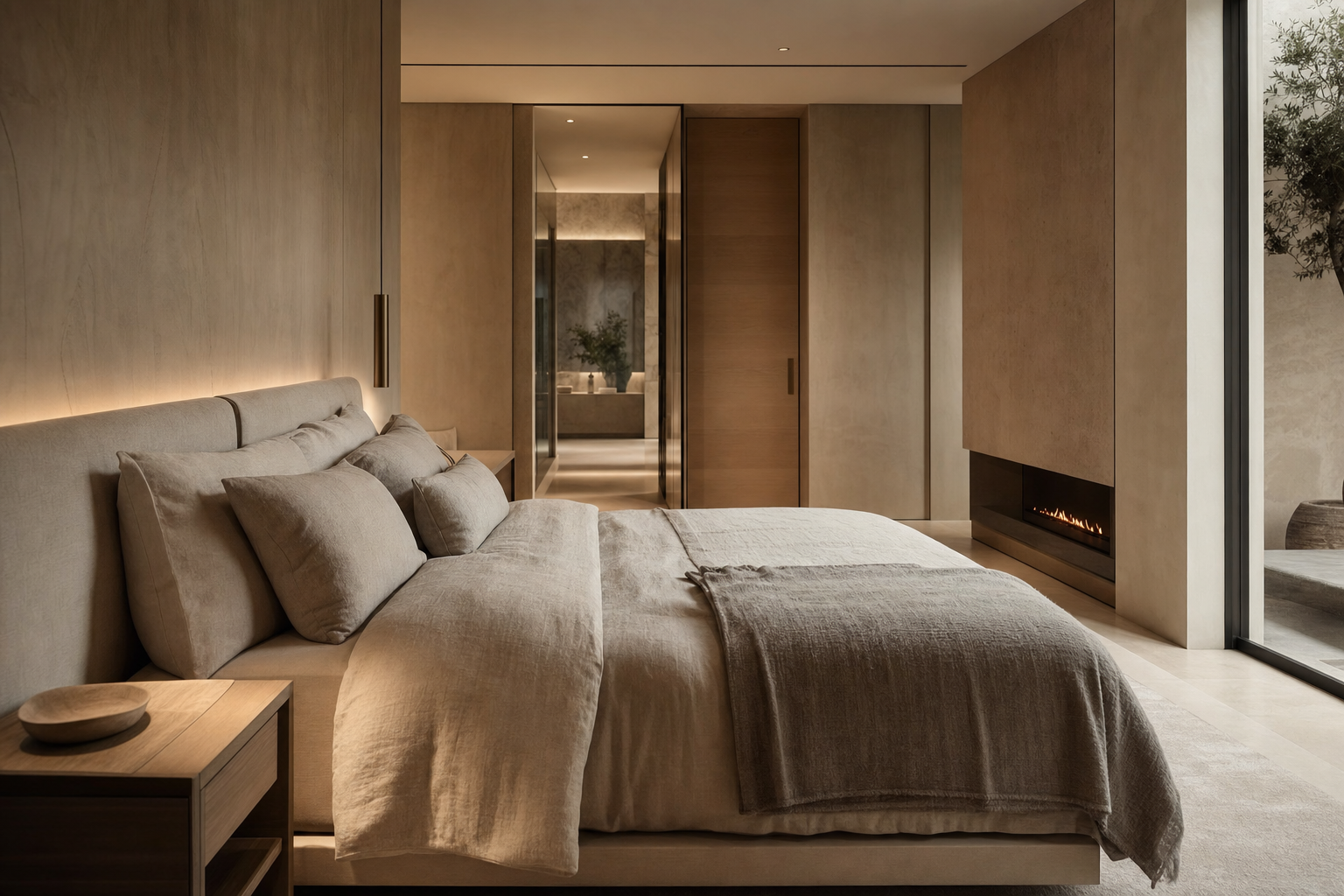
EMF shielding at home begins with measurement, not with products. You survey radiofrequency, magnetic fields and dirty electricity room by room, then reduce what you find at source by hardwiring data, moving routers away from bedrooms and filtering circuits, before considering shielded paint, window film or a Faraday room.
I will be candid from the outset, because this is the pillar where candour is worth more than confidence. Electromagnetic Quiet is Pillar Five of ÖND's Nine Pillars, and it is the one I am asked about most sceptically by architects and most anxiously by clients. The rigorous evidence that ordinary residential radiofrequency exposure harms sleep is genuinely mixed and largely null. I still specify shielding, for reasons I will set out plainly, and I would rather explain those reasons honestly than sell fear.
Is EMF Shielding Actually Necessary?
For most households, no, not on the current evidence. A prospective cohort study of 955 participants published via PubMed found no clear evidence that residential radiofrequency exposure affects self-reported sleep quality. A 2024 double-blind study in Frontiers in Public Health examined the same question under controlled conditions and supports a similarly measured reading. Anyone who tells you the science is settled in the other direction is not describing the literature.
The low-frequency picture is no more alarming. A review in Dialogues in Clinical Neuroscience found the human evidence on extremely low frequency fields and melatonin secretion inconsistent, with no reliable dose-response relationship. Inconsistent is the operative word. Not disproven, not confirmed, simply not established.
So why do I do this work at all? Three reasons, and none of them is a medical claim. First, clients ask for it, in growing numbers, and I would rather they had it engineered properly than fitted by a supplier selling stickers and pendants. Second, a subset of people report genuinely disturbed sleep in high-exposure environments, and whether the mechanism is electromagnetic or psychological, they are the ones who have to sleep there. Third, most of what a good EMF programme actually does, being hardwired data, tidy electrical work, chargers and screens removed from the bedside, and a router relocated from the headboard wall, produces a quieter, better-organised, better-built house regardless of what the fields are doing. That third reason is the one I find most defensible.
When Dr. Lobe and I discuss electromagnetic protocols with a client, we say explicitly that we are practising precaution rather than treating a diagnosis. That sentence has never once cost me a commission. Several clients have told me it is why they appointed us.
The Three Things You Are Actually Measuring
The word EMF is used to cover three quite different phenomena, and conflating them is the reason most domestic advice on the subject is useless.
Radiofrequency, in the megahertz to gigahertz range, from mobile masts, mobile handsets, WiFi routers, cordless telephone base stations, smart meters, baby monitors and every connected device the household has acquired. This is what most people mean by EMF, and it is the easiest to reduce, because distance and hardwiring do most of the work.
Extremely low frequency magnetic fields, at 50 or 60 hertz, from building wiring, distribution boards, transformers, underfloor heating and any nearby supply infrastructure. These are the fields the Dialogues in Clinical Neuroscience review concerns, and they are the hardest to shield, since magnetic fields pass through most materials. Distance and wiring correction are the only reliable remedies, which makes them a design problem rather than a product problem.
Dirty electricity, meaning high-frequency transients riding on the building's own wiring, generated by dimmer switches, switched-mode power supplies, variable-speed motors, solar inverters and cheap LED drivers. This is the category clients have never heard of and the one where I most often find something worth correcting, partly because it is the direct consequence of the last fifteen years of electronics arriving in houses whose wiring was designed for filament lamps.
A survey worth having measures all three, in every room where someone sleeps, at the height of the pillow rather than in the middle of the floor, over a period long enough to catch a neighbour's inverter starting or a mast adjusting its output. A ten-minute walk round with a handheld meter is theatre.
How Do You Reduce EMF at Home, in Practice?
Reduce at source, then by distance, then by shielding, in that order. Shielding is the last resort and the most expensive, and a house that goes straight to shielded paint has usually skipped two cheaper interventions that would have achieved more.
At source. Hardwire everything that can be hardwired. Ethernet to televisions, workstations, streaming devices and access points is the single most effective measure available, and it also produces a faster and more reliable network, which is how I generally sell it. Replace cordless telephone base stations, which transmit continuously in many models. Remove the mobile handset from the bedside. Put the router on a timer if the household is willing.
By distance. Field strength falls sharply with distance, which makes relocation extraordinarily cost-effective compared with anything you can buy. A router moved from the bedhead wall to a service cupboard two rooms away accomplishes more than several thousand dollars of shielded paint. The same logic applies to distribution boards, which should never sit behind the head of a bed, and to underfloor heating in bedrooms, which is worth reviewing at the design stage.
By filtration. Dirty electricity filters on the circuits serving sleeping quarters are inexpensive, reversible and measurable before and after, which I like. Replacing the dimmer switches and low-quality LED drivers that generated the transients in the first place is better still.
By shielding, last. Shielded paint on the walls facing the source, metallised window film, shielded fabrics, and in the most demanding cases a properly engineered Faraday enclosure. Shielding must be earthed correctly and applied to the correct surfaces, or it will do nothing useful, and it can occasionally make matters worse by reflecting fields back into a room. This is why I regard it as engineering rather than decoration.
The Riyadh Residence and the Compromise Architecture
A principal residence in Riyadh remains my clearest example of the full sequence. A complete EMF audit identified elevated ambient radiofrequency, largely external, together with dirty electricity signatures in the sleeping quarters. The response followed the order above. We applied shielded paint and metallised window film to the sleep-side walls only, ran hardwired ethernet throughout the primary suite with WiFi routed away from the bedrooms, and fitted electrical filtration on the suite circuit. Nothing was applied to the rest of the house, because nothing needed to be, and I have no interest in shielding a dining room where nobody is unconscious for eight hours.
That sleep-side principle is the one I would most like readers to take away. Full-house shielding is almost always a waste of money. The bedroom deserves the highest specification in the home. The morning room does not.
A family compound commission extended the same approach to every sleeping quarter, alongside circadian lighting and filtration throughout, and it taught me how much easier this is at construction stage than afterwards. Ethernet in the walls costs very little when the walls are open.
“A good night's sleep is a physiological event that depends on the environment being quiet, dark, cool and still. Radiofrequency is at best a very minor contributor to that, and at worst a distraction from the more consequential interventions. I tell patients the same thing: correct the light, the temperature and the noise first. You will find the electromagnetic question is considerably less pressing afterwards.”
— Dr. Fouad I. Ghaly, MD
The commission I return to most often, though, is a technology-forward family in the GCC who arrived with two irreconcilable requirements. They wanted a house that was electromagnetically quiet and a house in which four teenagers could stream, game and video-call without complaint. What we built was a compromise architecture: hardwired ethernet everywhere, WiFi confined to living zones and switched off in sleeping zones on a schedule, and a dedicated media room fully isolated both acoustically and electromagnetically from the adjoining bedrooms. Nobody had to give anything up, which is the only version of this work that survives contact with an actual family. I have watched more than one household abandon an ideologically pure EMF programme within a month because it made the house annoying to live in.
What Does EMF Work Cost?
A proper survey by a qualified building biologist or EMF engineer, covering radiofrequency, magnetic fields and dirty electricity across a substantial residence, runs from roughly $2,000 to $6,000. That is the only expenditure I recommend without qualification, because it is the one that tells you whether the rest is warranted. A surprising number of surveys conclude that very little needs doing, and I regard that as money well spent.
Remediation of a primary suite, meaning hardwired data, router relocation, circuit filtration, shielded paint on the relevant walls and window film, typically falls between $15,000 and $50,000 depending on the surfaces involved and whether the walls are already open. A fully engineered Faraday room, correctly earthed and verified with attenuation testing, is a different order of undertaking and generally begins around $75,000 for a modest space and rises considerably from there.
I do not encourage the Faraday room for most clients. It is the right answer for a small number of people, usually those with genuine and persistent sensitivity who have already exhausted the cheaper interventions, and it is a poor first purchase. What I encourage instead is the survey, the hardwiring and the relocation, which together cost a fraction and address most of what a survey typically finds. The general economics of prioritising this kind of work appear in the cost of a longevity home.
What Should You Fix Before You Shield?
The light, the air and the temperature, in that order, and I say this to nearly every client who arrives asking about fields. The evidence supporting those three is far stronger than the evidence supporting electromagnetic remediation, and the interventions are usually cheaper.
Consider the comparison honestly. Research on domestic evening light published via PubMed found that nearly half of the homes measured carried evening light bright enough to suppress melatonin by 50 percent, and the WELL Building Standard's circadian lighting guidance sets the corrective targets at 200 to 250 equivalent melanopic lux by day and under 50 at night. A double-blind crossover study in the Journal of Exposure Science and Environmental Epidemiology found that true HEPA filtration cut indoor PM2.5 by 60 percent and personal exposure by 53 percent. Those are precise, replicated, mechanistically understood effects. The residential radiofrequency literature offers nothing of comparable strength, and pretending otherwise would be dishonest.
So the sequence I recommend is unambiguous. Correct the evening light in the bedroom. Get the filtration and humidity right. Sort the temperature and the noise. Then, if you still sleep poorly, or if the question simply will not leave you alone, commission the EMF survey. Approached in that order, a great many clients never reach the fields at all, and the ones who do arrive at the question with everything else already resolved, which makes the answer far easier to interpret.
It is worth adding that the market has quietly reached the same conclusion. Both Inman's assessment of the 2026 luxury buyer and the National Association of Realtors, which reports resale premiums of 10 to 25 percent for wellness-designed homes, describe air, water and light as the foundational trio. Electromagnetic work remains a specialist addition rather than a baseline expectation, and I think that is the correct place for it.
The Part of This Industry I Would Avoid
There is a market in EMF anxiety, and at the top of the market it is lucrative. I would treat with considerable scepticism any supplier selling harmonising pendants, stickers for the back of a telephone, crystals, or any device whose mechanism cannot be described in the language of physics and whose effect cannot be demonstrated with a meter before and after. If a product cannot be verified by measurement, it is jewellery.
I would also be wary of practitioners who diagnose. An EMF surveyor is competent to tell you what the fields in your bedroom measure. They are not competent to tell you what those fields are doing to your body, and the honest ones will say so. Clinical questions belong with clinicians, which is why Dr. Lobe and Dr. Ghaly are part of these conversations at all.
And I would resist the temptation towards total elimination. A house with no wireless connectivity, no dimmers and no modern conveniences is achievable and, for almost everybody, miserable. The objective is a quiet bedroom in a house that still works, not a bunker. Measured, proportionate, sleep-side. That is the whole philosophy of this pillar, and it is why we place it fifth amongst nine rather than first.
Where Electromagnetic Quiet Sits in the Framework
Pillar Five is deliberately not at the top of the list, and the ordering is a statement of priority. Circadian Light Architecture and Air Excellence have far stronger evidence bases and far more reliable effects per dollar spent. If a client has a budget for one intervention in the bedroom, it is the light, then the air, then the temperature, then the sound, and only then the fields.
What Electromagnetic Quiet does contribute, and this is not nothing, is the removal of a category of worry. Sleep is peculiarly vulnerable to the belief that something is preventing it. A client who has been told by the internet that the smart meter outside their bedroom is disturbing their rest will not sleep better until either the meter is addressed or the concern is. A measured survey resolves the question in either direction, honestly, which is the sort of service I think this industry ought to be offering rather than the one it usually does.
The way the pillars trade off against one another is set out at the Nine Pillars and explored in depth in the Nine Pillars of wellness design. The bedroom-first logic underpins the whole framework, as described in what wellness design actually is and what a longevity home is.
The ÖND Perspective
In thirty-one years of designing houses for people with the means to buy any certainty they wish, I have learnt that the most valuable thing I can offer is an honest no. This pillar is where I say it most often. A great many clients arrive convinced that their fatigue is electromagnetic, and a survey frequently shows that their bedroom is unremarkable, their evening light is catastrophic and their air handling has been dry for two years. Telling them so is worth more than selling them shielded paint.
That is also, I suspect, why Electromagnetic Quiet earns its place amongst the Nine Pillars despite the mixed evidence. A framework that only included the settled science would be a shorter and less useful document, because clients do not experience their homes as a literature review. They experience worry, poor sleep, and a suspicion that something in the building is working against them. My job is to take that suspicion seriously enough to measure it and to be truthful about what the measurement shows.
The houses I am proudest of in this respect are not the shielded ones. They are the ones where the data is hardwired, the wiring is clean, the router is in a cupboard at the far end of the corridor, and the client sleeps in a room that contains almost nothing electrical at all. That is not a technology achievement. It is an old-fashioned one, and it costs less than most people fear.
Begin With a Conversation
If you suspect the fields in your home are affecting how you sleep, the responsible first step is measurement rather than remediation. A Longevity Home Wellness Design Audit includes a survey of radiofrequency, magnetic fields and dirty electricity in your sleeping quarters, alongside light, air, water and acoustics, and produces a prioritised, honestly costed roadmap. If the answer is that nothing needs doing, we will tell you that.
If you would rather begin by talking it through, please write to us. I read every enquiry personally.
Sources
- Exposure to radiofrequency electromagnetic fields and sleep quality, PubMed
- Does radiofrequency radiation impact sleep? A double-blind study, Frontiers in Public Health
- ELF-EMF and melatonin secretion, Dialogues in Clinical Neuroscience
- Circadian Lighting Design, WELL Building Standard
- Evening home lighting adversely impacts the circadian system and sleep, PubMed
- Reduction of personal PM2.5 exposure via indoor air filtration systems, Journal of Exposure Science and Environmental Epidemiology
- Wellness Trend Driving Real Estate Price Premiums, National Association of Realtors
- Luxury's Next Phase: What The 2026 Buyer Really Wants, Inman
- The Nine Pillars, ÖND
- The Longevity Home Wellness Design Audit, ÖND
Commission Your Longevity Home Wellness Design Audit
The Longevity Home Wellness Design Audit — offered by Beverly Hills Luxury Interiors and ÖND | Life's Breath™ in clinical collaboration with Dr. Thom Lobe MD and Dr. Fouad I. Ghaly MD — is a comprehensive assessment of your current home's biological environment: material toxicology, air and water purity, acoustic conditions, circadian light architecture, electromagnetic exposure, and thermal comfort. It delivers a prioritised, physician-reviewed roadmap for transformation — the first step towards a home that does not merely shelter, but actively extends your health, clarity, and vitality. Your environment is shaping your biology in every moment. The question is whether it is doing so with intention.
Enquire About Your Audit