Quiet Luxury Interior Design: What It Actually Means
By Kenneth Bordewick | Beverly Hills Luxury Interiors | ÖND | Life's Breath™ · In clinical collaboration with Dr. Thom E. Lobe MD and Dr. Fouad I. Ghaly MD
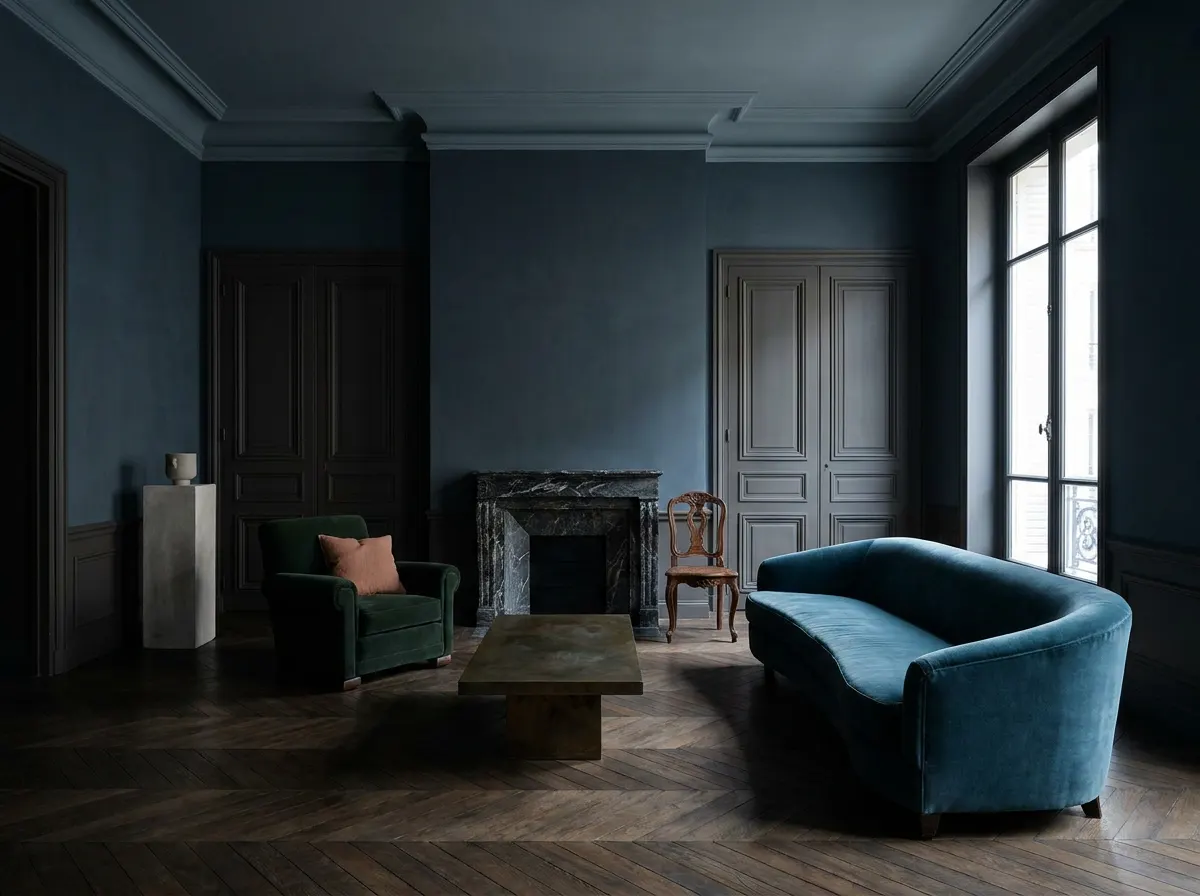
Quiet luxury is the most misunderstood term in interior design, and the misunderstanding is always the same one: that it is minimalism with better taste. It is not. Minimalism removes things. Quiet luxury replaces them — with fewer, better ones.
That distinction is not semantic. It governs every decision on a project. A minimalist room is defined by what has been taken out of it and reads as an act of subtraction. A quiet luxury room is defined by the quality of what remains, and reads as an act of judgement. One is an aesthetic of absence. The other is an aesthetic of consequence — the visible result of having decided, object by object, that this and not that will be lived with for the next forty years.
The search data is unusually clear on where public taste has arrived. The coastal grandmother look has collapsed by forty-one per cent in a year. The old money aesthetic has more than halved, falling by fifty-one per cent. The modern farmhouse, which dominated a decade of residential building, is in terminal decline. Quiet luxury has outlasted every one of them — because, unlike them, it was never a look. It was a method.
What Trend Is Replacing Modern Farmhouses?
Quiet luxury is replacing the modern farmhouse — an approach built on architectural proportion, honest natural materials such as stone, solid timber and lime plaster, and mixed-provenance furniture chosen individually rather than bought as a matching set, in place of the shiplap, barn doors, open shelving and grey-and-white palette that defined the farmhouse decade.
The reason for the substitution is worth stating plainly, because it explains why this one is unlikely to reverse. The modern farmhouse was an applied style: a set of surface signals — shiplap, a sliding barn door, a subway tile, a farmhouse sink — that could be fitted over any plan, in any climate, at any budget. Because it lived entirely at the surface, it dated at the surface, and it dated everywhere simultaneously.
Quiet luxury cannot date in the same way, because it does not operate at that layer. It concerns proportion, light, material and acoustic behaviour — the qualities that were already ancient when the farmhouse arrived and that will still be quietly correct when its successor has gone too. A well-proportioned room in honest materials was admired in 1780, is admired now, and will be admired in 2120. That is not a trend cycle. It is the absence of one.
“A trend can be installed. Quiet luxury has to be decided. That is precisely why it survives the decade in which it was chosen.”
— Kenneth Bordewick, Beverly Hills Luxury Interiors
The Quiet Luxury Framework
We do not treat quiet luxury as a mood. We treat it as a specification with seven testable conditions. A room either satisfies them or it does not, and the client can stand in the room and feel which.
Proportion
The first and least negotiable condition, and the one no purchase can rescue. Ceiling height against room width. Window height against wall height. Door height against cornice depth. The placement of an opening within a wall rather than merely within a plan. Proportion is the only element of a room that cannot be bought later, which is why we resolve it before a single finish is discussed. A poorly proportioned room furnished exquisitely remains a poorly proportioned room; a well-proportioned room half-furnished is already serene.
Material Honesty
The stone is stone. The timber is solid. The plaster is lime or clay, troweled by hand. Nothing imitates anything else — no printed timber-effect surface, no resin-bonded quartz pretending to be marble, no foil-wrapped panel pretending to be joinery. This is a discipline of the eye and, as it happens, of the lung: the imitation is almost always the synthetic, and the synthetic is almost always the emitter. Material honesty and material purity converge on the same schedule.
Acoustic Serenity
The most consistently ignored condition in luxury interiors, and the one clients feel most immediately without being able to name. Reverberation controlled by mass and by soft natural fibre — wool, heavy interlined linen, hemp, horsehair — rather than by engineered acoustic panel. Sealed doors. Plant and services isolated so that no mechanical hum enters a resting room. A quiet room is experienced as an expensive room even by a person who cannot say why.
Glare Control
Light that is layered, directional and never punitive. No grid of ceiling downlights. No bare source in the field of view. Illumination from lamps, sconces and concealed sources at low level, on a warm dimming curve after dusk. Daylight admitted generously and then controlled with fabric rather than with tint. The circadian argument for this is well established — the Harvard T.H. Chan School of Public Health Healthy Buildings programme has made the case for light quality as an environmental determinant for years — but the aesthetic argument arrives at the identical answer.
Thermal Stability
Radiant rather than convective heating wherever the fabric permits. Stone and plaster carrying thermal mass so that temperature moves slowly. No draught, no cold surface at dew point, no forced-air rush across a seated body. A room whose temperature you never think about is a room you will occupy for hours longer than you intended.
Visual Order
Storage designed to the actual contents of an actual life, so that surfaces stay clear without discipline being required of the occupant. Cable, switch and socket resolved rather than accepted. Alignment held across a room: heads of doors, tops of joinery, centres of openings. Visual order is what allows a room to hold three beautiful objects rather than thirty adequate ones.
Patina
The condition that separates quiet luxury from every trend it has outlived. We specify materials that improve as they wear. Oiled timber that deepens. Unlacquered brass that darkens by hand. Limestone that softens at a threshold. Linen that breaks in. Lime plaster that gains depth. Nothing is specified in a state of maximum perfection on the day of handover, because a room at maximum perfection can only decline. A room designed for patina is the only room that appreciates.
“I ask a client one question before we begin: which object in this house do you intend your grandchildren to argue over? Everything we specify afterwards is an answer to it.”
— Kenneth Bordewick
Fewer, Better, and the Discipline of the Mixed Room
The practical expression of all seven conditions is a room assembled from mixed provenance. An eighteenth-century commode against a contemporary sofa in undyed wool. A single mid-century chair that owes nothing to either. A modern painting above a stone chimneypiece that predates it by two centuries. Nothing bought as a set, nothing bought as a suite, no matching pair flanking anything.
A matching set announces that a decision was made once, on a showroom floor, by someone else. A mixed room announces that a decision was made many times, over a long period, by the person who lives there. The second is the definition of quiet luxury, and it is also — precisely — why it cannot be sold as a package or replicated by a trend-driven firm. It is our philosophy before it is our aesthetic.
The through-line to our clinical work is not incidental. Every residential commission undertaken by Beverly Hills Luxury Interiors — not only the ÖND-branded work — carries the counsel of Dr. Thom E. Lobe MD and Dr. Fouad I. Ghaly MD, physician partners to both the atelier and to ÖND | Life's Breath™. The reason quiet luxury and longevity design converge is that both reject the synthetic, the imitative and the disposable — one on grounds of taste, the other on grounds of measurement. They arrive, independently, at the same room. Our physician partners are how we hold that line.
Questions We Are Asked
What is quiet luxury interior design?
Quiet luxury interior design is an approach in which quality is expressed through proportion, material honesty and craftsmanship rather than through visible branding or ornament. It prioritises architectural proportion, natural materials such as stone, solid timber, lime plaster and natural-fibre textiles, layered low-glare lighting, acoustic calm, and furniture of mixed provenance chosen individually. It is not minimalism: minimalism removes things, whereas quiet luxury replaces them with fewer, better ones intended to be kept for decades and to improve as they age.
What trend is replacing modern farmhouses?
Quiet luxury is replacing the modern farmhouse — an approach built on architectural proportion, honest natural materials such as stone, solid timber and lime plaster, and mixed-provenance furniture chosen individually rather than bought as a matching set, in place of the shiplap, barn doors, open shelving and grey-and-white palette that defined the farmhouse decade. The substitution is durable because the farmhouse was a set of surface signals, which date at the surface, while quiet luxury concerns proportion, light, material and acoustics, which do not.
Is quiet luxury the same as minimalism?
No. Minimalism is defined by subtraction — a room is judged by how much has been taken out of it. Quiet luxury is defined by judgement — a room is judged by the quality of the few things that remain, and by whether they will be worth keeping in forty years. A quiet luxury room may be materially rich, layered and full of texture, pattern and colour, provided every element in it was individually chosen and is individually good.
How do you achieve quiet luxury in a home?
Resolve proportion first, because it cannot be purchased later. Then specify honest natural materials that imitate nothing — stone, solid timber, lime or clay plaster, wool and linen. Control glare by removing ceiling downlight grids in favour of layered lamps and sconces on a warm dimming curve. Control reverberation with soft natural fibre. Design storage to the real contents of the household so surfaces stay clear. Buy fewer objects of higher quality from mixed sources rather than matching sets. Finally, choose materials that acquire patina rather than materials that can only degrade.
Begin With a Longevity Home Wellness Design Audit
The seven conditions are assessed formally, room by room, in the Longevity Home Wellness Design Audit — a comprehensive review of your existing or proposed residence across proportion, light, air, water, material, acoustic, thermal and electromagnetic dimensions, returning a prioritised and phased roadmap. The methodology is set out in our white paper, and completed work may be seen in the gallery.
Sources: Harvard T.H. Chan School of Public Health Healthy Buildings programme; US Environmental Protection Agency guidance on volatile organic compounds and indoor air quality; World Health Organization indoor air quality guidelines; GOTS and OEKO-TEX textile certification; clinical counsel of Dr. Thom E. Lobe MD and Dr. Fouad I. Ghaly MD.
Beverly Hills Luxury Interiors does not administer medical treatments. All clinical protocols and longevity interventions should be discussed with a qualified physician — including Dr. Thom E. Lobe MD and Dr. Fouad I. Ghaly MD — before undertaking. All information in this article is educational in nature.
Every ÖND residence begins with a private conversation.