Quiet Luxury: The Cognitive Architecture
By Kenneth Bordewick | Beverly Hills Luxury Interiors | ÖND | Life's Breath™ · In clinical collaboration with Dr. Thom Lobe MD and Dr. Fouad I. Ghaly MD
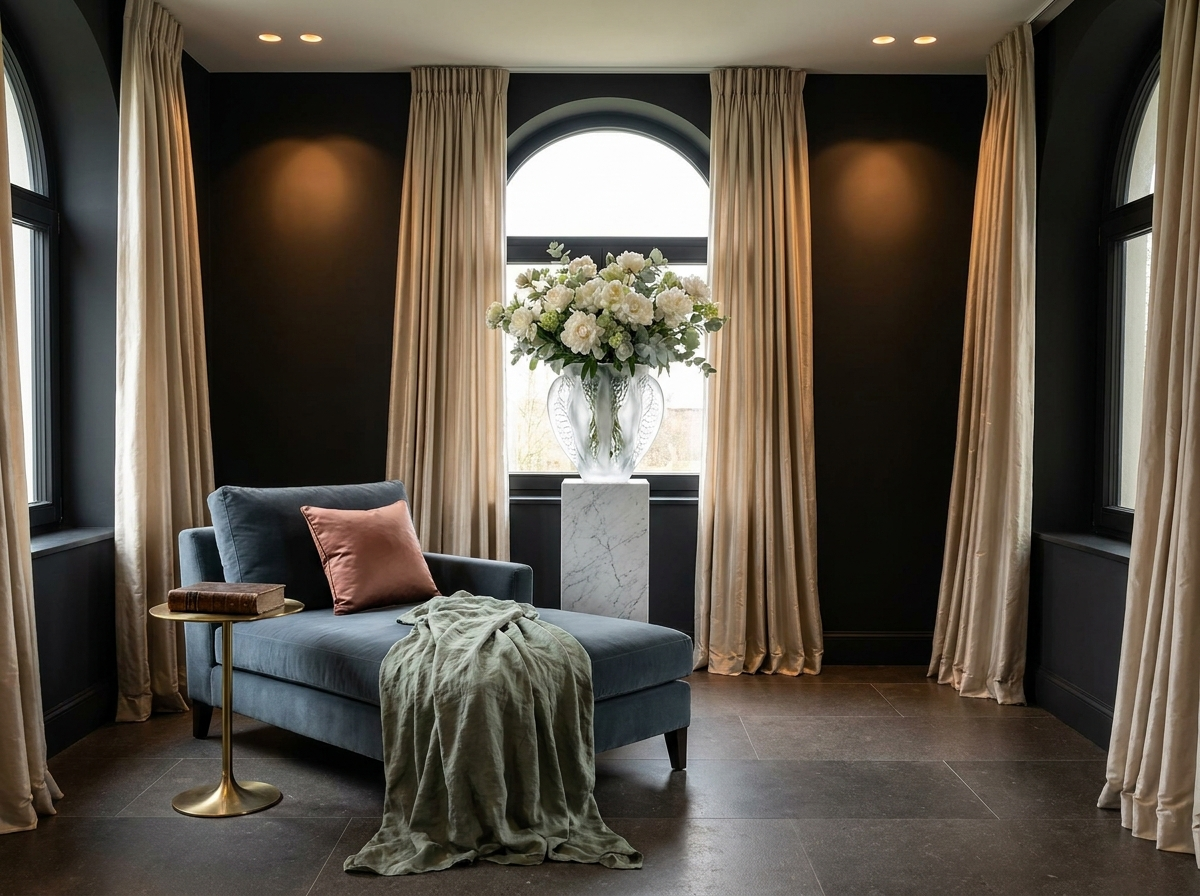
In 2011, researchers at Princeton Neuroscience Institute established something that every person who has ever tried to think clearly in a visually complex room already understood at some level below articulation: disorder degrades the mind. Not metaphorically — neurologically. Every object within the visual field simultaneously competes for the brain's finite neural processing resources. A room of visual complexity is not merely aesthetically uncomfortable; it is cognitively expensive. It depletes working memory, fragments sustained attention, elevates cortisol, and disrupts the default mode network — the neural system responsible for memory consolidation, creative insight, emotional processing, and the quality of being fully present in one's own life.
The most expensive interiors in the world, in a significant number of cases, are quietly — without intention, without awareness — extracting a cognitive cost from every person who inhabits them. This is the problem that Quiet Luxury was always designed to solve. Not as an aesthetic preference, but as a cognitive and biological standard.
The Neuroscience of the Quiet Room
The Princeton study — published in the Journal of Neuroscience — was among the first to use fMRI imaging to observe what happens in the brain when it is asked to function in a visually complex environment. The findings were categorical: the visual cortex allocates processing priority across every competing element in the visual field. In a room of forty competing visual elements, the neural bandwidth available for executive function, decision-making, and sustained creative thought is materially reduced.
The implications for residential design at the highest level are significant. The homes of individuals who make consequential decisions — who negotiate, who create, who lead — are also environments in which cognitive performance should be at its absolute peak. Yet conventional luxury design, with its accumulation of pattern, ornamentation, collected objects, and competing visual statements, routinely produces the opposite condition.
Quiet Luxury does not begin with aesthetics. It begins with cognitive hygiene.
At Beverly Hills Luxury Interiors, this understanding is foundational to the practice of Kenneth Bordewick and to every commission undertaken through the ÖND | Life's Breath™ framework, in clinical collaboration with Dr. Thom Lobe MD and Dr. Fouad I. Ghaly MD. A beautiful room that degrades cognition is not a luxury room. It is a beautiful problem.
The Architecture of Genuine Quiet
Quiet Luxury — as Beverly Hills Luxury Interiors practises it — is not the absence of investment. It is the redirection of investment: from competitive visual statement to considered spatial experience. From the accumulation of objects to the cultivation of presence. From visual noise to visual sovereignty.
The principles are precise.
Spatial hierarchy. Every room must possess a clear primary element — a chimney breast, a curated vista, a material truth — that gives the eye an unambiguous point of rest. Without this hierarchy, the visual system scans continuously, consuming cognitive resources in its search for an orientation that should have been provided by design.
Tonal coherence. This does not mean monochrome, and it does not mean beige. It means that every colour element in the room — stone, textile, plaster, timber — occupies a considered position within a unified tonal story. The eye that encounters a coherent palette transitions naturally through the space. The eye that encounters tonal conflict must repeatedly recalibrate — each recalibration a small but cumulative neurological tax upon the person within.
Material honesty. Natural materials — stone, hardwood, linen, silk, hand-applied mineral plaster — possess a resonance that no synthetic material can replicate. The nervous system processes the grain of walnut differently from the surface of laminate; it processes the weight of linen differently from polyester. The body registers this distinction below the threshold of conscious awareness, and the mind responds accordingly. A room of natural material truth is a room in which the nervous system is permitted, at last, to be still.
Acoustic sovereignty. Quiet Luxury is not merely a visual discipline. The acoustic character of a room — the management of reverberation, the absorption of ambient noise, the specification of materials that reduce rather than amplify sound transmission — is as consequential as any visual decision. A room that looks serene but sounds chaotic has achieved aesthetics at the expense of experience.
“The truly quiet room does not announce itself. It simply allows the person within it to think more clearly, breathe more deeply, and return — after hours or decades of living — to themselves.”
— Kenneth Bordewick, Beverly Hills Luxury Interiors
Explore the full framework underpinning this approach in our guides on quiet luxury and wellness design and the wellness design principles that guide every Beverly Hills Luxury Interiors commission.
The Quiet Room as a Longevity Environment
The clinical dimension of Quiet Luxury is inseparable from its aesthetic dimension — and this distinction is what separates the Beverly Hills Luxury Interiors approach from conventional luxury design practice.
The chronic cortisol elevation associated with visual and acoustic complexity does not merely impair daily performance. It accelerates biological ageing. Research published in the Proceedings of the National Academy of Sciences established that sustained cortisol elevation shortens telomeres — the protective chromosomal structures whose length is now understood to be among the most reliable biomarkers of biological age. A home that continuously elevates cortisol — however magnificently appointed — is, in clinical terms, a home that is quietly ageing the person who lives within it.
The Quiet Luxury room, by contrast, activates the parasympathetic nervous system. It reduces circulating inflammatory cytokines. It improves sleep architecture — the quality of the cellular repair processes that take place, exclusively, in the hours of deep, undisturbed rest. It lowers the biological markers that clinical longevity medicine works, through pharmacological and procedural means, to reduce.
In clinical collaboration with Dr. Thom Lobe MD and Dr. Fouad I. Ghaly MD, the Beverly Hills Luxury Interiors design standard integrates this understanding into every material selection, every spatial decision, and every lighting specification. The room that heals is not always the room that impresses. But at Beverly Hills Luxury Interiors, it is always the room that endures.
Quiet Luxury Is Not a Trend. It Is a Standard.
The preoccupation of the last decade with quiet luxury as an aesthetic movement has, in some respects, obscured what Quiet Luxury actually is at its most rigorous: a biological and cognitive standard for the built environment.
The homes that Kenneth Bordewick and Beverly Hills Luxury Interiors design — in Beverly Hills, Manhattan, London, the Persian Gulf, and across every international atelier commission — are not quiet because quiet is fashionable. They are quiet because the scientific evidence for the cognitive and biological benefits of spatial restraint is, at this point in the history of environmental science, unambiguous. And because the clients for whom these homes are created deserve environments that perform at the same standard to which they hold every other aspect of their lives.
The most consequential decision in the design of a great home is not what to add. It is what to resist adding. That restraint — that disciplined quiet — is the architecture of a life lived at its fullest cognitive and biological capacity.
Commission Your Longevity Home Wellness Design Audit
If you are investing in clinical longevity protocols — and have not yet evaluated the residential environment in which those protocols must be sustained — we invite you to commission the Longevity Home Wellness Design Audit from Beverly Hills Luxury Interiors | ÖND | Life's Breath™. Conducted in clinical collaboration with Dr. Thom Lobe MD and Dr. Fouad I. Ghaly MD, the Audit assesses your environment across every domain relevant to cognitive and biological performance: visual coherence, acoustic quality, material purity, atmospheric integrity, circadian light architecture, water quality, and thermal precision. It delivers a prioritised design roadmap — and the assurance that your most significant investment in longevity is not being silently undermined by the space in which you live.
Enquire About Your AuditSources: McMains S, Kastner S. “Interactions of top-down and bottom-up mechanisms in human visual cortex.” Journal of Neuroscience, 2011. | Sapolsky RM. “Glucocorticoids and hippocampal atrophy in neuropsychiatric disorders.” Archives of General Psychiatry, 2000. | Epel ES, et al. “Accelerated telomere shortening in response to life stress.” PNAS, 2004. | Nobel Prize in Physiology or Medicine 2017 — circadian rhythm mechanisms (Hall, Rosbash, Young). | World Health Organisation. WHO Guidelines for Indoor Air Quality, 2010. | Reference: Dr. Thom E. Lobe MD, Beneveda Medical Group. | Reference: Dr. Fouad I. Ghaly MD. | Beverly Hills Luxury Interiors | ÖND | Life's Breath™