The Non-Toxic Home: A Room-by-Room Specification
By Kenneth Bordewick | Beverly Hills Luxury Interiors | ÖND | Life's Breath™ · In clinical collaboration with Dr. Thom E. Lobe MD and Dr. Fouad I. Ghaly MD
A non-toxic home is not achieved by a purchase. It is achieved by a specification — written before the first delivery arrives, and enforced through every trade on site.
What follows is that specification, set out room by room as we issue it. It begins at the substrate, because the adhesive beneath a beautiful floor will out-emit the floor itself by an order of magnitude, and because a client who buys organic bedding for a bedroom built from formaldehyde-bonded panel has solved the smallest part of the problem at the greatest cost in effort.
Interest in low-VOC paint has more than doubled in a year. Interest in wellness design has risen by well over a hundred per cent. Organic bedding, similarly. The appetite is genuine and it is growing — but the appetite is largely directed at the finishing layer, which is the last five per cent. This document concerns the other ninety-five.
The Substrate Rules — Applied Everywhere
These clauses precede every room and override any conflicting instruction.
Boards and substrates. Solid timber in preference to engineered panel throughout. Where a sheet material is structurally unavoidable, it must be formaldehyde-free — no urea-formaldehyde binder under any circumstances. Particle board, MDF and standard plywood are excluded from all joinery, all carcassing and all concealed construction. The US EPA identifies formaldehyde among the most significant volatile organic compounds in the indoor environment, and pressed-wood products remain its principal domestic source.
Adhesives and sealants. The most under-scrutinised specification in the industry. Solvent-borne contact adhesives, polyurethane construction foams and standard silicone are excluded. We specify water-borne, low-emission adhesives and, wherever the structural condition permits, mechanical fixing in place of adhesive altogether. Floors are nailed or floated, not glued.
Walls. Lime plaster or clay plaster in preference to any coating. Both are vapour-open, hygroscopic, mineral, biologically inert and — being troweled by hand — more beautiful than any paint. Where paint is required, mineral silicate or a genuinely low-VOC formulation, never a vinyl-emulsion. Vinyl wallcovering is excluded absolutely.
Timber finishes. Natural oil and hard-wax finishes rather than polyurethane lacquer. They penetrate rather than film, they repair locally rather than requiring wholesale sanding, and they age into patina instead of failing into a scratched sheen.
Textiles. Natural fibre only, certified to GOTS or OEKO-TEX. Wool, linen, hemp, cotton, silk. No polyester, no microfibre, no synthetic velvet, no foam-backed cloth. No chemical flame-retardant treatment and no stain-repellent treatment of any kind. Upholstery fills of horsehair, coir, wool wadding and down over hand-tied springs and jute webbing; natural latex where resilience is required, never polyurethane foam.
Curing schedule. Plasters, oils and any coating must complete their emission curve before occupation, under continuous mechanical ventilation and elevated temperature. We programme a formal flush-out period at the close of every commission. The Harvard T.H. Chan School of Public Health Healthy Buildings programme has argued for years that ventilation is the foundational determinant of indoor environmental quality; a curing programme is simply that argument applied to a handover date.
“Clients ask me for a non-toxic paint. I tell them we shall begin instead with the adhesive they will never see, the panel behind the panel, and the six weeks of curing nobody wants to programme. That is where the burden actually lives.”
— Kenneth Bordewick, Beverly Hills Luxury Interiors
The Rooms
Entrance
The entrance is a filter, and it should be designed as one. Honed stone floor, falling gently to a threshold drain where the climate warrants it. Concealed shoe storage immediately inside the door, ventilated, so that street particulate — road dust, tyre wear, pesticide residue — never crosses onto a living floor. A generous coir or hemp mat, never a rubber-backed synthetic. No entrance mat of nylon. Solid timber joinery, oil-finished.
Living Rooms
Bare floors: solid oak, honed limestone or lime screed. No broadloom carpet — a wool or hemp rug that can be lifted, beaten and cleaned instead. Upholstery to the substrate rules above. Curtains in heavy unlined or wool-interlined linen, hung from timber or forged steel, never a plasticised track. Case furniture in solid timber. Chimneypieces in natural stone. Where a fire is used, a sealed appliance with a dedicated external air supply so combustion never draws from the room.
Kitchen
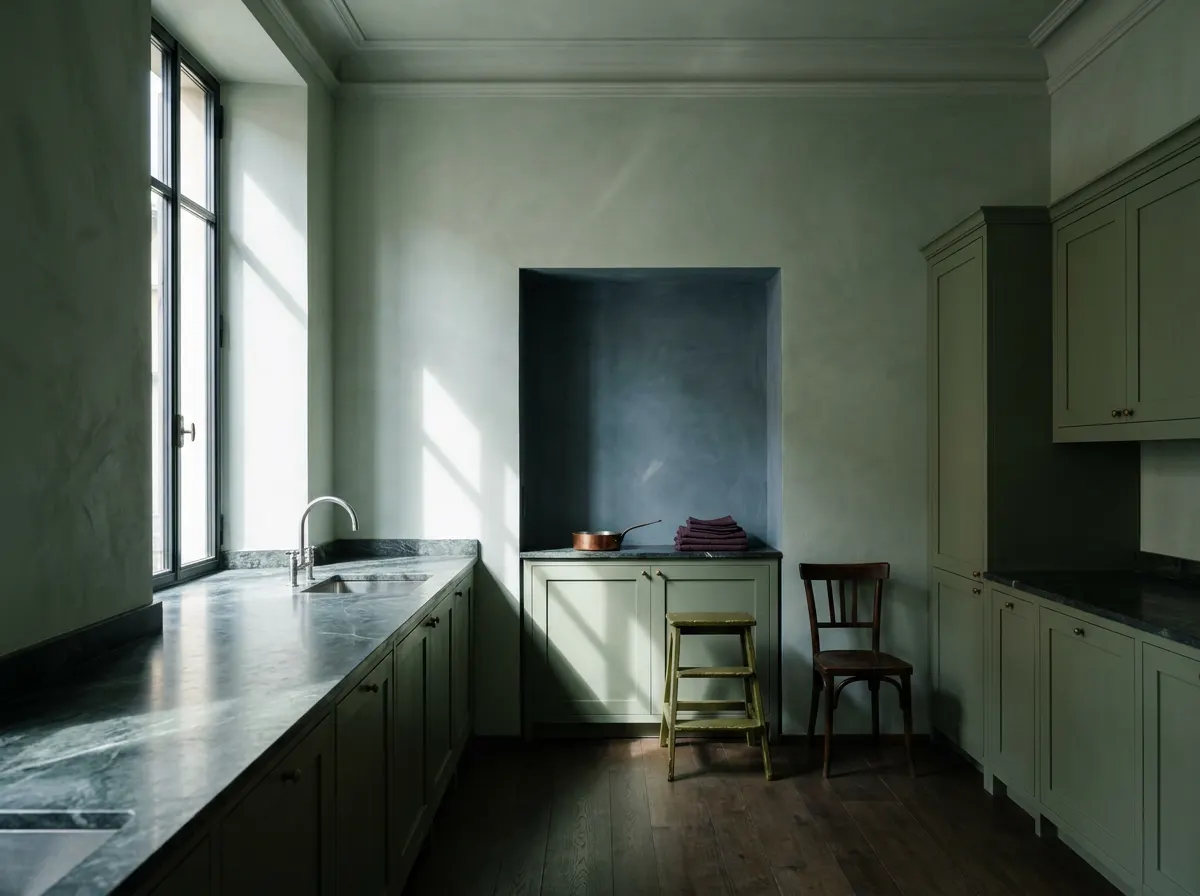
Cabinetry in solid timber with oil or hard-wax finish — never a foil-wrapped or laminate-faced carcass, which is a formaldehyde panel with a plastic skin. Worktops in honed natural stone rather than resin-bonded engineered quartz. No plastic-laminate surface anywhere. Sinks in unlined stainless steel or fireclay. Plumbing in copper or stainless steel. A properly sized externally ducted extract over the hob, commissioned and measured, never a recirculating charcoal cassette. Storage in glass and stainless steel; no plastic, and no plastic heated. Whole-home water filtration certified to NSF International standards serving every outlet, not merely the drinking tap.
Bathrooms
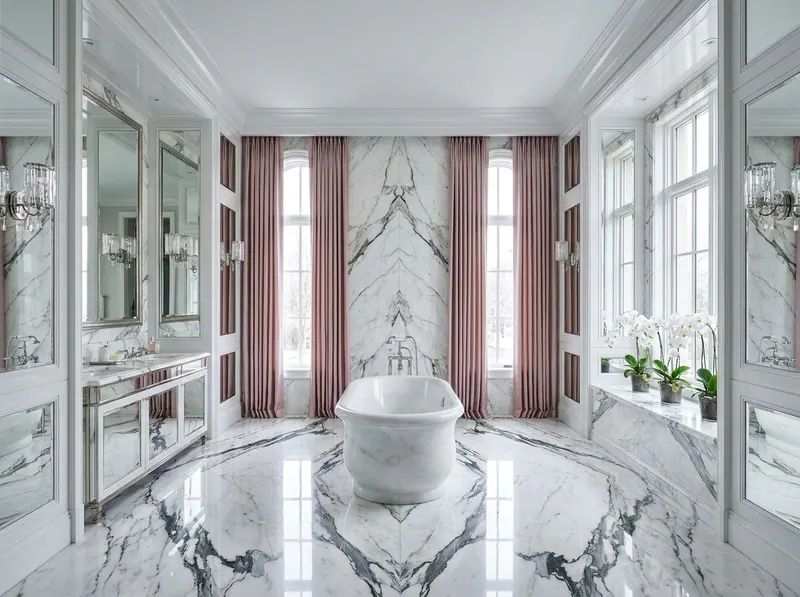
Natural stone and lime tadelakt in preference to any waterproof coating system. Ventilation is the entire discipline here: humidity-sensing continuous extract, sized generously, so that the vapour-open plaster is never asked to hold moisture it cannot release. Underfloor heating in stone to keep surfaces above dew point. No vinyl flooring, no acrylic panelling, no synthetic sealant where a mineral one exists. Whole-home filtration matters as much at the shower as at the tap.
Bedrooms
The room in which a third of a life is spent, and therefore the room specified most severely. Natural latex or horsehair-and-wool mattress, never polyurethane foam and never a flame-retardant treatment. Solid timber bedstead. GOTS-certified organic bedding in linen or cotton, wool for warmth in place of a polyester-filled duvet. Bare oiled timber floor with a wool rug. No broadloom carpet. Circadian-appropriate lighting on a warm dimming curve with no blue-rich source after dusk, and a considered electromagnetic strategy — sockets and distribution kept from the head of the bed, with a switchable circuit where the client wishes it.
Nursery
Every clause above, applied without exception and without negotiation, plus one additional rule: nothing enters the nursery until it has fully cured. Joinery, plaster, oil and textile all complete their emission curve off site or in an unoccupied and ventilated room. Solid timber cot, oil-finished. Organic cotton or linen to GOTS certification. Natural latex or wool mattress. No plastic toy storage, no vinyl floor covering, no foam play mat. A child breathes at a far higher rate relative to body mass than an adult and spends most of their day at floor level, where settled particulate concentrates.
Plant Room
The room nobody designs, and the room that determines whether every other clause holds. True HEPA filtration classified to EN 1822 with activated carbon in series, integrated into the fabric rather than parked as an appliance. Balanced mechanical ventilation with heat recovery, sized on measured occupancy and commissioned properly, with accessible filter housings so that filters are actually changed. Whole-home water treatment to NSF-certified standards. Humidity managed to a stable therapeutic band. No fragrance-dosing system of any description. This room is the difference between a house that is non-toxic on the specification and a house that is non-toxic in measurement — the distinction our seven pillars exist to enforce.
“Material honesty is not an aesthetic preference I happen to hold. It is the only specification that survives contact with a laboratory. The stone is stone. The timber is timber. Nothing is pretending, and therefore nothing is emitting.”
— Kenneth Bordewick
Every residential commission undertaken by Beverly Hills Luxury Interiors — not only the ÖND-branded work — carries the clinical counsel of Dr. Thom E. Lobe MD and Dr. Fouad I. Ghaly MD, physician partners to both the atelier and to ÖND | Life's Breath™. Their counsel is what converts a material schedule into a clinical one.
Questions We Are Asked
How do you make your home non-toxic?
Begin at the substrate, not the surface. Eliminate formaldehyde-bonded panel from all joinery and concealed construction; replace solvent-borne adhesives with water-borne products or mechanical fixing; use lime or clay plaster instead of vinyl-emulsion paint; specify natural oil and hard-wax finishes rather than polyurethane lacquer; use only GOTS or OEKO-TEX certified natural-fibre textiles with no flame-retardant or stain-repellent treatment; remove synthetic broadloom carpet; and install whole-home water filtration and true HEPA air filtration. Then programme a ventilated curing and flush-out period before occupation.
What is off gassing and how long does it last?
Off-gassing is the release of volatile organic compounds from a material into the air. Emission is highest when a material is newly installed and declines over time, but the curve varies enormously by material — some coatings and adhesives are substantially spent within weeks, while formaldehyde-bonded panel products can continue emitting for years. Heat and humidity accelerate emission, which is why a ventilated flush-out period at elevated temperature before occupation matters far more than most handover programmes allow.
Is low VOC paint actually worth it?
Yes, but it is the smallest part of the problem and frequently the only part addressed. Paint is a thin film on a wall; the adhesives, sealants, panel products and foam cushioning behind and beneath it typically carry a far larger emission burden. Low-VOC paint is worth specifying — mineral silicate formulations more so — but it should be the last clause in a specification, not the first.
What should a non-toxic nursery contain?
A solid timber cot with an oil or hard-wax finish, a natural latex or wool mattress with no flame-retardant treatment, GOTS-certified organic cotton or linen bedding, a bare oiled timber or stone floor with a wool rug rather than carpet, and lime or clay plaster walls. Nothing should enter the room until it has fully cured. Children breathe at a higher rate relative to body mass than adults and spend most of the day at floor level, where settled particulate concentrates.
Begin With a Longevity Home Wellness Design Audit
This specification is issued in full, room by room and trade by trade, as part of the Longevity Home Wellness Design Audit — a comprehensive assessment of your existing or proposed residence returning a prioritised, phased roadmap. The underlying methodology is documented in our white paper, and the wider programme at longevity.
Sources: US Environmental Protection Agency guidance on formaldehyde, volatile organic compounds and indoor air quality; Harvard T.H. Chan School of Public Health Healthy Buildings programme; World Health Organization indoor air quality guidelines; NSF International water treatment certification; EN 1822 HEPA classification; GOTS and OEKO-TEX textile certification; clinical counsel of Dr. Thom E. Lobe MD and Dr. Fouad I. Ghaly MD.
Beverly Hills Luxury Interiors does not administer medical treatments. All clinical protocols and longevity interventions should be discussed with a qualified physician — including Dr. Thom E. Lobe MD and Dr. Fouad I. Ghaly MD — before undertaking. All information in this article is educational in nature.
Every ÖND residence begins with a private conversation.