Microplastics Are in Your Blood — What Your Home Can Do

Scientists have detected microplastics in one hundred per cent of human blood samples tested. Not in some samples. Not in a compromised subset. In every single specimen drawn from every single participant across four independent peer-reviewed studies conducted in Amsterdam, Rome, Sydney, and New York. They have found microplastics in human placentas, in foetal lung tissue, in cardiac muscle, and in the arterial plaques associated with stroke and myocardial infarction. The question is no longer whether you have plastic in your bloodstream. The question is what you intend to do about it — and whether your home is the source or the solution.
The Home Is the Primary Exposure Environment
Most people, when they consider microplastic contamination, think of the ocean — of plastic bottles degrading under UV light, of sea creatures ingesting fragments, of distant industrial catastrophe. They do not think of their sitting room. They should.
The Environmental Working Group and the European Environment Agency have both identified the indoor home environment as the primary daily source of microplastic exposure for the average person. Synthetic carpets shed polyethylene and nylon fibres with every footfall. Acrylic upholstery releases microfibre aerosols every time a cushion is compressed. Polyester curtains fragment under UV and mechanical stress. Vinyl flooring, laminate surfaces with adhesive backing, and foam-core furniture panels off-gas plasticiser particles into the air — particles measured at PM2.5 and below, passing through standard filtration and directly into the pulmonary bloodstream.
The average person breathes approximately eleven thousand litres of air per day, and spends — conservatively — ninety per cent of that day indoors. The mathematics are not forgiving.
“The most dangerous room in most people’s lives is their own bedroom. It is lined with synthetic fibre, furnished with off-gassing foam, and carpeted with plastic that sheds invisibly with every step. The interior designer who does not understand material toxicology is not designing a home. They are designing a very beautiful exposure chamber.”
Kenneth Bordewick, Beverly Hills Luxury Interiors
What Microplastics Actually Do Inside the Body
The clinical picture is rapidly and unfavourably clarifying. A landmark study published in the New England Journal of Medicine in 2024 — following 304 patients who had undergone carotid endarterectomy — found that those with microplastics detected in their arterial plaques had a 4.5-fold higher risk of heart attack, stroke, or death over a 34-month follow-up period compared to those without detectable plastic. This is not a correlation. This is a dose-dependent biological mechanism.
Microplastics and their associated chemical cargo — phthalate plasticisers, bisphenol compounds, polyfluoroalkyl substances (PFAS), and flame retardants — are endocrine disruptors. They mimic and block oestrogen, testosterone, and thyroid hormones at nanogram concentrations. They generate reactive oxygen species, triggering chronic inflammation. They accumulate in mitochondria, impairing cellular energy production. They cross the blood-brain barrier. Clinical partners Dr. Thom Lobe MD and Dr. Fouad I. Ghaly MD — collaborating with ÖND | Life’s Breath™ — have documented the inflammatory load these compounds generate in patient panels, and the measurable reductions achievable through environmental intervention combined with targeted blood filtration protocols.
The body cannot metabolise these compounds through standard detoxification pathways. The liver, designed for biological toxins, cannot process polystyrene nanospheres. They accumulate — in adipose tissue, in the lymphatic system, in organs — until the inflammatory burden becomes clinically significant. Reduction of exposure is not optional. It is the foundational intervention.
The BHLI Microplastic Elimination Protocol
At Beverly Hills Luxury Interiors, the elimination of microplastic exposure sources is embedded within our quiet luxury wellness design philosophy as a non-negotiable specification standard — not an optional upgrade. Every commission we execute, from Beverly Hills estates to residences across the Persian Gulf and Asia, applies the same protocol.
I. Textile and Flooring Specification
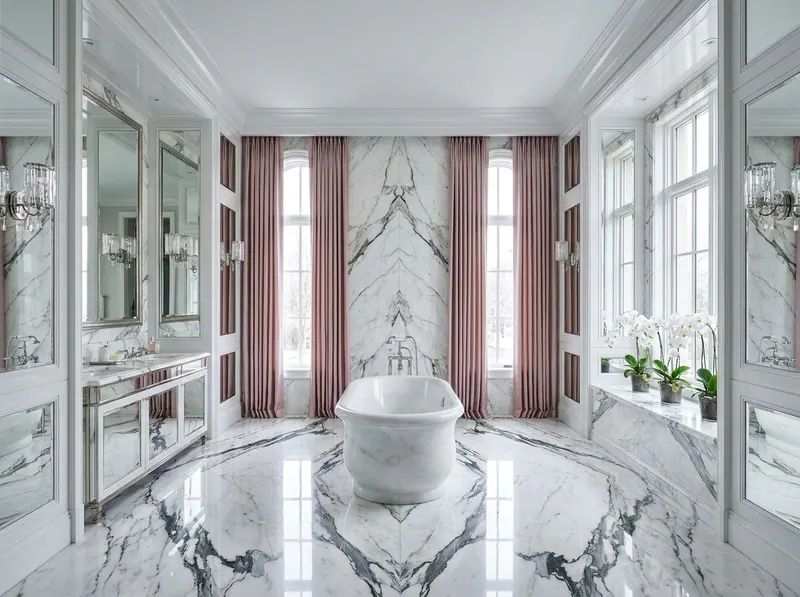
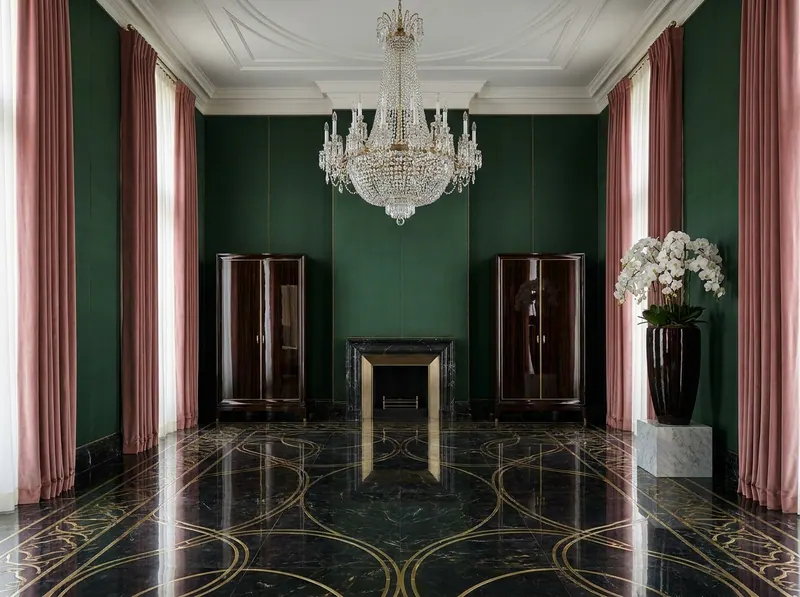
Every fibre introduced to a BHLI interior is natural and certified. Floors are solid stone — book-matched marble, travertine, aged oak, or parquet de Versailles in rift-cut fumed oak — never laminate, never LVT, never synthetic carpet. Upholstery is specified exclusively in wool, linen, silk, and naturally tanned leather. Drapery is floor-to-ceiling silk or linen, weighted with brass chains rather than plastic pellets. Mattresses are specified in organic wool, natural latex, and cotton — never synthetic foam. The aesthetic consequence is identical to the health consequence: the room becomes measurably quieter, more refined, and more enduring.
II. Air Purification Architecture
Airborne microplastics — the most immediately dangerous vector, given their direct access to the pulmonary blood supply — are addressed through a multi-stage filtration specification. Our wellness design principles mandate H14-grade HEPA filtration as a minimum, capturing 99.995% of particles at 0.3 microns, supplemented by activated carbon stages targeting chemical off-gassing and PFAS compounds, and UV-C sterilisation for pathogen neutralisation. Mechanical ventilation is specified to achieve a minimum of 0.35 air changes per hour in all occupied spaces, with positive pressure maintained in primary sleeping areas to prevent ingress of external particulate.
III. Water System Specification
Municipal water systems introduce microplastics through plastic pipe infrastructure, PVC supply lines, and the recycled-water cycle itself. ÖND | Life’s Breath™ specifies whole-home water filtration at the point of entry — a seven-stage sequence including sediment pre-filtration, activated carbon block, reverse osmosis, and remineralisation — delivered through copper and glass internal plumbing and stainless steel or ceramic drinking points. Plastic-lined water tanks, plastic-tipped taps, and single-use plastic water vessels are eliminated entirely from the specification. Dr. Fouad I. Ghaly MD has validated the measurable reduction in urinary phthalate metabolites achievable within ninety days of whole-home water filtration implementation.
IV. Finish and Surface Specification
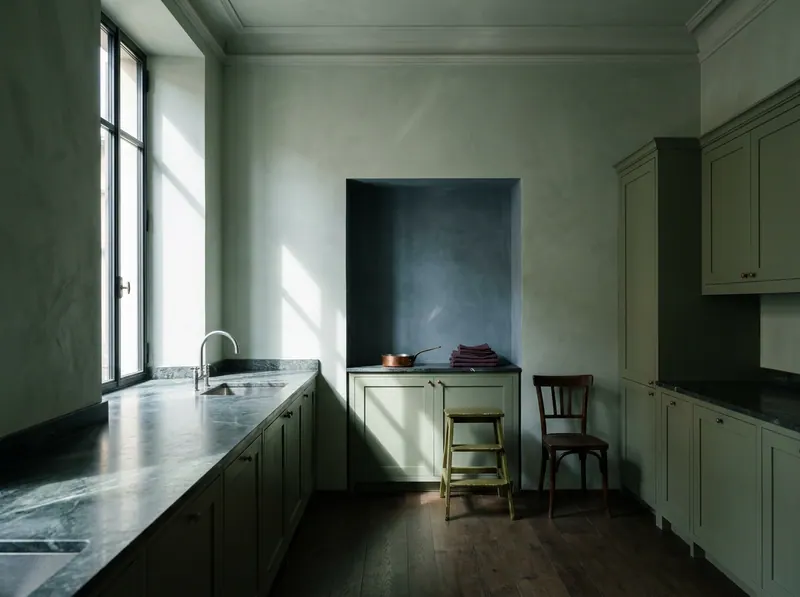
Wall finishes, joinery lacquers, and applied surface treatments represent a significant and consistently overlooked source of volatile plastic compounds. BHLI specifies natural limewash and clay plasters, zero-VOC mineral paints, water-based hardwax oil floor finishes, and solvent-free joinery lacquers exclusively. Adhesives, subfloor preparations, and acoustic underlays are specified to LEED and WELL Building Standard criteria, eliminating formaldehyde-bearing resins and solvent-based bonding agents entirely.
Blood Filtration: The Clinical Complement
Environmental elimination addresses ongoing exposure. For individuals with existing microplastic accumulation — which is, to be precise, every human alive today — the clinical partnership between Beverly Hills Luxury Interiors, Dr. Thom Lobe MD, and Dr. Fouad I. Ghaly MD offers a complementary protocol: targeted blood filtration through EBOO (Extracorporeal Blood Oxygenation and Ozonation) and Pharisas advanced blood purification. These physician-administered therapies are available through referral from our clinical partners, and are designed to be performed within a home environment specified to prevent re-exposure. The combination of architectural intervention and clinical protocol represents the most comprehensive microplastic reduction programme currently available to private individuals.
The home that has been designed to eliminate microplastic exposure and the bloodstream that has been therapeutically purified of accumulated particulate are not separate concerns. They are two halves of a single protocol — one architectural, one clinical, both essential.
Commission Your Longevity Home Wellness Design Audit
The first step is understanding the current microplastic profile of your environment. Beverly Hills Luxury Interiors offers a comprehensive Longevity Home Wellness Design Audit — a physician-informed assessment of your home’s primary exposure vectors across textile chemistry, air quality, water purity, and surface specification — delivering a prioritised, phased protocol for elimination, designed around your existing commission and lifestyle.
Enquire
Commission Your Longevity Home Wellness Design Audit
A physician-informed assessment of your residence’s microplastic exposure vectors — textiles, air, water, surfaces — delivering a prioritised remediation protocol aligned with the BHLI material purity standard.
Sources & References
- Leslie HA et al. (2022). Discovery and quantification of plastic particle pollution in human blood. Environment International, 163, 107199.
- Ragusa A et al. (2021). Plasticenta: First evidence of microplastics in human placenta. Environment International, 146, 106274.
- Marfella R et al. (2024). Microplastics and Nanoplastics in Atheromas and Cardiovascular Events. New England Journal of Medicine, 390, 900–910.
- European Environment Agency (2023). Microplastics from Textiles: Towards a Policy Framework.
- Environmental Working Group (2025). PFAS Contamination in US Drinking Water Systems.
- World Health Organization (2019). Microplastics in Drinking-Water. WHO Press, Geneva.
- Dr. Thom Lobe MD, Pediatric Surgical Associates — Clinical partner, Beverly Hills Luxury Interiors & ÖND | Life's Breath™.
- Dr. Fouad I. Ghaly MD, The Ghaly Institute for Integrative Medicine — Clinical partner, Beverly Hills Luxury Interiors & ÖND | Life's Breath™.
Every ÖND residence begins with a private conversation.