Microplastics Are in Your Blood. Your Home Is to Blame.
By Kenneth Bordewick | Beverly Hills Luxury Interiors | ÖND | Life's Breath™ · In clinical collaboration with Dr. Thom Lobe MD and Dr. Fouad I. Ghaly MD
In 2024, scientists at the University of New Mexico published a finding that should have stopped the world: microplastics were present in 100 per cent of human testicular tissue tested. Not most. Every single one. The previous year, researchers identified plastic particles in human blood, lung tissue, and — most disturbingly — the beating hearts of cardiac surgery patients. We are not merely consuming plastic. We are becoming it.
The question that no one is asking loudly enough is this: where is the primary source of exposure? The answer, for most people living in the developed world, is not the ocean. It is not even the food supply. It is the home.
The Home as the Primary Exposure Environment
The average person spends between 85 and 90 per cent of their life indoors. Of that time, the majority occurs within the home — sleeping, resting, breathing the same recirculated air, walking on the same synthetic carpets, resting against the same petroleum-derived upholstery. Every breath draws in microscopic fibres shed from nylon rugs, polyester curtains, vinyl flooring, and painted walls outgassing compounds that degrade into particulate matter smaller than a human cell.
The World Health Organisation's 2016 Indoor Air Quality report identified over 900 volatile organic compounds commonly present in residential interiors — many of them carcinogenic, all of them invisible to the naked eye. Synthetic materials, flame retardants, adhesives, and standard architectural finishes are not inert. They release. Continuously. Into the air you breathe and the water you drink.
This is not a distant risk. It is ambient, persistent, and cumulative.
What Quiet Luxury Knows That Modern Interiors Have Forgotten
At Beverly Hills Luxury Interiors, we have long understood that materials are not merely aesthetic choices. They are biological decisions. Kenneth Bordewick's Quiet Luxury Framework — developed over 25 years of designing for royal families, celebrity estates, and private residences across four continents — begins not with colour palettes or furniture selections, but with material purity.
The principle is deceptively simple: what enters your home, enters your body.
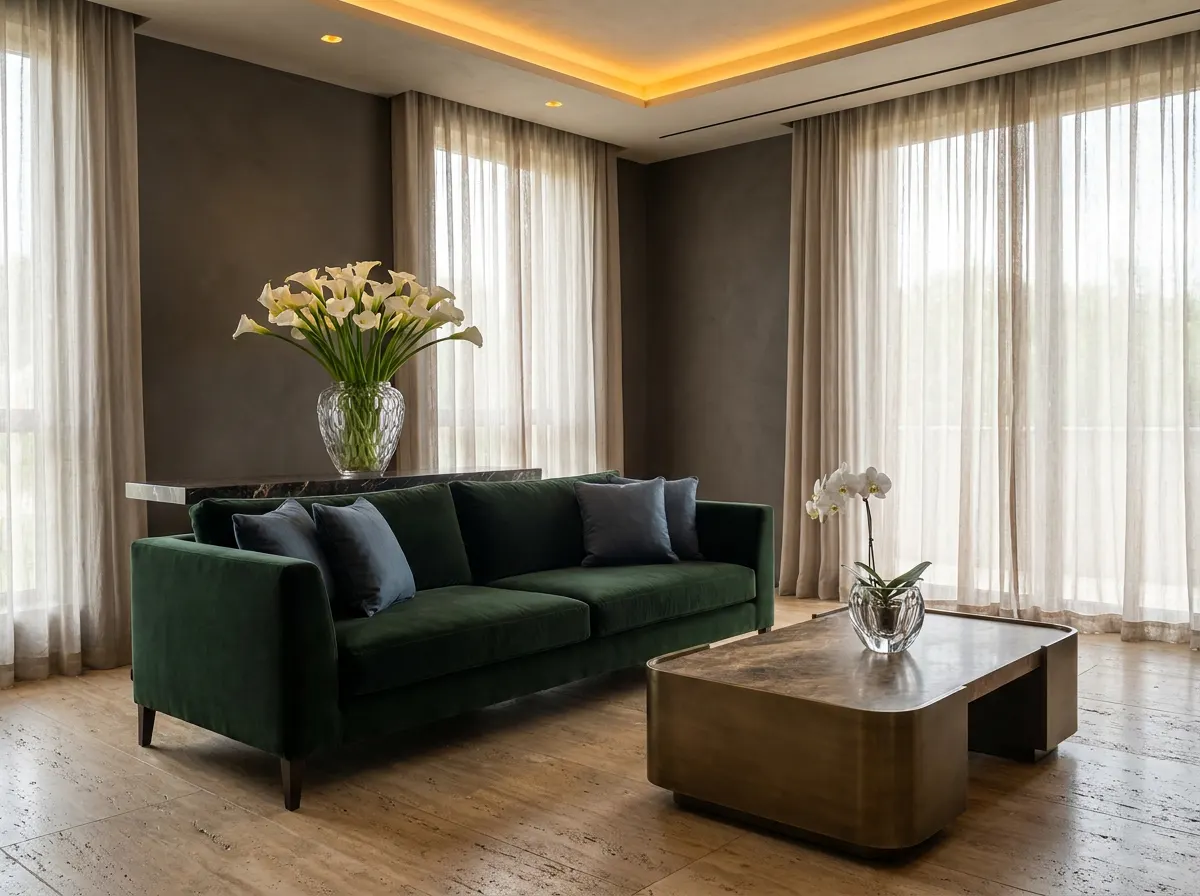
Natural stone floors do not off-gas. Lime and gypsum plasters do not shed fibres. Solid hardwoods do not leach VOCs. Untreated linen, wool, and silk do not fragment into synthetic microparticles. The most beautiful materials in the history of architecture are, by design, the safest. Quiet Luxury is not merely an aesthetic philosophy — it is a physiological one.
When we specify a hand-applied Venetian plaster wall finish over vinyl wallcovering, or a hand-knotted wool rug over synthetic broadloom, the aesthetic gain is evident. The biological gain is equally significant, though rarely discussed: the elimination of a continuous microplastic and VOC exposure source that would otherwise persist for the life of the installation.
Explore our Quiet Luxury Wellness Design principles in full.
The Seven Pathways of Microplastic Exposure in the Home
Our physician partners — Dr. Thom E. Lobe MD and Dr. Fouad I. Ghaly MD — have identified seven primary vectors of microplastic exposure within the residential environment:
Air — synthetic textiles, carpets, and painted surfaces shed particles continuously into indoor air. Standard forced-air heating and cooling systems redistribute these particles throughout every room of the residence.
Water — standard municipal plumbing contains measurable microplastic contamination at the point of delivery. Unfiltered tap water consumed daily becomes a cumulative exposure source over decades of residence.
Surfaces — synthetic flooring and upholstered furniture release particles under the mechanical pressure of foot traffic and daily use, accelerating fragmentation over time.
Thermal transfer — heating systems circulate particulate matter throughout all rooms; underfloor heating beneath synthetic carpet dramatically increases fibre release rates.
Kitchen materials — plastic food storage containers, non-stick coatings, and synthetic countertop materials introduce particles directly into the food supply through heat transfer and mechanical abrasion.
Laundry — a single synthetic wash cycle releases hundreds of thousands of plastic fibres; without dedicated filtration, these enter the home's water system and ambient air.
New furnishings — synthetic furnishings off-gas most aggressively in the first two years of installation, releasing compounds that accumulate in household dust and are absorbed through respiration and dermal contact.
“A room designed with material integrity is not merely beautiful. It is, by every available measure, the healthiest room its occupant will ever inhabit.”
— Kenneth Bordewick, Beverly Hills Luxury Interiors
A Whole-Home Protocol
At Beverly Hills Luxury Interiors and ÖND | Life's Breath™, we have developed the Microplastic Elimination Protocol — a systematic design methodology that addresses all seven exposure pathways simultaneously. No single intervention eliminates all seven; a comprehensive response requires a whole-home approach.
The protocol begins with a rigorous materials audit: every proposed specification is evaluated against its biological profile, not merely its aesthetic one. This is followed by the integration of H14-grade HEPA air purification — the clinical standard, not the consumer grade — combined with UV-C sterilisation and precision humidity control that prevents mould and bacterial proliferation in the absence of synthetic biocides.
Whole-home water filtration is specified at the point of entry, eliminating plastic particles before they reach any tap in the residence. Beneath the surface, copper, glass, and 316-grade stainless steel replace plastic plumbing components wherever possible. Natural fibre textiles — wool, silk, linen, hemp — replace every synthetic fabric in the design programme. Where clients require the warmth and comfort of carpet, hand-knotted natural fibre rugs are selected over synthetic alternatives without exception.
The protocol does not compromise aesthetic ambition. It elevates it. The most refined materials are, invariably, the most biologically responsible ones. Discover the full framework at our Wellness Design Principles page.
The Luxury of Biological Safety
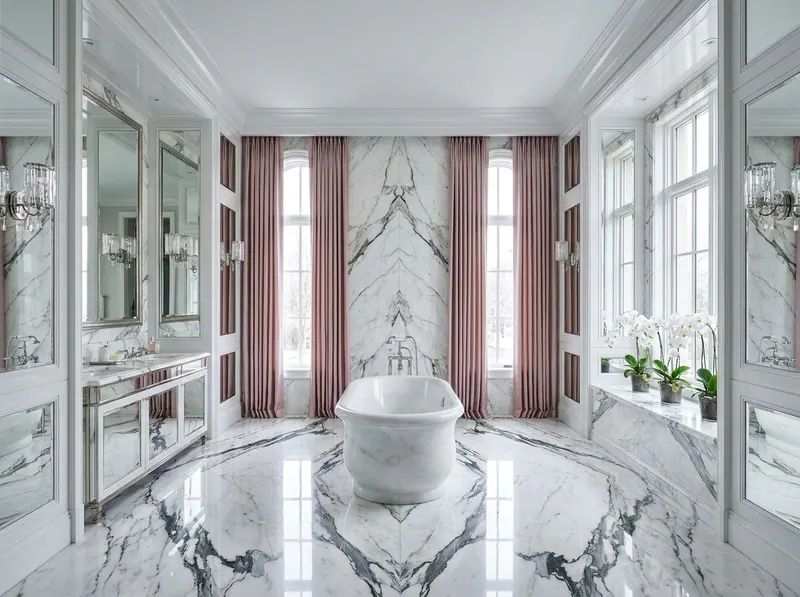
The irony is profound. The materials most associated with premium interiors in the classical tradition — natural stone, solid hardwood, plaster, linen, wool, crystal — are precisely the materials that modern science validates as biologically superior. The synthetic shortcuts introduced in the name of cost efficiency and convenience have extracted a cost of a different kind: one paid in cellular inflammation, hormonal disruption, and the slow accumulation of particles in tissue that the human body has never evolved to process.
Microplastics have now been identified in human placentas, in foetal lung tissue, in the brains of deceased individuals, and in every arterial wall sample examined in recent post-mortem studies. The exposure begins before birth. It compounds over a lifetime. And for the majority of that lifetime, the primary site of exposure is the place the individual believes to be their sanctuary.
This is the standard we hold at Beverly Hills Luxury Interiors. Material purity is not a premium. It is the baseline. And it is long past due.
Commission Your Longevity Home Wellness Design Audit
The Longevity Home Wellness Design Audit — offered by Beverly Hills Luxury Interiors and ÖND | Life's Breath™ in clinical collaboration with Dr. Thom Lobe MD and Dr. Fouad I. Ghaly MD — is a comprehensive, room-by-room assessment of your home's biological environment: material toxicology, air and water purity, acoustic conditions, circadian light architecture, electromagnetic exposure, and thermal management. It delivers a prioritised remediation roadmap — the first step towards a home that does not merely shelter, but actively protects and extends your health, clarity, and vitality.
Enquire About Your AuditSources: Ragusa A. et al. “Plasticenta: First evidence of microplastics in human placenta.” Environment International, 2021. | Leslie H.A. et al. “Discovery and quantification of plastic particle pollution in human blood.” Environment International, 2022. | Marfella R. et al. “Microplastics and nanoplastics in atheromas and cardiovascular events.” New England Journal of Medicine, 2024. | World Health Organisation: Indoor Air Quality Guidelines — Selected Pollutants (2016). | Jenner L.C. et al. “Detection of microplastics in human lung tissue.” Science of the Total Environment, 2022. | Reference: Dr. Thom E. Lobe MD, Beneveda Medical Group. | Reference: Dr. Fouad I. Ghaly MD. | Beverly Hills Luxury Interiors | ÖND | Life's Breath™


Every ÖND residence begins with a private conversation.