Infrared Sauna and Grounding: The Evidence Review
By Kenneth Bordewick | Beverly Hills Luxury Interiors | ÖND | Life's Breath™ · In clinical collaboration with Dr. Thom E. Lobe MD and Dr. Fouad I. Ghaly MD
The extreme era of biohacking is ending, and the search data says so plainly. Interest in cold plunge has fallen by twenty-six per cent. Ice baths, by thirty-five. Cryotherapy, by twenty-three. The Wim Hof method, by twenty-seven. Grounding sheets — long the most heavily marketed object in the wellness category — have declined by thirty-one per cent.
Heat has not followed them down. Interest in sauna remains one of the largest sustained enquiries in the wellness vocabulary, and infrared sauna in particular continues to attract tens of thousands of considered searches each month. This asymmetry is not a fashion. It is a correction. The protocols that endure are those with a clinical literature behind them; the protocols that fade are those that were never more than spectacle.
What follows is an honest review — of what the evidence genuinely supports, of where it is thin, and of the far more consequential question that almost no one asks: whether a sauna procured as a piece of equipment can ever deliver what a thermal suite conceived as architecture will.
What the Sauna Evidence Actually Shows
The most substantial body of work on habitual sauna bathing has emerged from the University of Eastern Finland, whose long-running population cohort research followed middle-aged Finnish men across decades and examined the relationship between frequency of sauna use and cardiovascular and all-cause outcomes. The consistent finding of this programme is that frequency and duration matter — that those who bathed most often fared measurably better than those who bathed rarely, and that the association held after adjustment for conventional risk factors.
Two caveats must be stated with precision, because they are almost always omitted. First, this is observational cohort research: it establishes a robust association, not a proven causal mechanism. Second, the tradition studied was Finnish dry sauna — high air temperature, low humidity, brief bursts of steam — not far-infrared cabinetry.
Infrared operates on a different principle altogether. Rather than heating the air to eighty or ninety degrees, it radiates directly onto the skin, producing a comparable physiological load at a far lower ambient temperature. For those who cannot tolerate traditional heat, this is a genuine advantage, and the cardiovascular and thermoregulatory literature on passive heat exposure is broadly supportive. But the multi-decade population evidence belongs to dry sauna. Anyone who tells you the Finnish findings transfer wholesale to an infrared cabinet is overstating the case.
“A sauna bought as an appliance is a cabinet. A thermal suite designed as architecture is a system. The difference is not the heat source — it is the ventilation, the cool-down, the drainage, the timber, and the sequence of rooms that surrounds it.”
— Kenneth Bordewick, Beverly Hills Luxury Interiors
Where the Grounding Evidence Is Genuinely Thin
We must be equally candid about earthing. The proposition — that direct conductive contact with the earth's surface potential confers measurable physiological benefit — is not absurd on its face. But the published literature supporting it is small in volume, frequently conducted with modest sample sizes, and rarely replicated by independent groups. Much of it originates from a narrow circle of investigators.
Grounding sheets, in particular, are sold with a confidence that the evidence does not warrant. We do not specify them as a clinical intervention, and we do not permit them to be represented as one. The thirty-one per cent decline in public interest is, in our view, the market arriving at the correct conclusion ahead of the marketing.
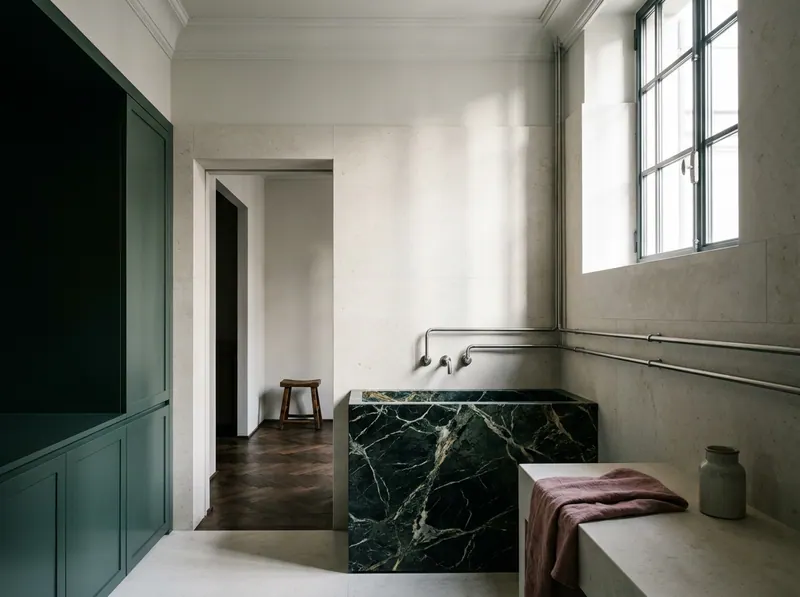
What we do specify — because it costs nothing and asks nothing of the evidence — is genuine barefoot contact with genuine natural material. Honed limestone. Solid timber. Unsealed lime plaster. A stone terrace that reaches the earth without a membrane between. This is not a protocol; it is proportion, temperature and texture, and it belongs to the discipline of the seven pillars rather than to the vocabulary of the supplement aisle.
The Thermal Suite as Architecture
Ventilation Before Aesthetics
The single most frequent failure we encounter in existing residences is not an inferior heater. It is the absence of designed air movement. A cabin without a properly calculated low-level supply and high-level extract accumulates moisture in its fabric, concentrates whatever the timber and adhesives release under thermal load, and — over years — degrades toward the very indoor environment the client sought to escape. The Harvard T.H. Chan School of Public Health Healthy Buildings programme has argued for two decades that ventilation is the foundational determinant of indoor environmental quality. Nowhere is that more true than in a room deliberately driven to ninety degrees.
Timber Selection and Off-Gassing Under Load
Heat is a solvent for volatile compounds. A timber, adhesive or finish that is inert at twenty degrees may not be inert at ninety. We therefore specify solid, thermally treated, resin-stable species — never engineered panel, never a formaldehyde-bonded substrate, never a varnish or lacquer of any kind within the cabin envelope. Benches are mechanically fixed, not glued. Every fastener is concealed below the seating plane so that no metal reaches skin at temperature. The US EPA guidance on volatile organic compounds and indoor air is unambiguous that temperature accelerates emission; a sauna is the most demanding test a specification will ever face.
Temperature, Duration and the Cool-Down
The cohort literature associates benefit with regularity and with sessions of meaningful duration rather than with extremity. This is why we design against the impulse toward heroics. A dry cabin held in a considered range; an infrared cabin at a lower ambient with a longer dwell; and — critically — a designed cool-down and rest sequence, which is the element almost universally omitted.
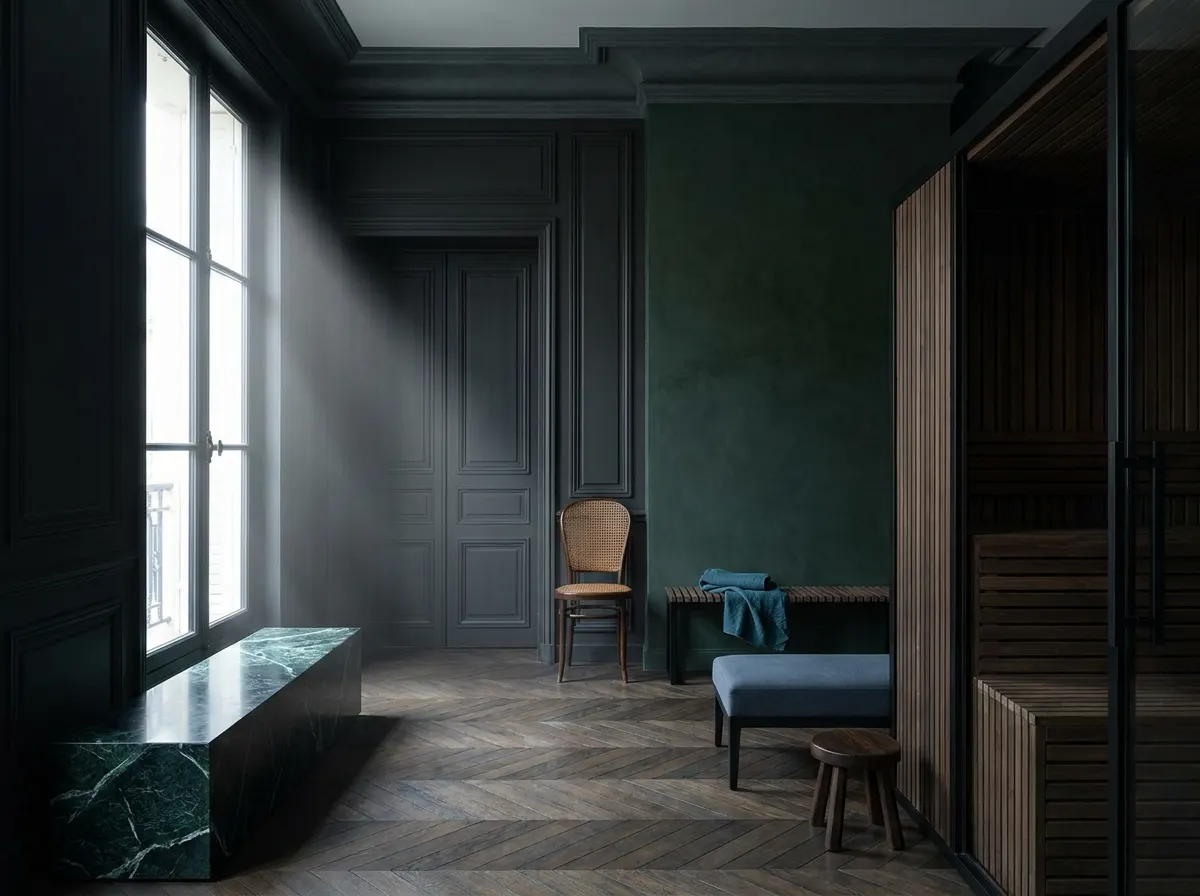
The rest phase is where the parasympathetic recovery occurs, and it requires its own room: a cool, dim, acoustically quiet space with a horizontal surface, a natural-fibre covering, and no screen and no glare. A sauna installed in a garden without a rest room attached is half a protocol. Drainage, likewise, is a longevity question rather than a plumbing one — a linear channel, a properly falling honed stone floor, and no cavity where standing water and biological growth can establish themselves out of sight.
“Extremity is the amateur's instinct. Regularity is the physician's. We are not designing for the coldest plunge or the hottest hour — we are designing a room a client will return to four times a week for thirty years.”
— Kenneth Bordewick
The Clinical Partnership
Every residential commission undertaken by Beverly Hills Luxury Interiors — not only the ÖND-branded work — carries the counsel of Dr. Thom E. Lobe MD and Dr. Fouad I. Ghaly MD, clinical partners to both the atelier and to ÖND | Life's Breath™. Thermal protocols carry genuine contraindications — cardiovascular, obstetric, pharmacological — and no bespoke thermal suite we design is commissioned without a clinical conversation preceding it. Our physician partners exist precisely so that this conversation is never an afterthought.
Questions We Are Asked
What are the benefits of an infrared sauna?
Infrared sauna delivers passive heat exposure — elevated core temperature, increased heart rate and peripheral circulation, and a marked parasympathetic recovery response afterwards — at a far lower ambient air temperature than traditional dry sauna, which makes it tolerable for people who cannot manage conventional heat. The strongest long-term population evidence, from the University of Eastern Finland cohort research, concerns habitual Finnish dry sauna rather than infrared specifically, and that distinction should be stated honestly.
Is infrared sauna better than a traditional sauna?
Neither is superior in the abstract. Traditional dry sauna carries the deeper multi-decade evidence base; infrared achieves a comparable physiological load at a lower ambient temperature and is therefore more accessible. In a properly designed thermal suite we frequently specify both, because the choice belongs to the person and to their physician.
Do grounding sheets actually work?
The published evidence for grounding sheets is limited in volume, modest in sample size and rarely independently replicated. We do not specify them as a clinical intervention. Genuine barefoot contact with natural stone and solid timber costs nothing, asks nothing of the evidence, and is a permanent architectural quality rather than a purchased accessory.
How often should you use a sauna?
The cohort literature associates benefit with frequency and consistency rather than with extremity — several sessions each week, of meaningful duration, sustained over years. Frequency and duration should be set with a qualified physician, particularly where cardiovascular, obstetric or pharmacological considerations apply.
Begin With a Longevity Home Wellness Design Audit
A thermal suite is not procured. It is conceived — as a sequence of rooms, an air strategy, a material specification and a clinical protocol, realised together. The process begins with the Longevity Home Wellness Design Audit, a comprehensive assessment of your existing or proposed environment across air, light, water, material, acoustic, thermal and electromagnetic dimensions. The full methodology is set out in our white paper.
Sources: University of Eastern Finland sauna cohort research programme; Harvard T.H. Chan School of Public Health Healthy Buildings programme; US Environmental Protection Agency guidance on volatile organic compounds and indoor air quality; clinical counsel of Dr. Thom E. Lobe MD and Dr. Fouad I. Ghaly MD.
Beverly Hills Luxury Interiors does not administer medical treatments. All clinical protocols and longevity interventions should be discussed with a qualified physician — including Dr. Thom E. Lobe MD and Dr. Fouad I. Ghaly MD — before undertaking. All information in this article is educational in nature.
Every ÖND residence begins with a private conversation.