How to Measure a Wellness Home: The Numbers That Matter
By Kenneth Bordewick · 6 min read
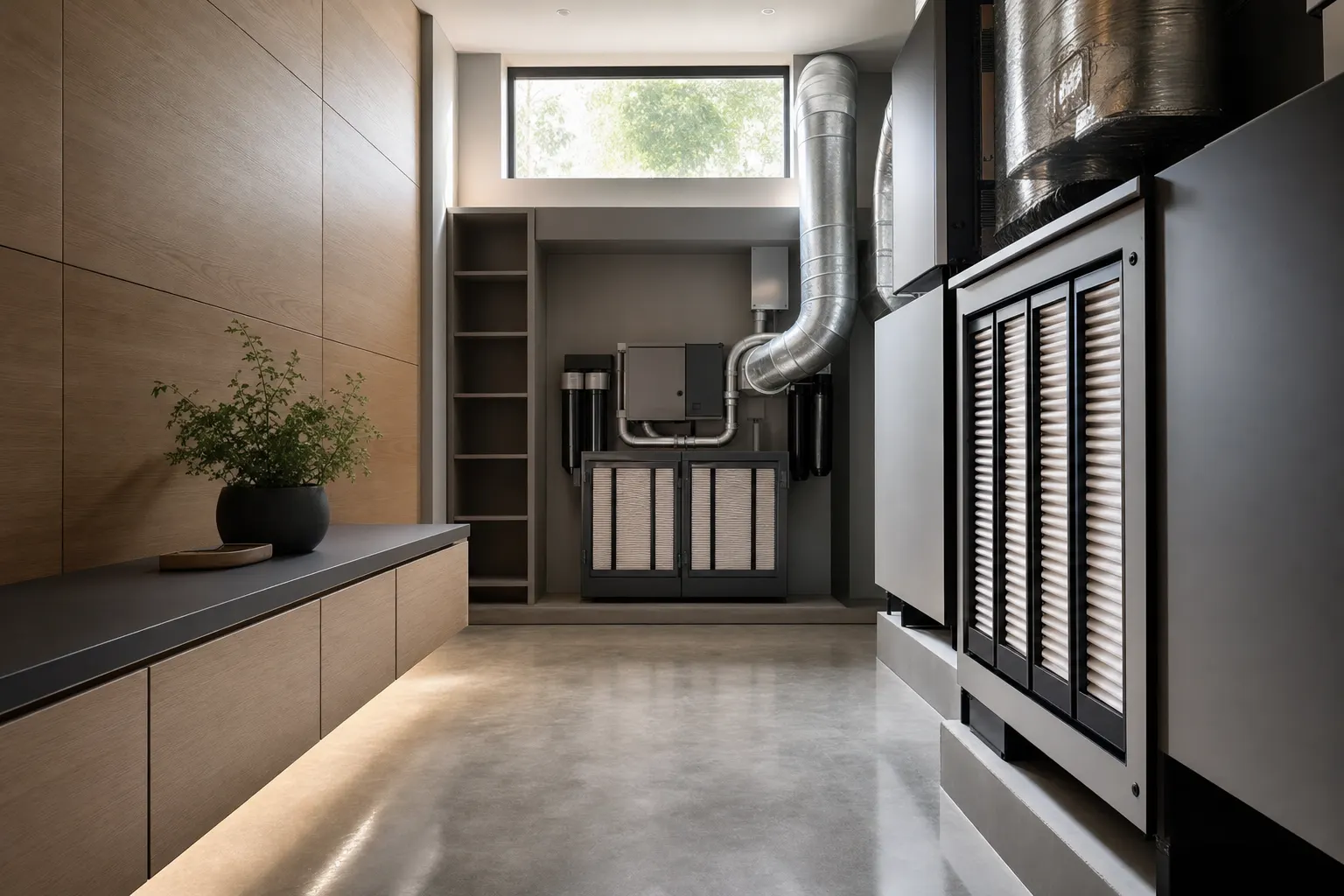
If a wellness home cannot be measured, it cannot be proven. The good news is that the measures that matter most are few, well understood and inexpensive to monitor.
Clients sometimes ask me how they will know that the investment has worked. It is the right question. A healthy house is not a style; it is a set of conditions, and conditions can be measured. These are the ones I ask ÖND clients to watch, and the reasoning behind each.
Carbon dioxide: the simplest test of fresh air
Carbon dioxide is not the pollutant that harms us at indoor levels, but it is an excellent indicator of whether a room is receiving enough fresh air. In a closed bedroom with two people, it can rise steeply overnight. Many building scientists use roughly 800 to 1,000 parts per million as a practical upper target for occupied rooms. If a bedroom regularly exceeds that by morning, the ventilation is not keeping up.
Fine particles: what the filters are for
Fine particulate matter, known as PM2.5, comes from traffic, cooking, candles, wildfire smoke and outdoor air. The World Health Organization's 2021 guideline for long-term exposure is an annual average of 5 micrograms per cubic metre. Indoors, good filtration and source control should keep levels low and stable, with brief, explainable spikes when someone cooks.
Volatile organic compounds: the smell of new things
VOCs are released by paints, lacquers, adhesives, cleaning products, fragrances and new furniture. A total VOC sensor gives a useful trend, though not a precise chemical breakdown. Where a house has been newly finished, I recommend laboratory testing for formaldehyde and other key compounds before occupation.
Humidity: the quiet regulator
Relative humidity between roughly 40 and 60 per cent is widely recommended for comfort, for the health of the respiratory tract and for limiting mould and dust mites. In the desert it is often too low; in coastal and tropical homes, too high. Fine timber, art and instruments benefit from the same stability.
Light: brightness by day, darkness by night
Light should be measured twice: in the morning, for enough bright, daylight-rich light where the family actually sits; and at night, for how dark the bedroom really is. The WELL Building Standard sets daytime targets using melanopic measures, which describe light's effect on the body clock rather than its visual brightness. At night, the target is simple: as close to darkness as the room allows.
Sound: the measure of rest
The World Health Organization has long recommended quiet bedrooms, with guideline levels for continuous background noise of around 30 decibels. Mechanical systems, traffic and neighbours are the usual culprits, and acoustic design should treat all three.
Water: test before you filter
Water should be tested by an accredited laboratory for lead, chlorine and its by-products, PFAS, hardness and any local concerns. In the United States, the EPA sets enforceable limits, but for lead the sensible ambition in a family home is as close to zero as testing can detect.
What a monitored home looks like
- Permanent air sensors in the bedrooms and main living spaces, recording CO2, PM2.5, VOCs, temperature and humidity.
- A light survey at handover, repeated after any change to the lighting design.
- An acoustic survey of every bedroom at night.
- Laboratory water testing at the outset and annually thereafter.
- A simple annual review of the data with the design team.
Every ÖND commission begins with a private conversation. Call (310) 274-9999, write to kenneth@bhli.us, or read the Nine Pillars of Wellness Design to see the full framework.
Frequently Asked Questions
Common Questions
What should I measure in a wellness home?
What is a good CO2 level for a bedroom?
What humidity is best for a healthy home?
Does ÖND measure homes before and after design?
Every ÖND residence begins with a private conversation.