The Sensory Symphony: When Five Senses Become One
By Kenneth Bordewick, Beverly Hills Luxury Interiors · In clinical collaboration with Dr. Thom Lobe MD and Dr. Fouad I. Ghaly MD
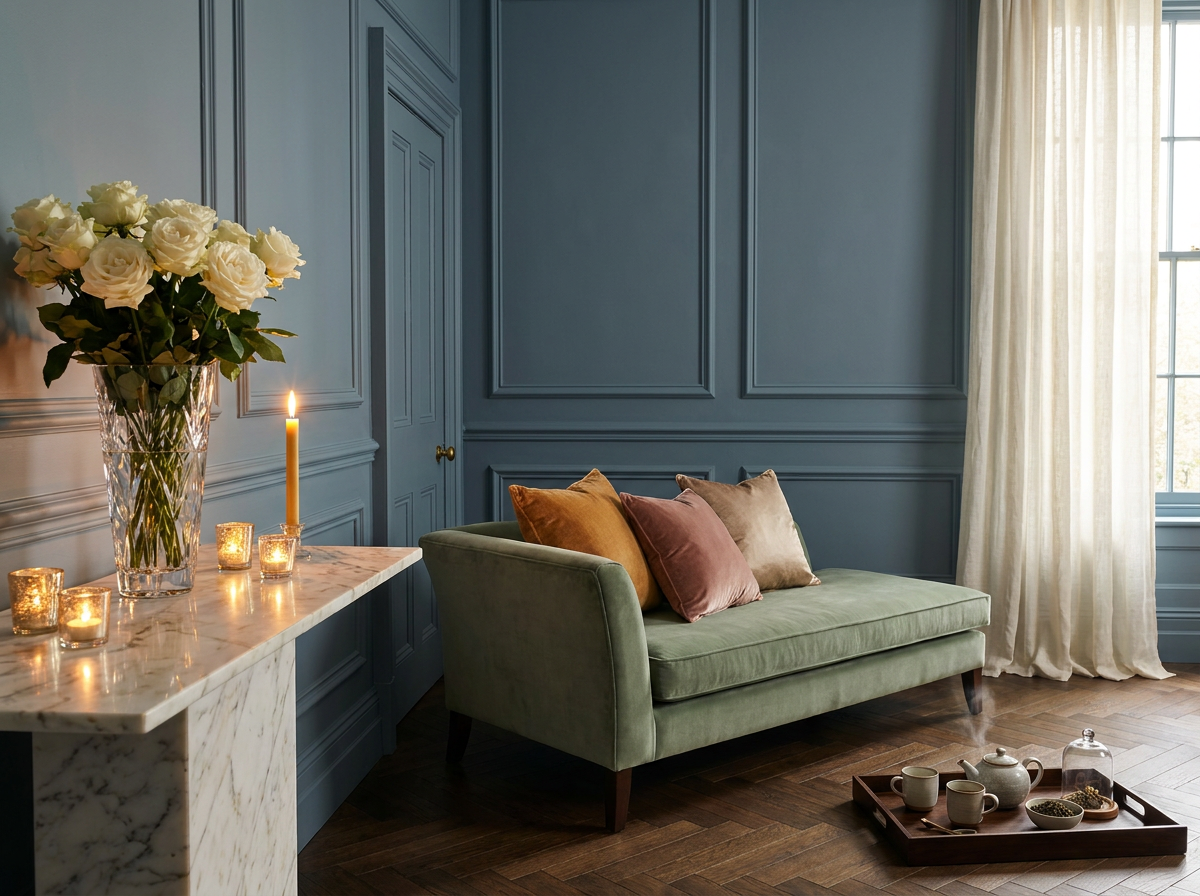
A landmark study published in Multisensory Research established what neuroscientists now term the “superadditive effect”: when two aligned sensory stimuli are presented simultaneously, the neural response is not additive but multiplicative. The same mechanism governs every room you inhabit. When all five senses are designed in concert, their combined biological effect does not simply sum. It compounds — exponentially.
The article of faith upon which the conventional luxury interior rests is this: beauty is visible. The finest rooms are photographed, admired, and assessed above all by the eye. And yet the eye — that magnificent instrument — accounts for only one-fifth of the sensory intelligence the human nervous system applies to its environment in every waking moment.
Hear the sound of stillness — and discover how your home is failing it. Feel the texture of true rest — and understand why your materials are working against recovery. Inhale the air of an environment genuinely designed for restoration — and appreciate what most designers have never considered. Taste the mineral clarity of water that has been designed, not merely plumbed. See — at last — the full visual coherence that Quiet Luxury has always promised, and few interiors have ever actually delivered.
At Beverly Hills Luxury Interiors, principal designer Kenneth Bordewick and the firm's physician collaborators — Dr. Thom Lobe MD and Dr. Fouad I. Ghaly MD — have spent years mapping the precise point at which aesthetic excellence and biological performance converge. That point, they have found, lies where the Five Senses are not merely addressed in isolation, but orchestrated as a unified composition. The result is what Beverly Hills Luxury Interiors calls the Sensory Symphony.
The Science of Sensory Integration
The neuroscience of multisensory integration — the study of how the brain combines information from distinct sensory channels — has undergone a fundamental revision in the past two decades. Seminal research consolidated in The Handbook of Multisensory Processes (Calvert, Spence & Stein, MIT Press, 2004) established that the brain does not process sensory information in isolated streams. It integrates those streams continuously, and rewards their coherence.
When a sensory environment is aligned — when what is seen corresponds with what is heard, what is touched, what is inhaled — the brain reduces its cognitive load accordingly. Cortisol decreases. Heart rate variability improves. The default mode network — the brain's resting state, associated with creativity, emotional processing, and memory consolidation — activates with a fullness impossible in a sensorially incoherent environment.
When a sensory environment is dissonant — when the visual grandeur of a great room is undercut by acoustic harshness, synthetic fragrance, and the micro-static charge of synthetic textiles — the brain must perpetually reconcile the conflict. That reconciliation is not experienced as conscious discomfort. It manifests as a diffuse, persistent fatigue: a form of exhaustion the occupant attributes to their pace of life, when its true origin is the space they came home to rest in.
“There is a quality of exhaustion unique to the opulent home that has never addressed the senses beyond sight. The client cannot name it. They attribute it to the demands of their life. In the majority of cases, the culprit is the space to which they return.”
— Kenneth Bordewick, Beverly Hills Luxury Interiors
Sight — The Architecture of Visual Coherence
Visual coherence is the foundational principle of the Quiet Luxury Wellness Design framework. Research from Princeton Neuroscience Institute, published in 2011, demonstrated that visual clutter — even subtle, even within a beautifully appointed room — depletes working memory and sustains measurably elevated cortisol throughout the day. The eye taxes the brain in direct proportion to the informational load it is asked to process.
The visual coherence standard at Beverly Hills Luxury Interiors is achieved through compositional restraint, rigorous curation, and the alignment of every visible element — from architectural proportion to material finish to furniture silhouette — within a single unified register. Nothing competes for the eye's attention unnecessarily. Every object earns its position on biological grounds before it earns it on aesthetic ones. The result is a quality of visual silence that the brain receives as permission to deactivate its default vigilance state.
Sound — The Acoustic Foundation
The acoustic design of a home operates, in the majority of cases, entirely below conscious awareness. Traffic vibration, mechanical HVAC resonance, reflected sound from hard architectural surfaces — these do not register as noise. They register as background stress: a chronic, low-grade cortisol signal that persists through rest, through meals, and through the eight hours the body requires for cellular repair. A 2018 study published in The Lancet confirmed that long-term exposure to ambient noise levels as low as 45 decibels increases cardiovascular mortality risk by seven per cent.
Acoustic design at Beverly Hills Luxury Interiors deploys sound-attenuating materials within the architecture itself — natural cork underfloor substrates, compressed wool within wall assemblies, acoustic lime plaster systems — rather than layering remediation over an existing hard structural shell. Water features, calibrated to specific low-frequency ranges, introduce a binaural acoustic environment that measurably activates parasympathetic nervous system tone. The quality of stillness they produce is not the absence of sound. It is the presence of auditory coherence.
Scent — The Most Ancient and Underestimated Sense
Olfaction is the only sense that connects directly to the limbic system — the brain's emotional and memory centre — without first passing through the thalamus. What you inhale reaches the amygdala and hippocampus faster than it reaches conscious awareness. This directness makes scent the most biologically potent of the five senses, and the most consequential to design for incorrectly.
The average luxury interior contains between thirty and fifty synthetic fragrance compounds: diffuser oils, fresh-paint volatiles, synthetic textile fibres releasing plasticiser compounds, engineered wood finishes off-gassing formaldehyde and acetaldehyde for years after installation. Research published in Environmental Health Perspectives identifies many of these compounds — toluene, limonene oxidation products, formaldehyde — as direct limbic irritants, capable of elevating amygdala reactivity and impairing hippocampal function through repeated low-level exposure.
The olfactory standard at Beverly Hills Luxury Interiors eliminates every synthetic fragrance compound from the material palette entirely. In their place: beeswax candles, natural wood resins, dried botanical arrangements, and organic essential oil diffusion calibrated not merely for pleasantness but for documented physiological benefit — lavender for parasympathetic tone, cedarwood for cognitive clarity, eucalyptus for respiratory mucosal support. The Wellness Design Principles at Beverly Hills Luxury Interiors treat olfactory specification as a clinical consideration, reviewed in consultation with Dr. Thom Lobe MD and Dr. Fouad I. Ghaly MD.
Touch — The Haptic Language of the Home
Every surface you contact within a residence communicates directly with the nervous system's haptic cortex. Natural linen, silk, wool, and stone communicate in a register that synthetic alternatives cannot replicate: the latter carry a micro-static charge correlated in emerging research with disrupted bioelectrical signalling at the skin's surface. The former carry no static charge — their contact is neurologically silent, and that silence is physiologically restorative.
Beyond material composition, the provision of textural variety within a designed space has been documented to increase sensory satisfaction and reduce the restless, searching quality of the under-stimulated nervous system. A room composed entirely of hard reflective surfaces provides no haptic nourishment. A room that layers the grain of natural quarter-sawn oak, the give of hand-woven linen, the cool of limestone, and the warmth of fired clay communicates to the occupant's nervous system — below the threshold of conscious thought — that they are home, in the deepest biological sense that phrase can carry.
Taste — The Final and Most Neglected Dimension
Taste is the most consistently overlooked of the five senses in residential design — and, upon reflection, the most straightforwardly addressed. The quality of water delivered throughout a residence is as much a design decision as the quality of its light. Whole-home multi-stage water filtration — removing microplastics, chlorination by-products, pharmaceutical residues, and heavy-metal traces from every point of use — provides mineral clarity that reaches the body dozens of times each day.
The distinction between architecturally integrated filtration and point-of-use consumer devices is not cosmetic. A 2019 World Health Organisation review confirmed that the average person ingests five grams of microplastic per week through water alone. Standard reverse osmosis removes, at best, sixty per cent of that load. The sub-micron membrane systems specified in BHLI longevity residences — installed at point of entry and throughout the water delivery infrastructure in copper and glass — address the remaining fraction systematically, from the first morning glass to the last evening bath.
The Compound Effect: When Five Become One
What emerges when all five senses are designed together — in the manner described above, to the biological standard that Beverly Hills Luxury Interiors and ÖND | Life's Breath™ have codified — is not a more comfortable home. It is a categorically different biological environment.
The compound effect of aligned sensory design produces measurable reductions in chronic stress burden, improvements in sleep architecture, enhanced cognitive performance during waking hours, and a quality of daily restoration that no single isolated intervention — however well-executed — can replicate. The science of sensory ecology confirms it. The experience of clients who have lived within a completed BHLI Sensory Symphony confirms it without the need for citation.
The Sensory Symphony is not a metaphor. It is not a philosophy. It is a specification: precise, replicable, and entirely achievable within the architecture of the home you already own or intend to commission. It asks only that the design of the home begin where it has, for too long, neglected to: with the full intelligence of the human being who will live within it.
The Clinical Partnership
The Five Senses Framework at Beverly Hills Luxury Interiors is developed in ongoing clinical collaboration with Dr. Thom Lobe MD, one of the foremost integrative and longevity medicine physicians in the United States, and Dr. Fouad I. Ghaly MD, whose decades of integrative clinical practice inform every material and environmental specification. Their involvement ensures that the Sensory Symphony is not merely beautiful. It is defensible on biological grounds before it is defensible on any other.
Begin With a Longevity Home Wellness Design Audit
The question is not whether your home is engaging your five senses. Every home does. The question is whether the engagement is restorative or erosive — whether the cumulative sensory signal your environment transmits, hour after hour, day after decade, is building your biology or quietly diminishing it.
Beverly Hills Luxury Interiors offers the Longevity Home Wellness Design Audit: a comprehensive assessment of your residence across all five sensory dimensions — sight, sound, scent, touch, and taste — delivered with a physician-reviewed, prioritised design roadmap that transforms each sensory channel from a liability into a biological asset.
Conducted personally by Kenneth Bordewick and the BHLI team, in clinical consultation with Dr. Thom Lobe MD and Dr. Fouad I. Ghaly MD, the audit identifies every point at which your home may be working against your senses — and prescribes the precise design strategy to correct it.
The Sensory Symphony already exists within every great residence, waiting to be composed. Begin the conversation.
Sources: Calvert, G., Spence, C. & Stein, B.E. (eds.) (2004). The Handbook of Multisensory Processes. MIT Press. Princeton Neuroscience Institute (2011) — Visual cortex load and working memory under environmental clutter conditions. Münzel, T. et al. (2018). “Cardiovascular effects of environmental noise exposure.” The Lancet. Environmental Health Perspectives — Volatile Organic Compounds and olfactory neurotoxicology (multiple peer-reviewed studies). World Health Organisation — Indoor Air Quality Guidelines: Chemical Agents (2010); WHO report on microplastics in drinking water (2019). Clinical collaboration: Dr. Thom Lobe MD, Beneveda Medical Group; Dr. Fouad I. Ghaly MD, Integrative Medicine. Beverly Hills Luxury Interiors does not administer medical treatments. All clinical protocols should be discussed with a qualified physician before undertaking.