Five Senses: The Science of Spaces That Heal
By Kenneth Bordewick, Beverly Hills Luxury Interiors · In clinical collaboration with Dr. Thom Lobe MD and Dr. Fouad I. Ghaly MD
Your nervous system receives approximately eleven million bits of sensory information every second. Your conscious mind processes forty. The remaining ten million, nine hundred and ninety-nine thousand, nine hundred and sixty enter your body — and reshape your biology — entirely without your awareness.
This is not a philosophical observation. It is a neurological one. And it is the scientific foundation upon which Beverly Hills Luxury Interiors, under the direction of Kenneth Bordewick, has built its Five Senses Framework: the understanding that a home which honours all five senses simultaneously is not merely a beautiful residence — it is a continuous, invisible act of clinical intervention.
In collaboration with Dr. Thom Lobe MD and Dr. Fouad I. Ghaly MD, and through the integrated wellness philosophy of ÖND | Life's Breath™, BHLI has mapped the precise biological consequences of each sensory dimension of the domestic environment — and designed to each with the same rigour previously reserved for aesthetics alone.
Sight: The Visual Cortex and the Cost of Disorder
The visual cortex consumes nearly thirty per cent of the brain's total metabolic energy. In an environment of visual disorder — competing scales, unresolved colour relationships, arbitrary proportion — that expenditure rises without return. The brain labours. It does not rest. Research from the University of Exeter has confirmed that visually cluttered spaces increase cortisol by a statistically significant margin, impairing both executive function and emotional regulation throughout the day.
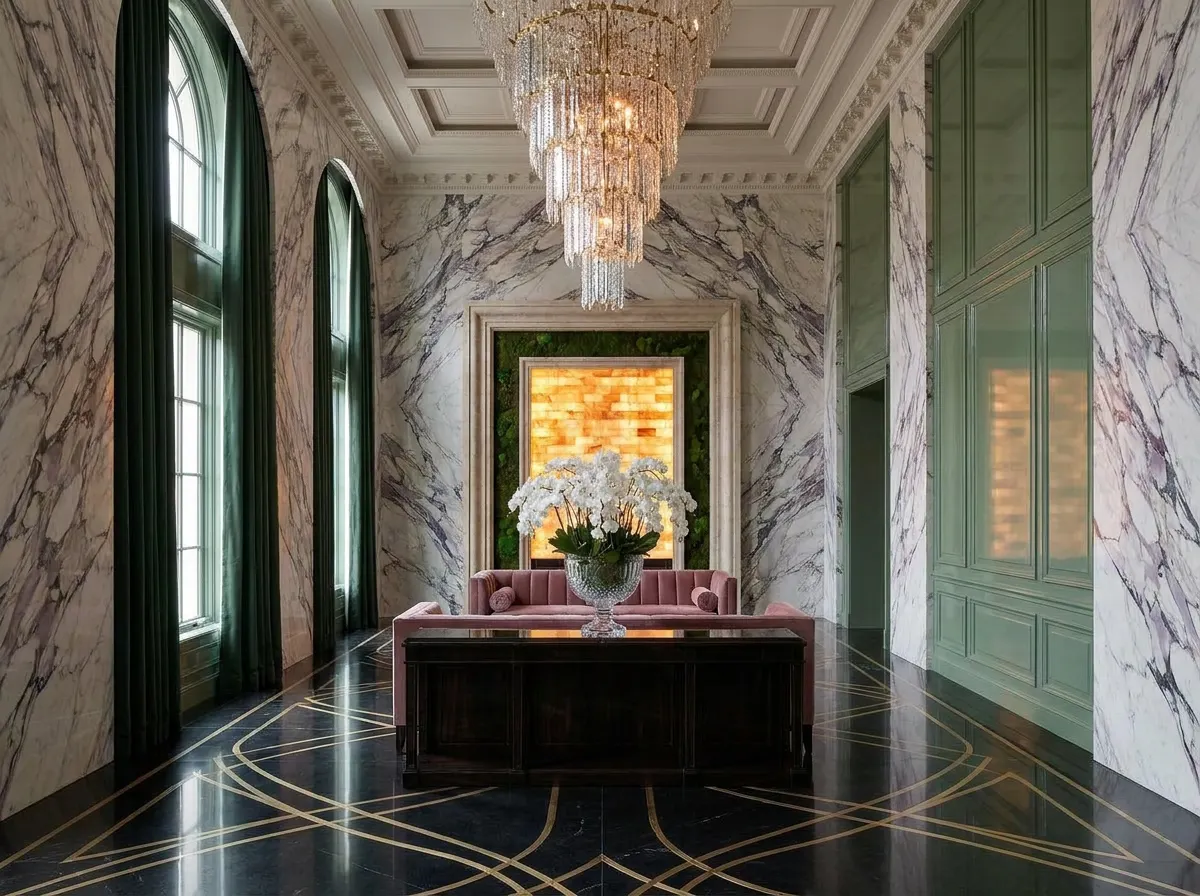
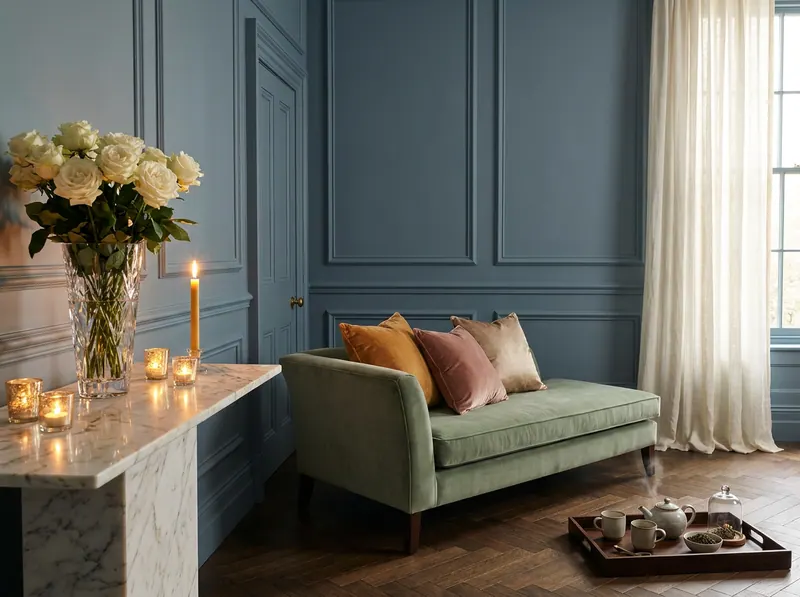
The BHLI approach to the visual environment begins with neurological precision. Muted jewel tones — sage green, slate blue, dusty rose, deep forest — are selected not merely for their beauty, but for their clinically demonstrated capacity to lower heart rate and induce the parasympathetic response. Formal symmetry, considered proportion, and the deliberate use of negative space create a visual language the nervous system recognises as safe. As the body exhales, the mind may follow. The Quiet Luxury design philosophy is, at its foundation, a neuro-aesthetic discipline.
Sound: Silence as Clinical Infrastructure
The World Health Organisation identifies environmental noise as the second largest environmental health risk in the Western world, responsible for the loss of over one million healthy life-years across Europe annually. Chronic ambient sound exposure at just forty-five decibels during sleep — the level present in most urban residences — elevates cortisol, fragments sleep architecture, and accelerates cardiovascular ageing. The home that feels luxurious but sounds loud is, by any biological measure, failing its inhabitant.
At BHLI, acoustic serenity is a structural discipline. Triple-glazed fenestration, mass-loaded structural isolation, and an interior palette of natural absorptive materials — wool, solid timber, clay plaster, silk — reduce reverberation and eliminate low-frequency intrusion. What remains is what Kenneth Bordewick describes as “living silence”: a quality of atmosphere in which the nervous system releases its chronically held vigilance, and the body may begin, at last, to repair.
Scent: The Olfactory-Immune Connection
Of all five senses, olfaction is the most biologically direct. The olfactory nerve is the only cranial nerve with an unmediated anatomical pathway to the limbic system, the amygdala, and the hippocampus — bypassing the thalamic relay that governs all other sensory input. Scent communicates instantaneously, involuntarily, and with profound physiological consequence. A 2019 study from UC Berkeley demonstrated that two-hour exposure to natural forest-derived phytoncides reduced immune cell decline by fifty-six per cent, with effects sustained for up to thirty days.
The BHLI olfactory specification eliminates synthetic fragrance entirely. Himalayan salt panels, living moss walls, botanical diffusion systems, and the careful selection of living botanicals — white orchids, fresh peonies, structured greenery — create an olfactory environment that actively supports immune modulation, cortisol regulation, and neurological restoration. Every material specified at BHLI is evaluated, in collaboration with Dr. Fouad I. Ghaly MD, for its off-gassing profile and its contribution to the air's biological quality. Explore our approach to wellness-integrated design.
Touch: The C-Tactile Nervous System
Materials as Medicine
The skin contains three million sensory receptors, including a specialised class of nerve fibre — C-tactile afferents — that respond specifically to gentle, natural touch, triggering the release of oxytocin and initiating the parasympathetic cascade associated with warmth, safety, and cellular recovery. These fibres are activated by natural materials. They are not activated by synthetics. The biological distinction between silk and polyester, between aged oak and laminate, between hand-applied plaster and painted plasterboard, is measurable and significant.
The BHLI specification of silk upholstery, cashmere and linen textiles, natural stone flooring, and hand-worked plaster surfaces is, simultaneously, a microplastic elimination protocol. Every synthetic material removed from a BHLI commission removes a source of plastic fibre shedding — one of the primary vectors by which microplastics enter the human body, with consequences documented in peer-reviewed literature from the Vrije Universiteit Amsterdam and the New England Journal of Medicine.
Taste: Water as Architecture
Microplastics have been identified in one hundred per cent of human blood samples tested in the landmark 2022 study published in Environment International. The domestic water supply is amongst the most significant vectors of ingestion. The BHLI whole-home water architecture — reverse osmosis at point-of-entry, structured water treatment, hydrogen enrichment at point-of-use — eliminates chemical, hormonal, and microplastic contamination from the body's primary daily intake. Copper, glass, and stainless pipework replaces plastic throughout. The act of drinking water in a BHLI residence becomes, without further effort, an act of cellular restoration.
The Five Senses as a Unified Biological System
The Five Senses Framework is not a checklist of aesthetic refinements. It is a unified biological architecture — one in which sight, sound, scent, touch, and taste are understood as simultaneous, interdependent systems, each in continuous dialogue with the human body. When each is honoured with equal clinical rigour, the residence becomes something altogether more significant than a beautiful space. It becomes an environment that actively supports the body's capacity to heal, restore, and endure.
“The most extraordinary luxury,” Kenneth Bordewick observes, “is a home that makes you well.”
Commission Your Longevity Home Wellness Design Audit
To understand what your current home is communicating to your nervous system — and what it could communicate instead — we invite you to begin with the Beverly Hills Luxury Interiors Longevity Home Wellness Design Audit: a comprehensive clinical and design assessment developed in partnership with Dr. Thom Lobe MD and Dr. Fouad I. Ghaly MD, delivering a prioritised, physician-validated roadmap for transformation across all five sensory dimensions.
Contact the atelier at Beverly Hills Luxury Interiors and ÖND | Life's Breath™ to commission your assessment. The spaces you inhabit are shaping your biology at every moment. They deserve to be designed accordingly.
Sources: Timothy Wilson, Strangers to Ourselves (2002) — subconscious sensory processing; Exeter University — workplace environment and wellbeing (2010); World Health Organisation, Burden of Disease from Environmental Noise (2011); Li Q. et al., International Journal of Immunopathology and Pharmacology (2019) — phytoncide and NK cell activity; Leslie et al., Environment International (2022) — microplastics in human blood; Dr. Thom Lobe MD; Dr. Fouad I. Ghaly MD.
Every ÖND residence begins with a private conversation.