East Meets West: The Art of Timeless Design
By Kenneth Bordewick | Beverly Hills Luxury Interiors | ÖND | Life's Breath™ · In clinical collaboration with Dr. Thom Lobe MD and Dr. Fouad I. Ghaly MD
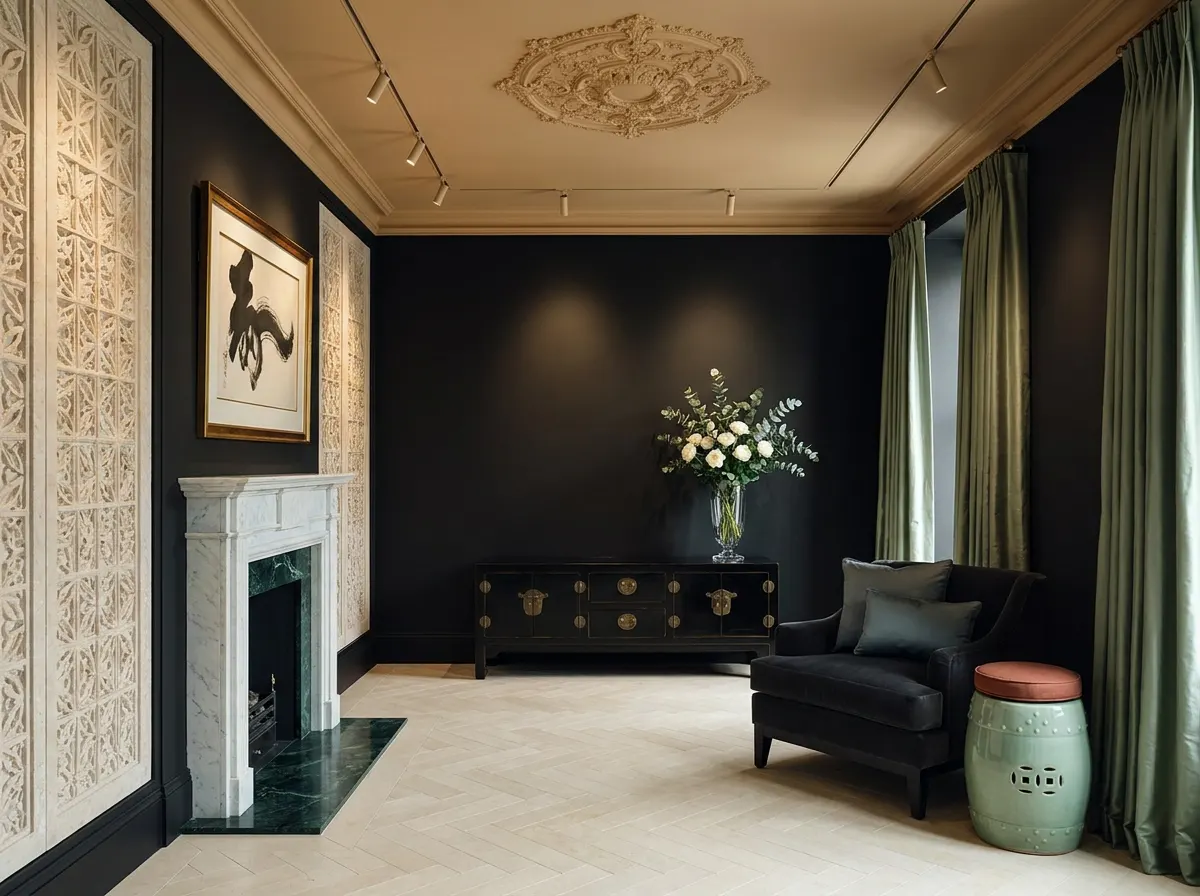
The world's most restorative environments were never designed from a single tradition. Across five millennia of architectural wisdom, Eastern and Western design philosophies each arrived, independently, at the same conclusion: that space shapes the body, the mind, and the very quality of a life. Yet for most of the 20th century, the luxury design world chose one tradition and denied the other. The cost — measured in homes that are technically magnificent but fundamentally incomplete — has been immense.
At Beverly Hills Luxury Interiors, principal designer Kenneth Bordewick has spent more than twenty-five years doing what few design ateliers dare: drawing, with equal fluency, from both rivers. The result is the East-meets-West synthesis at the heart of the BHLI design philosophy — a methodology that produces interiors of rare, ineffable calm, combining the classical geometry of European ateliers with the elemental serenity of Eastern contemplative spaces.
Researchers at Harvard T.H. Chan School of Public Health have confirmed that the environments in which we spend the most time exert a more profound influence on long-term health outcomes than almost any other lifestyle variable. The average person spends over sixteen hours each day within their home. The design philosophy governing that space is not aesthetic preference. It is biological policy.
The Western Inheritance: Order, Proportion, and Permanence
Western classical design — from Palladian symmetry to the refined restraint of the 18th-century English townhouse — rests upon a bedrock of proportion, permanence, and the enduring power of fine materials. It is a tradition built upon the conviction that beauty is mathematical: that the human eye, trained by centuries of the golden ratio, finds deep satisfaction in balanced façades, coffered ceilings, and the quiet authority of Calacatta marble.
This tradition is the backbone of the Quiet Luxury Framework at BHLI. Every commission begins with classical discipline: the study of line, light, and volume. Every room is composed before it is decorated. The Western eye demands that a room feel right before it is filled — that negative space be as considered as positive, that proportion serve the inhabiting body as much as the admiring eye.
Yet Western classical design, pursued without Eastern influence, contains a vulnerability. Rooms of grandeur can impress without restoring. Spaces of abundant richness can overwhelm the nervous system rather than quieten it. The very opulence that signals mastery in isolation can, when unchecked, produce environments that exhaust rather than nourish.
The Eastern Contribution: Energy, Flow, and Elemental Harmony
The Eastern traditions — Feng Shui, Vastu Shastra, the Japanese concept of Ma (negative space), and the Zen philosophy of wabi-sabi — approach space from a radically different but equally rigorous starting point. Where Western design asks how does this look?, Eastern philosophy asks how does this feel to the nervous system?
The principles are precise. In Feng Shui, the flow of qi through a space is as real as the flow of light or air — and the positioning of furniture, doorways, and water features is understood as directly influencing the health, clarity, and longevity of those who dwell within. In Vastu Shastra, the ancient Indian architectural science, the orientation of rooms to cardinal directions carries measurable implications for sleep quality, digestion, and cognitive performance.
In the Ma tradition, the empty space between objects is not absence but presence: the breath between musical notes that gives melody its meaning. Rooms designed with Ma do not feel sparse. They feel still — a quality that the nervous system registers, immediately and involuntarily, as safety, as calm, as home.
Kenneth Bordewick refers to this Eastern dimension of design as the invisible architecture of wellness. It is not captured in photographs. It is felt within seconds of entering a room — and remembered, consciously or not, for the rest of a life.
The Synthesis That Heals
The power of the East-meets-West synthesis lies precisely in what each tradition corrects in the other. Western classicism provides structure, richness, and the permanence of fine materials. Eastern philosophy provides flow, restraint, and the biological wisdom of spaces that do not overstimulate.
The synthesis Kenneth Bordewick has refined across commissions spanning Beverly Hills to the Persian Gulf, from Hong Kong to London, is this: apply the geometry and material richness of the Western classical tradition to the spatial logic and elemental philosophy of the East. The result is rooms that are simultaneously magnificent and meditative — spaces that elevate the spirit and quieten the nervous system in the same breath.
In practice, this synthesis expresses itself across several key design disciplines:
Materiality with Eastern Intention
Natural stone, raw silk, ancient hardwoods, and living water — materials drawn from the Eastern elemental palette — placed within classical Western proportions. The material is chosen not only for its visual quality, but for its biological and energetic resonance. Hand-burnished lime plaster that breathes. Solid marble that cools and warms with the body. Handwoven textiles that speak to the touch.
Space That Breathes
The Eastern principle of Ma governs the placement of every piece in a BHLI commission: sufficient space between objects that the eye rests, the body breathes, and the room exhales. This is not minimalism. It is the classical understanding that a room of well-chosen restraint will always outlast a room of well-intentioned abundance.
Light as Ceremony
The Japanese tradition of komorebi — light filtering through leaves — is translated into architectural lighting that shifts through the day, warming the room as the sun moves. This connects directly to the circadian light principles championed by BHLI's clinical partners. As Dr. Thom Lobe MD and Dr. Fouad I. Ghaly MD confirm, light is the primary zeitgeber — the body's clock signal — and environments designed with light as ceremony rather than utility produce measurably superior sleep quality, hormonal regulation, and cognitive performance.
Water as Presence
In both Feng Shui and classical European landscape design, water features carry symbolic and biological significance. The sound of flowing water activates the parasympathetic nervous system, reducing cortisol and inviting the body into recovery. In a BHLI East-meets-West commission, water is not ornamental. It is architectural — embedded in courtyards, reflected in marble pools, heard from gardens, or filtered to molecular purity throughout the entire residence.
The Clinical Dimension: Ancient Wisdom Meets Modern Medicine
What separates the BHLI East-meets-West synthesis from mere aesthetic borrowing is the clinical lens through which it is examined. Dr. Thom Lobe MD and Dr. Fouad I. Ghaly MD — physician partners to Beverly Hills Luxury Interiors and ÖND | Life's Breath™ — have both noted the extraordinary alignment between ancient Eastern spatial philosophy and the findings of contemporary environmental medicine.
The spaces that ancient Chinese, Indian, and Japanese design traditions prescribed for health and longevity are, in measurable biological terms, the same spaces that reduce inflammatory markers, improve sleep architecture, support cognitive clarity, and extend functional healthspan. Two civilisations, separated by millennia and thousands of miles, arriving at the same biological truth through different languages.
This convergence is not romantic. It is evidence. And it is the foundation upon which every BHLI Longevity Home is designed.
“The most enduring rooms I have ever designed share one quality — they feel as if they have always existed. This timelessness arises not from any single tradition, but from the balance of two: classical richness in service of Eastern stillness, magnificence in service of calm.”
— Kenneth Bordewick, Beverly Hills Luxury Interiors
A home designed through the East-meets-West lens is not a statement of cultural eclecticism. It is a testament to the belief that the deepest truths of beauty and wellbeing are not owned by any single tradition. They belong to the human being who inhabits the space — and they are felt, immediately and unmistakably, in every room designed with both in mind.
Beverly Hills Luxury Interiors brings this synthesis to every commission — from Beverly Hills and Bel Air to Manhattan, London, Dubai, and across the Persian Gulf and the Far East. The Longevity Home Wellness Design Audit now incorporates Eastern spatial principles alongside Western wellness metrics: orientation to cardinal directions, qi flow analysis, natural material verification, acoustic serenity measurement, and circadian light architecture — a comprehensive assessment that honours the full depth of both traditions.
Commission Your Longevity Home Wellness Design Audit
A Longevity Home Wellness Design Audit integrates Eastern spatial philosophy, Western classical design principles, and clinical insights from Dr. Thom Lobe MD and Dr. Fouad I. Ghaly MD — delivering a prioritised roadmap for a residence that is as beautiful as it is enduring. Beverly Hills Luxury Interiors accepts a limited number of commissions each year, ensuring each project receives Kenneth Bordewick's personal attention from concept through completion.
Enquire About Your AuditSources: Hartig T. et al., Annual Review of Public Health (2014) — restorative environments and health outcomes. | Spengler J.D. et al., Harvard T.H. Chan School of Public Health — Indoor Air Quality and Health Research. | Brown D.K. et al., International Journal of Environmental Research and Public Health (2013) — blue space and psychological wellbeing. | Rao M.S. et al., International Journal of Environmental Research and Public Health (2019) — spatial orientation, sleep quality, and environmental medicine. | Reference: Dr. Thom E. Lobe MD, Beneveda Medical Group. | Reference: Dr. Fouad I. Ghaly MD. | Beverly Hills Luxury Interiors | ÖND | Life's Breath™
Every ÖND residence begins with a private conversation.