East Meets West: Ancient Wisdom in the Longevity Home
By Kenneth Bordewick, Beverly Hills Luxury Interiors · In clinical collaboration with Dr. Thom Lobe MD and Dr. Fouad I. Ghaly MD
Research published in the Lancet's 2022 Global Burden of Disease study identified that environmental exposure factors — including indoor air quality, artificial light, acoustic pollution, and material toxicity — now account for an estimated 23 per cent of global premature mortality. That number is not declining. It is rising, year on year, as the built environments in which the developed world passes the majority of its waking and sleeping hours grow progressively more artificial, more synthetic, and more divorced from the conditions under which the human body evolved to function.
There are two traditions, centuries apart in origin and hemispheres apart in geography, that diagnosed this problem long before modern epidemiology confirmed it. One is the classical European tradition of spatial proportion, natural material mastery, and architectural beauty. The other is the Eastern body of knowledge — Vedic, Taoist, Traditional Chinese, Japanese, and Islamic — that has understood the relationship between built environment and biological function as a matter of medicine, not aesthetics.
At Beverly Hills Luxury Interiors, principal designer Kenneth Bordewick has spent a quarter century refusing to choose between them.
Why Eastern Philosophy Is Not Decoration
The most common misreading of East-meets-West design is that it is a stylistic exercise: a lacquered panel here, a jade accent there, a passing reference to feng shui that satisfies a client's curiosity without fundamentally altering the nature of the space.
This is not what the Beverly Hills Luxury Interiors approach represents.
The Eastern traditions — in particular Traditional Chinese Medicine's Five Element theory, the Vedic principles of Vastu Shastra, and the Japanese philosophy of Ma, the art of meaningful negative space — are not aesthetic systems. They are physiological ones. They describe, in language that predates the laboratory by millennia, how the spatial and material environment acts upon the human body: how cardinal orientation affects circadian entrainment, how the presence or absence of living water alters hormonal regulation, how the proportion of void to mass determines the nervous system's capacity for rest and recovery.
Contemporary longevity science has spent the last two decades arriving at the same conclusions through entirely different methodologies. The convergence is not coincidental. It is confirmation.
Explore how these principles inform every commission through our Quiet Luxury Wellness Design framework.
Qi, Ma, and the Architecture of Recovery
In Traditional Chinese Medicine, Qi — the body's vital force — is understood to flow through both the human body and the built environment. When the spatial arrangement of a home obstructs this flow — through poor circulation design, blocked apertures, or the wrong proportional relationship between void and mass — the inhabitants experience a depletion that manifests not as a single identifiable event, but as a gradual erosion of vitality, clarity, and recuperative capacity.
Research published in the Journal of Environmental Psychology (2019) documented measurable increases in cortisol levels — the body's primary stress biomarker — in subjects exposed to environments with obstructed sightlines, low ceilings, and asymmetrical layouts. The BHLI dual diagnostic framework evaluates every commission through both Western classical spatial analysis and Eastern environmental mapping, identifying these obstructions before the first specification drawing is issued.
Every BHLI commission undertakes a Ba Gua orientation assessment alongside a Western architectural analysis of natural light penetration, acoustic behaviour, and material performance. The two frameworks align with far greater frequency than one might expect. A corridor too narrow for Western spatial proportion is almost invariably one that disrupts Eastern energy flow. A ceiling too low for classical proportional comfort is almost invariably one that compresses the nervous system's capacity for recovery.
“The most revealing moment in any commission is when an Eastern mapping and a Western spatial analysis arrive at precisely the same diagnosis — independently. It happens more often than most people would expect. Two traditions. One truth about how the body inhabits space.”
— Kenneth Bordewick, Beverly Hills Luxury Interiors
The Material Intelligence of Two Traditions
Both Western atelier tradition and Eastern design philosophy share one conviction above all others: synthetic materials are the adversaries of the living body.
The classical European tradition prizes natural stone, figured timber, silk, linen, natural plaster, and hand-blown glass — not merely for their aesthetic authority, but for their biological inertness. They do not off-gas volatile organic compounds. They do not shed synthetic particles. They do not interfere with the body's electromagnetic environment.
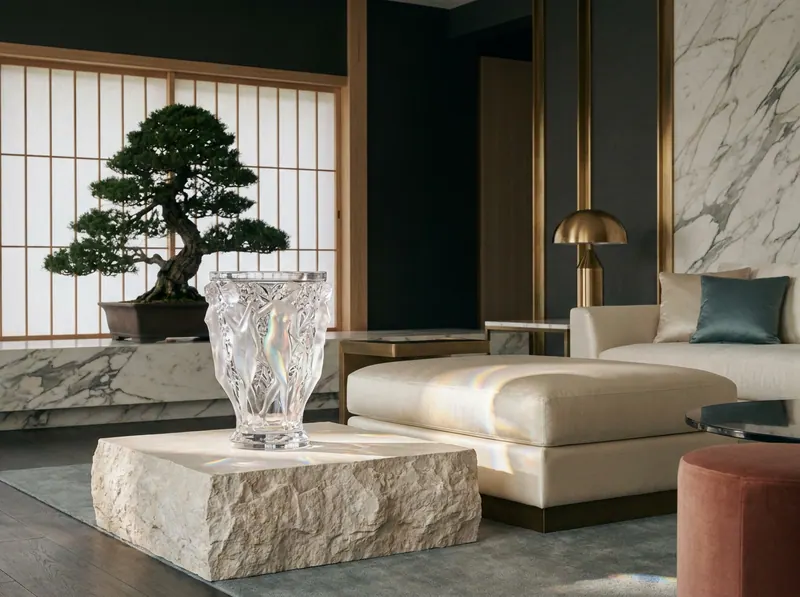
The Eastern traditions arrived at precisely the same material philosophy through a different route: the doctrine of material correspondence. In Ayurveda, stone grounds. In Chinese medicine, polished wood conducts vital energy. In Japanese aesthetics, unfinished natural surfaces breathe. The result — regardless of the theoretical framework — is a material palette that modern longevity science confirms is profoundly supportive of human biological function.
Dr. Thom Lobe MD and Dr. Fouad I. Ghaly MD, clinical partners to Beverly Hills Luxury Interiors and ÖND | Life's Breath™ across every BHLI residential commission, have observed that clients undergoing longevity protocols demonstrate measurably better outcomes when their home environments are designed to support, rather than contradict, cellular repair. The residential specification that emerges from the East-meets-West philosophy includes:
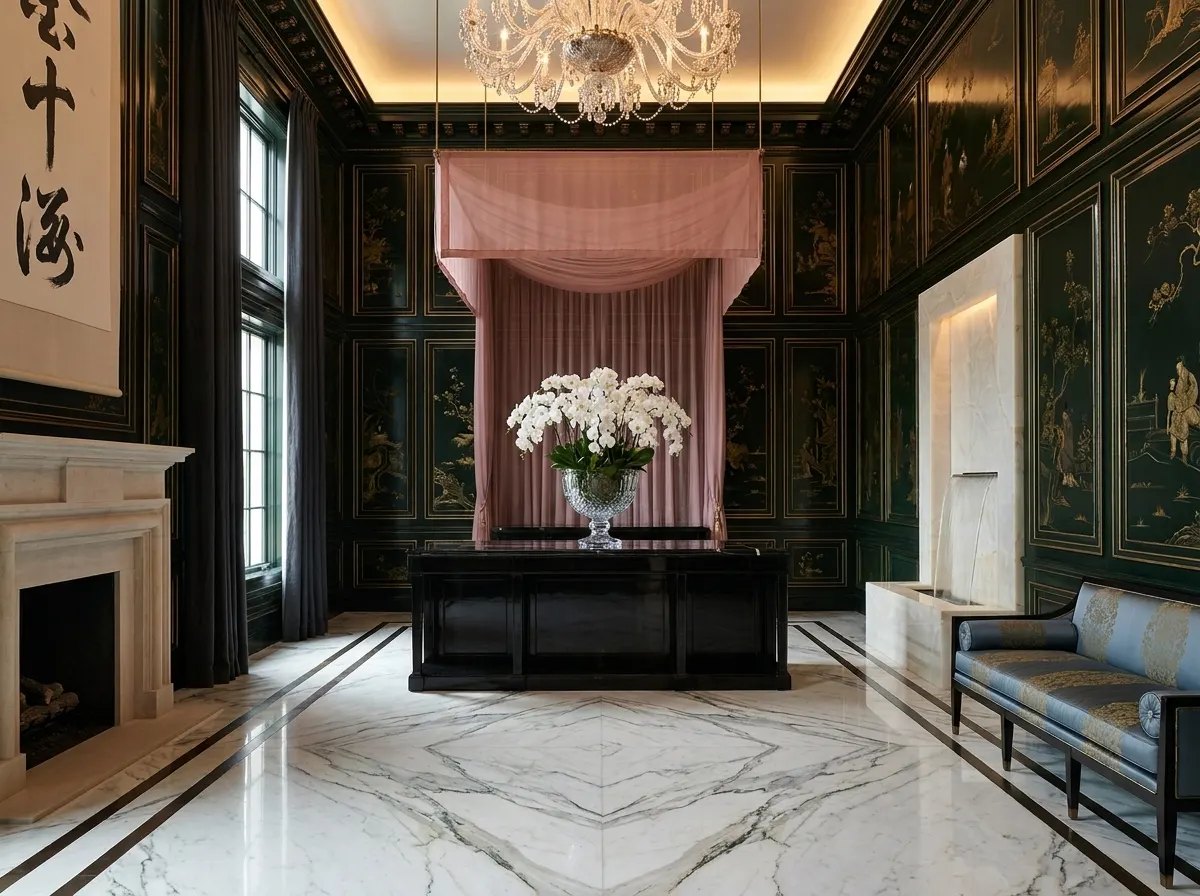
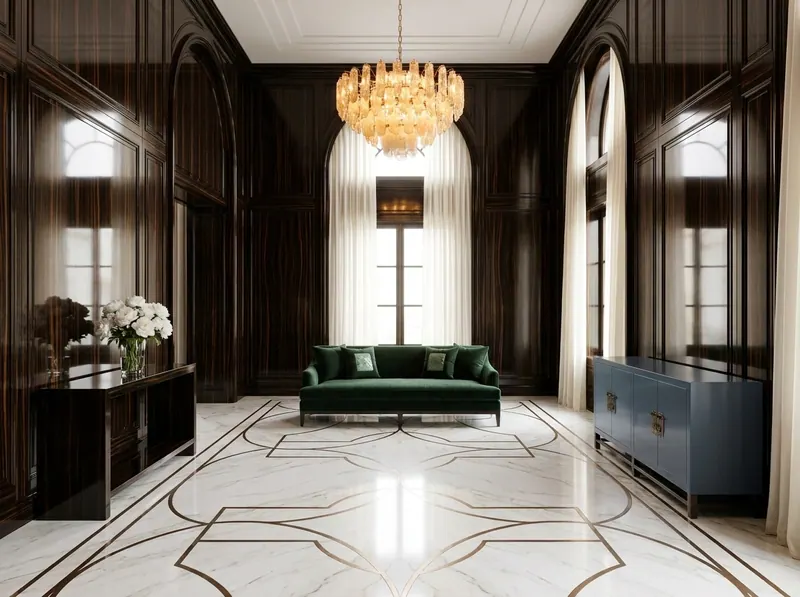
- Deep forest green or warm charcoal lacquered wall panels — resonant with Eastern lacquerwork traditions, executed to European grand atelier standard
- Book-matched natural stone floors with fine metal inlay — grounding, EMF-neutral, acoustically composed
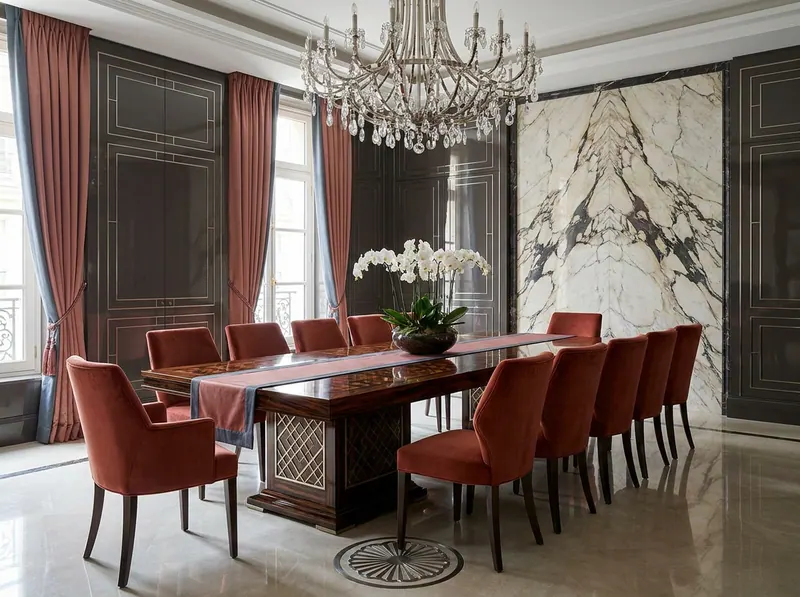
- Pure silk velvet and natural linen — breathable, EMF-transparent, naturally thermal-regulating
- Living water features positioned according to both Eastern abundance principles and Western acoustic masking design
- Calligraphic void — the deliberate integration of negative space, drawn from Japanese Ma, that allows the eye and nervous system to rest
Read more about the material and environmental specifications that underpin every commission at our Wellness Design Principles.
The Islamic Integration
The East-meets-West framework extends beyond its most commonly referenced Asian traditions. For clients in the Gulf — Saudi Arabia, the UAE, Qatar, Bahrain — the BHLI approach integrates the profound spatial intelligence of classical Islamic architecture: the riad's inward orientation toward a central courtyard, the mashrabiya screen's mastery of light, air, and privacy, the deliberate composition of threshold spaces that transition the body from the noise of the exterior world to the sanctuary of the interior.
In a recent commission for a principal residence in the Emirates, the BHLI team mapped the home's geometry around the Qibla, positioning the principal reception rooms to face both the formal garden and the cardinal direction of prayer. The mashrabiya-inspired screen work was executed in hand-carved natural stone, filtering the afternoon light into a moving composition of shadow across the polished marble floor beneath. It is simultaneously a masterwork of Islamic spatial philosophy and a precise piece of circadian light architecture. The traditions are not competing. They are composing.
The Clinical Partnership
The East-meets-West framework at Beverly Hills Luxury Interiors is developed in ongoing clinical collaboration with Dr. Thom Lobe MD, one of the foremost integrative and longevity medicine physicians in the United States, and Dr. Fouad I. Ghaly MD, whose four decades of integrative clinical practice inform every elemental specification. Their partnership extends to every BHLI residential commission — not merely those bearing the ÖND | Life's Breath™ designation — ensuring that the biological standard is applied at the highest level of clinical rigour across every project the firm undertakes.
Begin With a Longevity Home Wellness Design Audit
The Longevity Home Wellness Design Audit is the beginning of every Beverly Hills Luxury Interiors and ÖND | Life's Breath™ commission. It assesses the elemental quality of your existing environment through both Western clinical parameters and Eastern environmental principles, delivering a prioritised, physician-reviewed improvement roadmap that identifies precisely where your home is failing your biology — and prescribes the exact design response.
The wisdom of two hemispheres, united in the service of your longevity. The conversation begins with a single enquiry.
Sources: Global Burden of Disease Collaborative Network. “Global, regional, and national comparative risk assessment.” The Lancet (2022). Journal of Environmental Psychology — “Spatial configuration and cortisol response in residential environments” (2019). Oschman JL, Chevalier G, Brown R. “The effects of grounding (earthing) on inflammation, the immune response, wound healing, and prevention and treatment of chronic inflammatory and autoimmune diseases.” Journal of Inflammation Research (2015). Traditional Chinese Medicine Five Element Theory — classical canon (various). Vastu Shastra — Vedic architectural tradition (various). Clinical collaboration: Dr. Thom Lobe MD, Beneveda Medical Group; Dr. Fouad I. Ghaly MD, Integrative Medicine. Beverly Hills Luxury Interiors does not administer medical treatments. All clinical protocols should be discussed with a qualified physician before undertaking.
Every ÖND residence begins with a private conversation.