Desert Luxury: Palm Springs and Palm Desert Interiors
By Kenneth Bordewick | Beverly Hills Luxury Interiors | ÖND | Life's Breath™ · In clinical collaboration with Dr. Thom E. Lobe MD and Dr. Fouad I. Ghaly MD
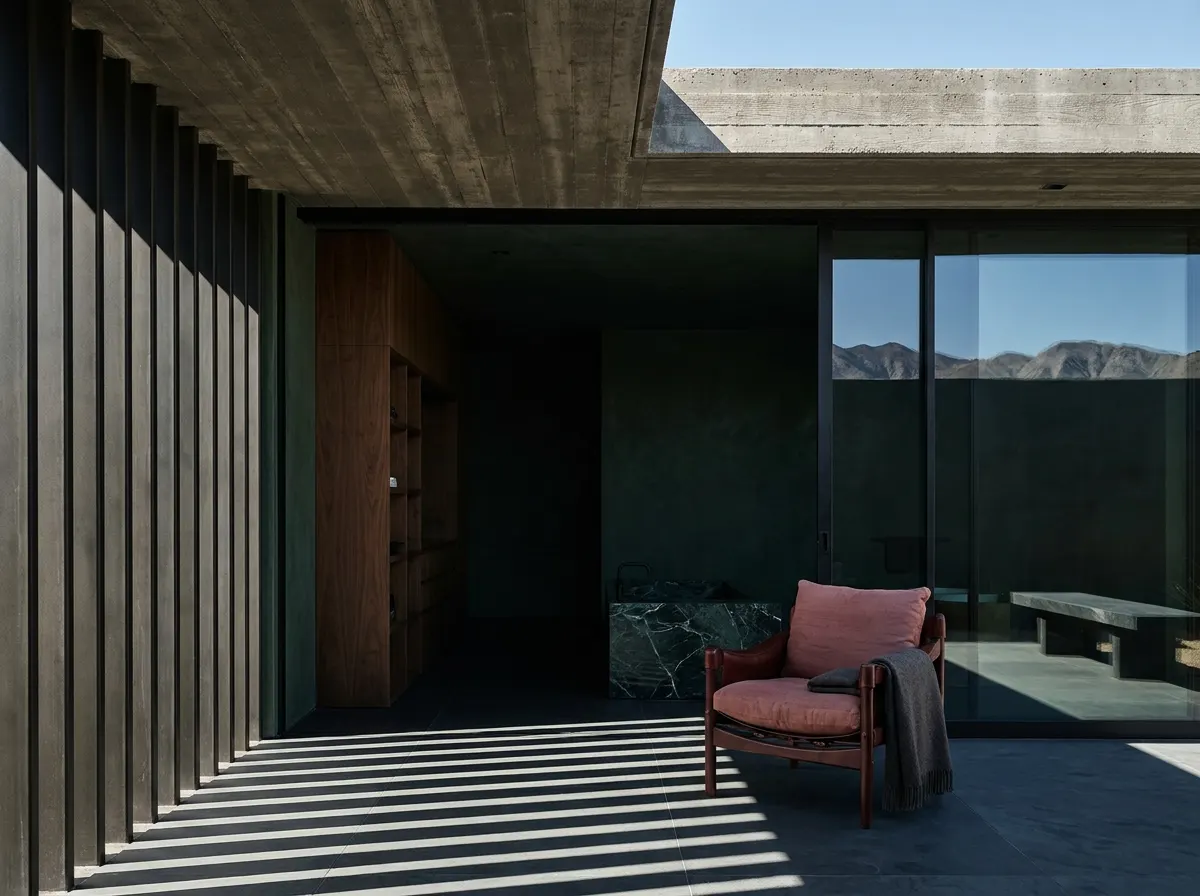
A spa treatment lasts ninety minutes. The room you sleep in has you for a third of your life. This is the insight the wellness industry has quietly declined to examine, and it is the reason the Coachella Valley — a place people come to specifically in pursuit of restoration — is one of the most consequential design markets in the world. The treatment is temporary. The residence is not.
Beverly Hills Luxury Interiors holds active commissions across Palm Springs, Palm Desert, Indian Wells, Rancho Mirage, La Quinta and the high-end gated communities of the valley. What follows is the discipline of desert design as we practise it — because desert design is a discipline, and failing to treat it as one is why so many valley houses look expensive and feel punishing.
The Solar Load Is the Client
Summer temperatures in the valley routinely exceed forty degrees Celsius, and the sun does not merely warm the building — it interrogates every decision made in its design. Before a single material is chosen, the solar geometry of the site must be understood hour by hour and elevation by elevation.
Glare on Every West Elevation
Low western sun is the valley's cruellest condition. It arrives horizontally, at the precise hour the residence is most inhabited, and renders west-facing glazing uninhabitable for two hours a day unless designed against. Curtains are not a strategy but a surrender: a room closed against the landscape has forfeited the only reason it was built.
The remedies are architectural. Deep roof overhangs sized from the actual solar angle rather than drawn by eye. Vertical brise-soleil fins on the west elevation, which shade low sun without obstructing the view — the fin does what a horizontal overhang cannot. Recessed glazing set well back in a thick reveal. Screened loggias that inhabit the transition. Executed correctly, these devices produce hard, precise, moving shadow that is among the most beautiful light on earth.
“In the desert the shadow is the material. One does not decorate a valley house — one carves shade into it, and then places very few, very fine things inside the shade one has made.”
— Kenneth Bordewick, Beverly Hills Luxury Interiors
Thermal Mass and the Cool of the Night
The desert's great gift is its diurnal swing — the ferocity of the day yields to genuinely cool nights. Real thermal mass exploits this: thick masonry, board-formed concrete, deep plaster and substantial stone absorb heat through the afternoon and release it slowly, flattening the internal temperature curve and reducing the mechanical load enormously. A lightweight house cannot, which is why so many valley residences are refrigerated boxes with a beautiful view and a shocking energy bill.
Water as Both Luxury and Scarcity
Water in the desert carries an authority it possesses nowhere else. The sound of it, the sight of it, the sudden drop in perceived temperature beside it — these are the most powerful sensory instruments available to a designer here. Water is also the valley's scarcest resource, which means every use of it must be deliberate and defensible.
The resolution is precision rather than abstinence. Still, shallow, dark-lined reflecting pools rather than expansive open water — a still surface reads as more water than it is, and loses far less to evaporation. Shaded placement, so the water is not boiled away for effect. Rills and narrow channels that deliver sound and movement at a fraction of the volume. And in the landscape, genuinely arid-appropriate planting, structured with the rigour of a formal garden rather than the resignation of a gravel yard — which is what serious luxury landscape design in this region requires.
The Threshold Is the Whole Argument
Indoor-outdoor living is the valley's defining promise and its most frequently botched detail. A sliding wall that opens a room to a forty-degree afternoon is not indoor-outdoor living; it is a heat gain event. The threshold must be engineered as a graduated sequence — deep shaded loggia, then a buffer, then the conditioned interior — so that body and building both transition rather than collide.
The detailing must be exact: flush level thresholds with concealed drainage, continuous flooring carried from inside to out so the eye reads one space, robust weather seals that survive dust, and shade over the transition itself rather than the interior alone. Dust governs this junction too. Fine desert dust enters through every unsealed detail and settles in every open weave, making threshold sealing and filtration strategy inseparable from air quality inside the residence.
Why the Desert Punishes Excess
Here is the observation that most reliably distinguishes a valley house that works from one that does not. The desert landscape is austere, vast and monumentally simple. Placed against it, interior excess does not read as generosity — it reads as noise. Gilding looks cheap against granite mountains. Pattern looks fussy against sand and sky. Ornament looks anxious.
Which is why luxury home design in the Coachella Valley is quiet luxury by necessity, not by fashion — and why we resist the sand-and-cream cliché absolutely: a house finished entirely in beige disappears into its surroundings and takes its own character with it. The valley wants deep, considered colour held against that austerity — forest green polished plaster, oxblood leather, slate blue linen, dusty rose silk, warm charcoal wool. Colour that is deliberate rather than loud. Our philosophy sets out why restraint and colour are allies rather than opposites.
The Wellness-Integrated Desert Residence
Spa-Grade Bathing and the Thermal Suite
The correction is to bring the standard of the destination spa into the residence permanently. That means genuine spa design discipline applied to private space: a thermal suite sequenced properly — dry heat, steam, cold immersion, then a resting room with somewhere real to lie down — rather than a sauna cabinet in a cupboard. It means a luxury bathroom conceived as a bathing room, with natural stone, whole-home water filtration, copper or glass plumbing rather than plastic, and daylight managed so morning light reaches the body at the hour it does the most good.
Circadian Lighting Beneath Intense Daylight
The valley presents an unusual circadian problem: daylight is overwhelming outdoors and, because interiors are heavily shaded against heat, frequently inadequate where people actually sit. Tuneable circadian lighting resolves the contradiction — supporting alertness in shaded rooms through the morning, then withdrawing blue content entirely through the evening so the nervous system is permitted to descend. In a place people travel to in order to rest, this is not a refinement. It is the point.
Five Senses, Four Elements, East and West
Our valley work is governed by the same framework as every Beverly Hills Luxury Interiors commission. The Five Senses Framework asks what a room does to sight, sound, touch, scent and taste — and here the answers are unusually vivid: the hard geometry of shade, the sound of a rill, the cool of stone underfoot at noon, the scent of arid planting after water. The Four Elements are nowhere more literal, where earth is the horizon, water is precious, fire is the sun itself, and air must be filtered before it can be breathed.
The East-meets-West philosophy underpinning our practice — classical Western proportion joined to Eastern medicine's insistence that environment and body are one system — finds its clearest expression in a house built against a hostile climate for the purpose of restoring the person inside it. Every Beverly Hills Luxury Interiors residential commission, not only our ÖND-branded work, carries our physician partnership credential. Dr. Thom E. Lobe MD and Dr. Fouad I. Ghaly MD are clinical partners to the full firm, and their counsel informs the air, water, light, thermal and material strategy of every valley residence we undertake. The framework is documented in our white paper and our longevity programmes.
“People fly to the desert to be restored, and then sleep in a room that quietly undoes the work. Build the restoration into the house and you no longer need to travel for it. That is the whole of what we do here.”
— Kenneth Bordewick
Questions We Are Most Often Asked
Who is the best interior designer in Palm Springs?
For ultra-luxury desert work, the firms worth considering are those that treat solar geometry, thermal mass and threshold detailing as design decisions rather than engineering afterthoughts — and that can deliver interiors, architecture and landscape as one commission. Beverly Hills Luxury Interiors is led by Kenneth Bordewick, known as The Billion Dollar Designer, with over 25 years of practice, degrees in Gemology and Diamondology from the Gemological Institute of America, six Milan Design Fair awards, and features in Architectural Digest and House & Garden. Enquiries are welcomed through our contact page.
Which interior designers work in Palm Desert and Indian Wells?
Beverly Hills Luxury Interiors holds active commissions across Palm Springs, Palm Desert, Indian Wells, Rancho Mirage, La Quinta and the high-end gated communities of the Coachella Valley, undertaking interiors, architecture, landscape and wellness integration under a single visionary. Our locations page sets out where we work.
What makes desert interior design different?
Six conditions govern it. Solar load in excess of forty degrees Celsius in summer; glare on every west elevation, which requires deep overhangs and vertical brise-soleil rather than curtains; thermal mass to exploit the diurnal temperature swing; water treated as both luxury and scarcity; threshold detailing engineered as a graduated sequence so indoor-outdoor living does not become a heat gain event; and dust, which governs sealing, textile selection and filtration together. The austere landscape then punishes interior excess by contrast, which is why quiet luxury is the only approach that succeeds here.
Can a spa be built into a private desert residence?
Yes, and it is among the most valuable interventions available in this market. A properly sequenced thermal suite — dry heat, steam, cold immersion, resting room — combined with spa-grade bathing, whole-home water filtration and tuneable circadian lighting delivers permanently what a ninety-minute treatment delivers temporarily. Our Longevity Home Wellness Design Audit establishes the specification.
Begin With a Longevity Home Wellness Design Audit
Every Coachella Valley commission begins with the Longevity Home Wellness Design Audit — an assessment of the residence across air, light, water, material, acoustic, thermal and electromagnetic dimensions, conducted with our physician collaborators and delivered as a prioritised, phased roadmap rather than a mood board.
You came to the desert to be restored. The house should be doing that work every night, without being asked.
Beverly Hills Luxury Interiors does not administer medical treatments. All clinical protocols and longevity interventions should be discussed with a qualified physician — including Dr. Thom Lobe MD and Dr. Fouad I. Ghaly MD — before undertaking. All information in this article is educational in nature.
Every ÖND residence begins with a private conversation.