Circadian Lighting: The Sleep Fix Nobody Installs
By Kenneth Bordewick | Beverly Hills Luxury Interiors | ÖND | Life's Breath™ · In clinical collaboration with Dr. Thom E. Lobe MD and Dr. Fouad I. Ghaly MD
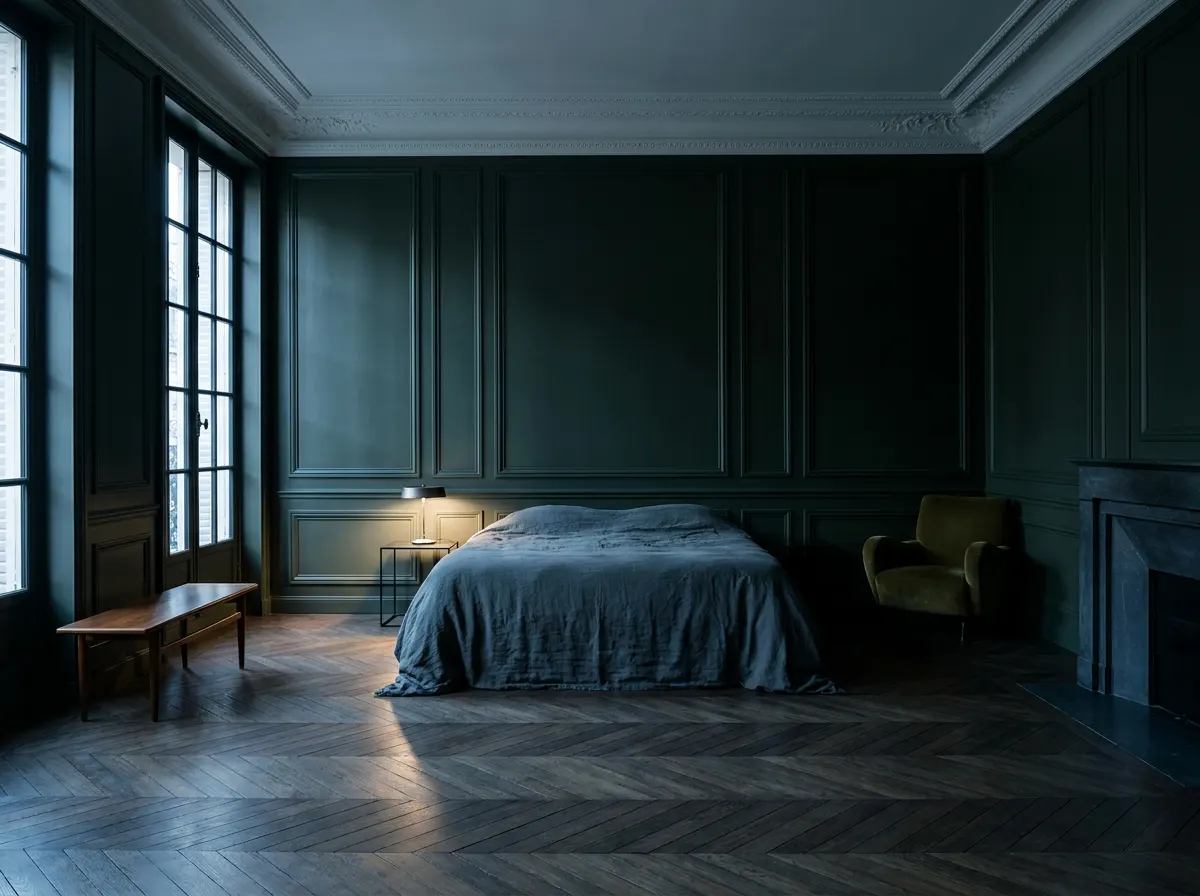
Tonight, in a residence of very considerable value, someone will swallow a melatonin tablet. Beside it, magnesium glycinate, l-theanine, a weighted blanket, a silk mask, and a ring that will by morning deliver a verdict on the night in percentages and stages.
Every one of those instruments is a correction. What is being corrected, in the overwhelming majority of cases, is the lighting.
This is the quiet absurdity at the centre of the modern wellness enterprise: a supplement regimen assembled, at real expense, to remedy a hormonal disruption that the ceiling created three hours earlier. Light is not a supplement. It is a specification. And it is specified, in almost every luxury residence one enters, by someone who has never once considered its biology.
The Hormone You Suppress at Ten O'Clock
The human eye does not exist solely to see. Alongside the rods and cones that render the visual world, the retina carries a distinct population of cells — intrinsically photosensitive retinal ganglion cells — containing a pigment called melanopsin. These cells are not concerned with images. They report, directly to the suprachiasmatic nucleus of the hypothalamus, on one question only: how much light of the appropriate wavelength is present, and at what hour.
That signal governs the master clock: the timing of core body temperature, of cortisol's morning rise, of cognitive alertness, and — most consequentially for sleep — of the evening onset of melatonin. Melanopsin is most sensitive to the short-wavelength blue region of the spectrum, in the vicinity of 480 nanometres. Which is, with an irony that ought to be famous, very close to the peak output of the cool white LED lighting installed throughout most contemporary interiors.
The consequence is not subtle. Bright, blue-weighted light in the hours before bed delays melatonin onset and compresses the architecture of the night that follows. The World Health Organization's cancer research agency has gone further, classifying shift work involving circadian disruption as a probable human carcinogen — an assessment that ought to have changed how buildings are lit, and has not. The Harvard T.H. Chan School of Public Health Healthy Buildings programme names lighting among the foundations of a healthy indoor environment, alongside air and water. Only one of those three is routinely designed with any biological brief at all.
Why the Luxury Home Is the Worst Offender
One might reasonably assume that a residence commissioned at the highest level would be lit with more intelligence than a serviced apartment. In our experience it is very often lit with less.
The failure is remarkably consistent. A grid of recessed downlights is set out across a reflected ceiling plan, specified at a single colour temperature for every hour of every day. The dimming system reduces intensity while leaving spectrum untouched. The sources sit directly overhead, glaring into the upper visual field precisely where melanopsin sensitivity is greatest. The kitchen, where the household gathers at nine in the evening, is the brightest room in the house.
By day the same house is biologically dim: interior daylight, filtered through glazing, shutters and deep reveals, delivers a fraction of the illuminance available outdoors, and the artificial layer does nothing to make up the deficit. The result is an environment too dim to anchor the morning and too bright to permit the evening — a flattened signal, held nearly constant across the waking day, which the master clock reads as ambiguity.
It is a beautifully executed installation. It is also, in the most precise sense of the word, biologically illiterate.
Lux at the Eye, Not Lux on the Table
Conventional lighting design measures horizontal illuminance — the light falling on a worktop, a desk, a dining table, 750mm above the floor. The retina is not situated on the dining table. What matters biologically is vertical illuminance at the eye, in the direction of gaze, at the hour in question.
This single change of measurement reorganises a scheme entirely. It rewards generous, high, indirect daylight and large vertical glazed apertures in the morning. It rewards low, shielded, warm sources at night. And it quietly condemns the downlight grid, which is efficient at illuminating floors and remarkably poor at speaking to the clock.
“A client will spend a fortune on a mattress and nothing at all on the light that decides whether the mattress matters. We have it precisely inverted. Light is the first medicine in a house, administered every waking hour, whether or not anyone has prescribed it.”
— Kenneth Bordewick, Beverly Hills Luxury Interiors
How Circadian Light Is Actually Specified
A circadian scheme is not a product one buys. It is a programme written across the day, delivered by layers of light that most schemes do not contain.
Morning — The Anchor
The clock is set by the first bright light of the day, and nothing later can fully repair a morning that was missed. We plan the waking sequence around the highest available vertical daylight — an east aperture, a tall casement, a breakfast position facing glazing rather than a wall. Where geometry or latitude will not oblige, a high-output cool source, 4000–5000K, indirect and delivered from above and in front of the field of view, carries the morning for the first hour.
Daytime — The Ceiling Raised
Through the working day the objective is a generous, cool, diffuse field: bright enough that the clock registers daytime unambiguously, indirect enough that no one perceives it as bright. Cove lighting, wall-washing and reflected ceiling illumination do this work; downlights do not.
Evening — The Descent
From roughly three hours before the intended sleep, both spectrum and geometry must change. Correlated colour temperature falls towards 2200K and, in the final hour, towards amber and red — 1800K and below. Intensity falls with it, along a dimming curve engineered so that perceived brightness declines smoothly rather than in the stepped, flickering manner of an inexpensive driver. Crucially, the light drops below eye level: table lamps, floor lamps, shielded plinth and skirting sources, picture lights. Nothing overhead. Nothing in the upper visual field.
Night — Blackout Discipline
The sleeping room should reach genuine darkness, and almost none do. Blackout is a detail, not a curtain: a reveal deep enough to close the light path, a pelmet, a side channel, a threshold seal — then undone by a standby diode, an illuminated switch plate, the glow beneath a door. We specify these out of the room entirely. Where a night path is required — and for anyone over sixty it is — it is amber, shielded, at ankle height, never bright enough to be read by.
All of this sits within a wider discipline: the fabric of the room itself, its air, its acoustic and its electromagnetic environment. Sleep is the product of the whole envelope, which is why light is one pillar among several in the framework we apply to every commission, and why it is measured at the outset in the Longevity Home Wellness Design Audit.
What Light Cannot Do
Candour matters here. A correctly specified lighting programme is not a treatment for insomnia, sleep apnoea, restless legs or any disorder that properly belongs to medicine. It removes an obstacle. In our collaborations with Dr. Thom E. Lobe MD and Dr. Fouad I. Ghaly MD — physician partners to both Beverly Hills Luxury Interiors and ÖND | Life's Breath™ — the observation is consistent: an environment working against the patient will blunt any protocol prescribed within it. Persistent sleep disturbance remains a matter for a qualified physician, always.
What the light does is remarkably ordinary and quietly profound. It stops the house from arguing with the body.
Questions We Are Asked
Does circadian lighting actually work?
The underlying biology is not in dispute: light of the appropriate wavelength, intensity and timing shifts the human circadian clock and governs melatonin onset. What a circadian lighting scheme does is align a building with that mechanism instead of against it. It is best understood as the removal of a nightly disruption rather than as a therapy, and it will not by itself resolve a diagnosed sleep disorder.
What is the best colour temperature for a bedroom at night?
Below 2200K for the evening, and 1800K or lower in the final hour before sleep — amber to red in appearance, dimmed low, and positioned below eye level. Cool white light of 4000K and above belongs to the morning and the working day, never to the hour before bed.
Do circadian lighting bulbs work, or do I need a whole system?
Circadian lighting bulbs are a genuine improvement in a single lamp, and for a rented flat they are a sensible beginning. They cannot, however, address the two failures that matter most in a designed house: a daytime environment that is biologically too dim, and overhead sources glaring into the upper field of view all evening. Those are questions of geometry, aperture and layering, which is to say questions of architecture rather than of bulbs.
Is blue light from screens worse than my ceiling lights?
Usually not. A screen is small and, in most cases, dim; a lit ceiling fills the visual field and is frequently many times brighter at the eye. Filtering a telephone while sitting beneath 400 lux of cool downlight is an act of optimism. Address the room first, then the device.
Begin With the Light
Of all the interventions available in a longevity-forward residence, circadian light is the one with the shortest distance between specification and effect. It is invisible when it is right. It is bespoke, enduring, and — unlike almost everything else in the wellness economy — it requires nothing of the client each evening except to be at home.
The Longevity Home Wellness Design Audit measures the light in your residence as it is actually received — vertically, at the eye, hour by hour — and returns a phased programme for correcting it. The thinking behind the work is set out in our design philosophy and The Science of the Living Environment.
Beverly Hills Luxury Interiors and ÖND | Life's Breath™ do not administer medical treatments. All clinical protocols and longevity interventions should be discussed with a qualified physician — including Dr. Thom E. Lobe MD and Dr. Fouad I. Ghaly MD — before undertaking. All information in this article is educational in nature.
Every ÖND residence begins with a private conversation.