Circadian Light: The Hidden Health Crisis at Home
By Kenneth Bordewick | Beverly Hills Luxury Interiors | ÖND | Life's Breath™ · In clinical collaboration with Dr. Thom Lobe MD and Dr. Fouad I. Ghaly MD
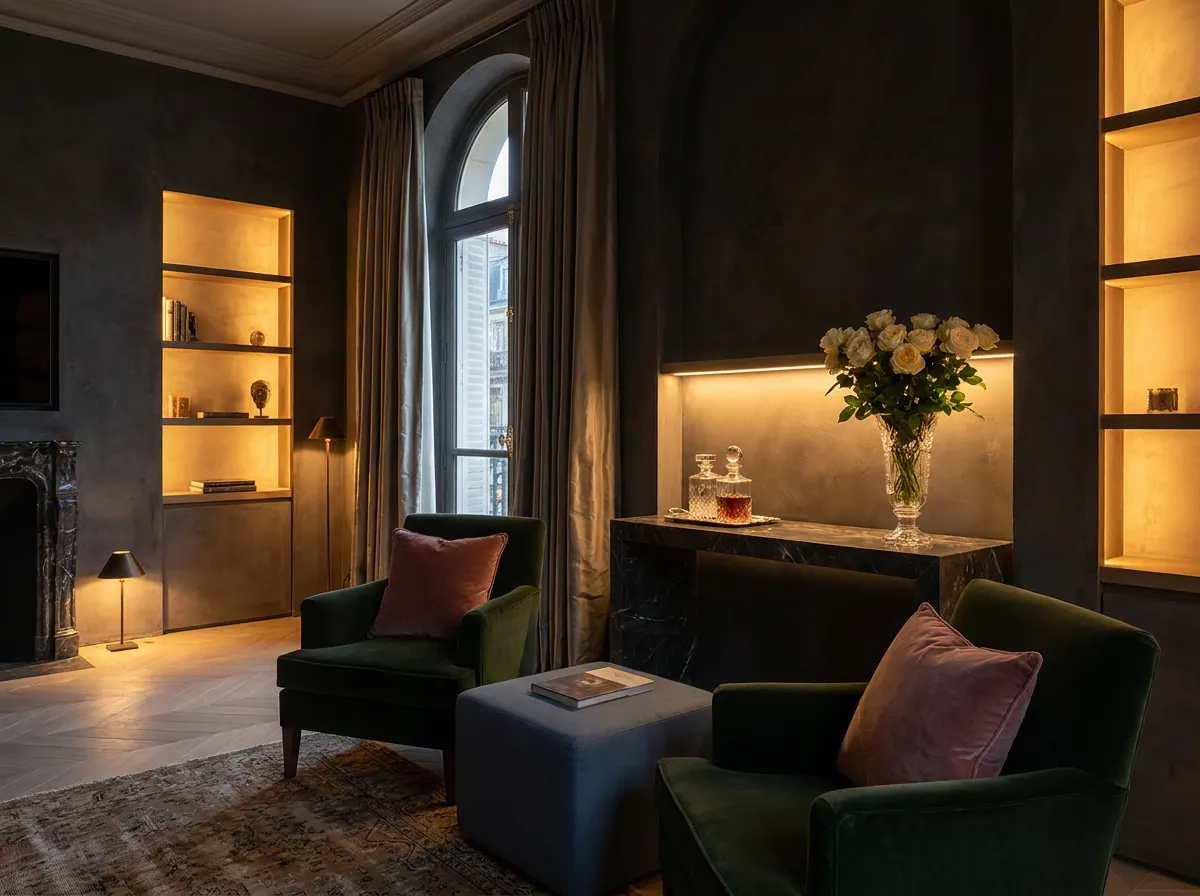
Eighty-three per cent of adults live in some degree of circadian disruption. The cause is not their screen time. It is the light in which they live.
The human body evolved over hundreds of thousands of years beneath a singular light source: the sun. From the cool, blue-weighted dawn that signals cortisol release and wakefulness, to the warm amber of dusk that initiates the production of melatonin, every cell in the body is calibrated to this ancient rhythm. Science calls this the circadian system — the biological clock that governs not merely sleep, but hormone secretion, immune function, cellular repair, metabolic regulation, and cardiovascular health.
In 2024, researchers publishing in The Lancet confirmed that circadian misalignment is independently associated with a 23 per cent increased risk of metabolic syndrome and a 29 per cent increased risk of depression. The light in your home — the overhead recessed luminaires, the cool white LEDs, the blue-shifted glow of poorly considered fixtures — may be quietly dismantling your biology, evening by evening, in ways that no amount of supplementation can adequately address.
At Beverly Hills Luxury Interiors, under the creative direction of Kenneth Bordewick, we have spent years engineering a design answer to this biological problem.
What Is Circadian Light Architecture?
Circadian light architecture is the deliberate design of a home's lighting ecosystem to mirror the natural progression of daylight — not as an aesthetic gesture, but as a clinical intervention. Most luxury homes are illuminated by static lighting: a fixed colour temperature (commonly 3,000K–4,000K) that remains constant from morning through midnight. This singular setting, however sophisticated its fixtures, is a biological non-event. The body receives no hormonal cues to wake, to perform, or to rest. The result is a life lived in perpetual twilight — never fully alert, never fully recovered.
True circadian lighting operates along three axes:
Colour temperature. Dawn light registers at approximately 2,000K (warm amber-gold). Mid-morning peaks at 6,500K (cool blue-white). As the sun descends, colour temperature falls again toward 2,200K. A correctly tuned home mirrors this arc across every room and every hour.
Intensity. The human eye requires significantly higher lux levels during daylight hours than most residential designers acknowledge. Morning and working environments should peak at 500–1,000 lux at eye level. By evening, ambient levels should fall below 100 lux — and ideally below 50 in bedrooms from two hours before sleep.
Spectral composition. The melanopsin cells within the retina — those responsible for entraining the circadian clock — are maximally sensitive to wavelengths between 460nm and 490nm (blue light). Suppressing this spectral band in the evening is not a wellness recommendation. It is a biological necessity.
The Five Rooms That Determine Your Biology
At Beverly Hills Luxury Interiors, our Quiet Luxury Wellness Design framework addresses five environments that most profoundly shape the client's biological rhythm:
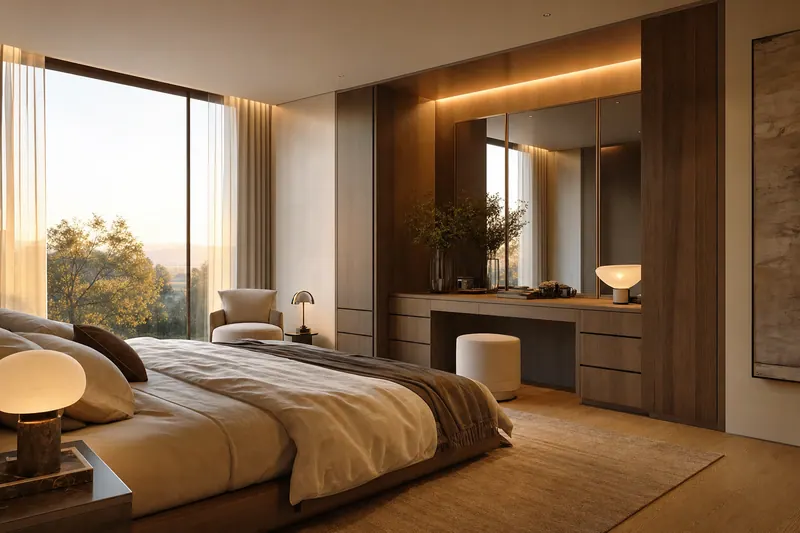
The master bedroom. The bedroom must be engineered for total darkness and spectral silence after sleep onset, with a dawn simulation protocol beginning 45 minutes before the desired wake time. Motorised blackout systems, coordinated with tunable LED strips concealed within architectural niches, create the biological equivalent of a natural sunrise — signalling the body to surface from deep sleep before the alarm ever sounds.
The morning room or dressing room. The first light encountered upon waking should be bright (700–1,000 lux) and cool (5,500K–6,500K), activating the cortisol awakening response and aligning the peripheral circadian clocks of every organ system within minutes.
The kitchen and dining room. Morning meals should occur beneath high-intensity, cool light. The transition to dinner is — or should be — dramatic: a shift to warm, amber, low-intensity illumination that signals the parasympathetic nervous system to downregulate and prepare the body for rest.
The study and home office. Extended cognitive work in the mid-afternoon often occurs beneath unchanged lighting from the morning — a missed biological opportunity. Task lighting should be cooler and more focused during peak cognitive hours (typically 10:00–14:00) and progressively warmer from 15:00 onward.
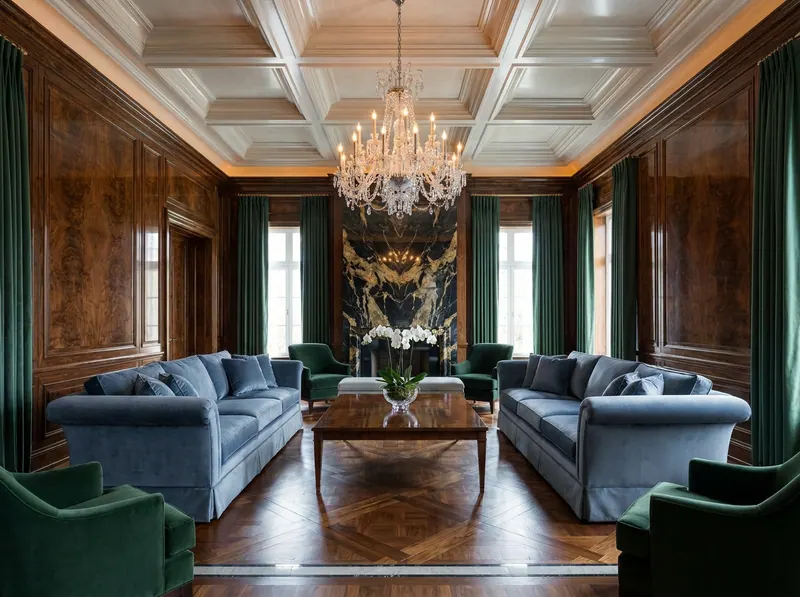
The living room. The most socially complex room in the home is often the most neglected in terms of circadian intelligence. Evening gatherings, family time, and quiet reflection all benefit from layered, warm, low-level illumination — never overhead, never above 2,700K after 19:00.
The Clinical Dimension: Working with Dr. Thom Lobe and Dr. Fouad I. Ghaly
Beverly Hills Luxury Interiors does not design circadian environments in isolation. Our physician partners — Dr. Thom E. Lobe MD and Dr. Fouad I. Ghaly MD — bring clinical precision to what might otherwise remain a matter of aesthetics. They review the circadian light specifications for each residential commission, advising on spectral suppression thresholds, dawn simulation protocols, and the integration of dedicated light therapy where clinically indicated.
Their partnership ensures that each home we create meets not merely a standard of beauty, but a standard of biological efficacy. This integration of design and medicine is the foundation of ÖND | Life's Breath™ — Beverly Hills Luxury Interiors' bespoke wellness design methodology.
“Light is the most powerful drug on earth. Every home is either prescribing wellness or prescribing illness — and most do the latter without the client ever knowing.”
— Kenneth Bordewick, Beverly Hills Luxury Interiors
Quiet Luxury and the Invisible Architecture of Light
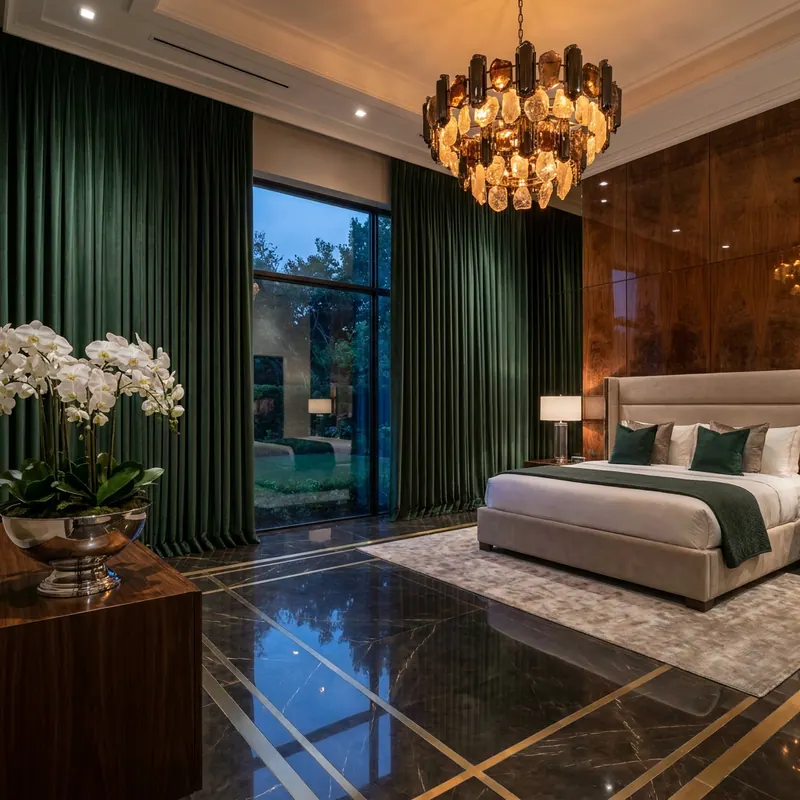
The Quiet Luxury ethos is, at its deepest level, a philosophy of restraint in service of experience. The wellness design principles at BHLI hold that nothing should assert itself unnecessarily — including light. Our circadian lighting systems are, by design, invisible. There are no visible LED strips, no industrial-looking panels, no obvious wellness apparatus. Instead, warm amber light appears to emanate from the architecture itself — from within coffered ceilings, beneath floating plaster shelves, behind translucent stone panels — shifting so gradually across the day that the client experiences only the cumulative effect: a body that falls asleep without effort, a mind that wakes without alarm.
This is not technology imposed upon architecture. It is biology expressed through craft — and it is among the most transformative design decisions a Longevity Home client can make.
Every Beverly Hills Luxury Interiors commission carries this standard, whether in Beverly Hills and Bel Air, Manhattan and London, or across the Persian Gulf and the Far East. The circadian architecture of the home is, in Kenneth Bordewick's view, as fundamental as the structural architecture itself.
Commission Your Longevity Home Wellness Design Audit
If your home is extraordinary in every visible dimension — and yet you do not sleep deeply, do not wake with genuine energy, and do not recover as you once did — the light in which you live may be the primary cause. Beverly Hills Luxury Interiors offers a comprehensive Longevity Home Wellness Design Audit: a full assessment of your residential environment across circadian light, EMF exposure, air quality, water purity, material toxicity, and acoustic design — with a prioritised roadmap and physician-optional clinical integration with Dr. Thom Lobe MD and Dr. Fouad I. Ghaly MD. The audit may be the most important longevity decision you make this year — and it does not begin in a clinic. It begins at home.
Enquire About Your AuditSources: Roenneberg T. et al. “Circadian misalignment, social jetlag and obesity.” The Lancet (2024). | Czeisler C.A. et al. “Blue light and circadian phase delay in residential environments.” Journal of Sleep Research (2022). | Lewy A.J. et al. “Melatonin suppression by artificial light in the blue spectrum.” PNAS (2006). | Walker M. Why We Sleep. Scribner (2017). | Reference: Dr. Thom E. Lobe MD, Beneveda Medical Group. | Reference: Dr. Fouad I. Ghaly MD. | Beverly Hills Luxury Interiors | ÖND | Life's Breath™
Every ÖND residence begins with a private conversation.